 From aerodynamic checks that once took two weeks to patent rules that still demand a human inventor, here is where AI in car design stands in late 2026.
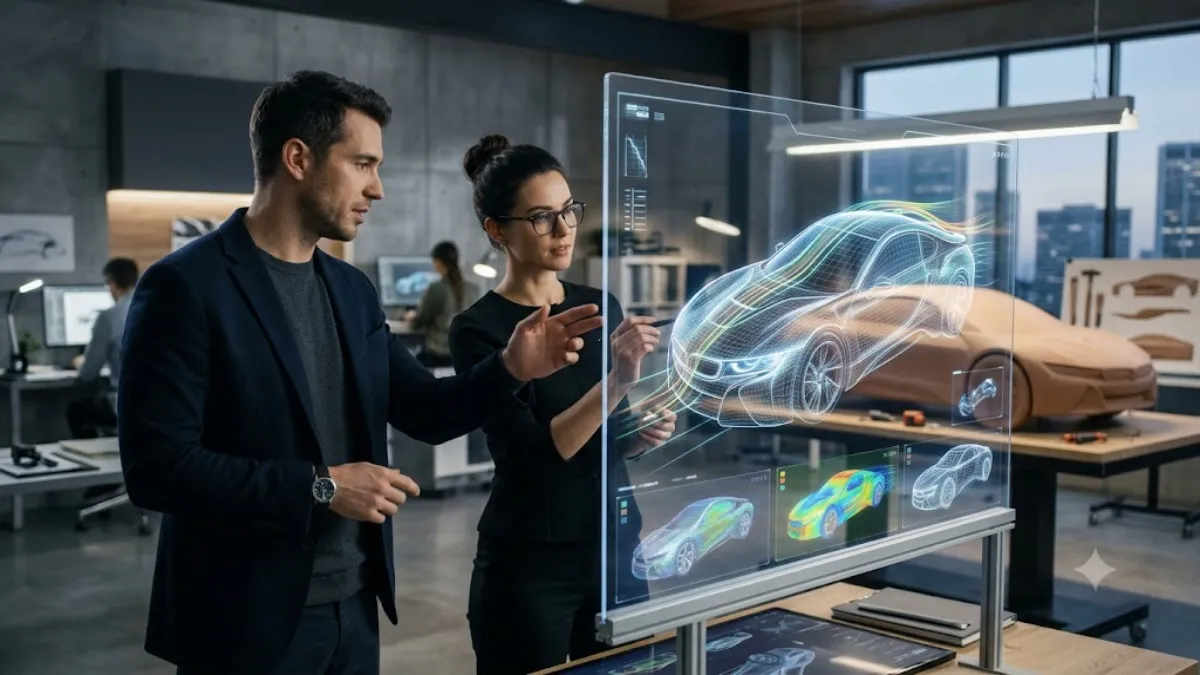
Inside General Motors’ design and engineering labs, a decision that once needed about two weeks of back-and-forth now happens at a single shared screen in roughly a minute. GM says an aerodynamicist and a designer can adjust a roofline or hood and watch predicted drag change almost immediately. One GM executive described settling a roofline question in one minute and 18 seconds. That is one visible edge of AI in car design, a shift that is quieter than the robotaxi headlines but may reach showrooms sooner.
The changes touch sketching, aerodynamics, parts engineering, crash and durability testing, and even who can legally be named as an inventor. Some are well documented. Others rest on company statements that no outside party has measured, and a few have already run into limits. This article separates the three, using company disclosures, federal guidance and reporting current as of November 2, 2026.
Future of Mobility: 7 Technologies That Could Change How We Travel
What Does MPG Mean and How Does It Affect Fuel Costs?
Sketches Become 3D Concepts in Hours, Not Months
Cars still begin with a pencil. GM said in an April 2026 newsroom feature that the starting point for every new vehicle has not changed, but what a designer can build from those first drawings in a single day has. In one recent project, a GM creative designer fed a handful of hand-drawn views of a futuristic Chevy concept into an AI tool, prompted it to generate a series of images, and ended up with a teaser animation showing the concept in motion. The designer’s account is that this work once took multiple teams multiple months and now fits within a day for one person.
The time savings come from the unglamorous parts of the job. According to GM, the software handles much of the technical setup for a 3D render, including virtual cameras, lighting and environments, which used to consume days. That frees designers to generate dozens of variations of one idea, set aside the strongest and refine from a more advanced starting point.
GM is also candid about what the tool does not do. Its designers describe working both with and against the software to get the result they want, and they say human judgment still decides what makes a Buick look like a Buick rather than a Cadillac or a Chevy. That caveat matters in an era when generic AI-generated cars fill online feeds, and it is the closest the industry comes to acknowledging the risk of sameness. As with most claims in this field, the timing figures come from GM itself and have not been independently tested.
Virtual Wind Tunnels Pull Aerodynamics Into the Sketch Phase
Aerodynamics may be where AI has the clearest practical payoff, because drag has a direct line to range and efficiency. GM describes the traditional workflow this way: designers shape a surface, release it to engineers, and wait days or weeks for computational fluid dynamics results. By the time feedback returns, the surface has often changed, so work gets duplicated. High-fidelity simulation and full-scale wind tunnels remain accurate, GM says, but they are expensive and slow.
GM’s R&D team built an AI-powered virtual wind tunnel that predicts drag and plugs the result into the digital sculpting tools designers already use. The company says a full design-and-engineering iteration that took about two weeks is now close to instant. The tool was trained on GM’s own simulation data, and a GM technical fellow summed up the dependency plainly: the model is only as good as the training data.
The motivation is economic as much as technical. GM says lower drag can give an electric vehicle more range or, alternatively, allow a smaller and cheaper battery that the company could pass on to buyers.
Toyota has pursued the same idea from the research side. In June 2023, Toyota Research Institute unveiled a technique that pairs text-to-image generative AI with engineering optimization. A designer can ask for styles such as “sleek” or “SUV-like” while the system works to reduce aerodynamic drag over successive iterations, and constraints such as ride height and cabin dimensions can be built into the process. TRI’s own division director cautioned at the time that generic generative tools cannot handle the engineering and safety demands of real car design, which is the gap the research aimed to close. The announcement described research papers rather than a production tool.
Software vendors make bigger claims. Neural Concept, a Swiss engineering-AI company, says customers have reported design cycles up to 30 percent shorter and $20 million in savings on 100,000-unit vehicle programs. Those are vendor figures, and readers should treat them as marketing until a carmaker confirms them.
Generative Engineering: Parts Designed by Algorithm
Styling gets the attention, but generative design for structural parts arrived first. In May 2018, GM and Autodesk showed a seat bracket produced with cloud-based generative design software. The software generated more than 150 alternatives, and GM chose a single stainless-steel, 3D-printed part that replaced an assembly of eight pieces. GM reported it was 40 percent lighter and 20 percent stronger than the original.
The result looks organic rather than machined, and the logic is straightforward. Engineers define where material is required, such as mounting points and load paths, and the software removes everything else. Lighter parts help efficiency and, for EVs, range, while consolidating components can shorten supply chains. At the time, a GM executive said the bracket was a small demonstration of what the approach could do across the more than 30,000 parts in its vehicles.
The caveat is that the bracket was a proof of concept. Trade coverage described it that way, and the sources reviewed for this article do not document it going into series production. Printing metal parts at automotive volumes and costs remains a separate challenge from designing them.
Shorter Development Cycles, With Caveats
The loudest claim in the industry is about speed. Nissan said on June 12, 2026, according to CarNewsChina, that it had cut its development cycle from 55 months to 26 months. The company said the new process was validated on the next-generation Skyline, due in winter 2026, and that it plans to apply it to 90 percent of vehicle projects in fiscal 2026.
By that report’s account, AI is used across the lifecycle: design software that proposes shapes balancing aerodynamics and aesthetics, virtual simulation replacing more than 60 percent of physical prototype testing, and analytics for supply-chain risk. Two cautions apply. The reporting rests on one outlet, so confirm details against Nissan’s own materials. And Nissan credited much of the change to lessons from its Chinese joint venture with Dongfeng, where AI is one ingredient of a broader reworking of how cars are developed. Faster cycles also do not guarantee demand. The same article noted Nissan’s China sales fell 41.1 percent year over year in May 2026.
| Use of AI | Who says so | Strength of evidence |
|---|---|---|
| Sketch-to-3D concept visuals | GM, April 2026 | Company account; not independently measured |
| Near-instant drag prediction | GM, April 2026 | Company account; trained on GM’s own data |
| Drag-guided generative styling | Toyota Research Institute, 2023 | Published research; not a production tool |
| Algorithm-designed structural parts | GM and Autodesk, 2018 | Proof of concept; production use not documented |
| Cycle cut from 55 to 26 months | Nissan, June 2026 | Single-outlet report of company statements |
| AI quality inspection | Ford, mid-2026 | Fell short; Ford rehired veteran engineers |
Where AI Has Fallen Short
The most instructive recent example is not about styling. In late June 2026, Bloomberg reported, and other outlets relayed, that Ford had brought back more than 300 veteran quality engineers over about three years after AI-driven inspection systems failed to match their judgment. Ford had expanded AI cameras and machine learning on its production lines, but the tools lacked decades of practical knowledge about how a car should go together. A Ford vice president of vehicle hardware engineering, Charles Poon, said AI is only as good as the information used to train it. The rehired engineers now help train the systems and mentor younger staff.
This was a manufacturing quality story, not a design story, but the lesson carries over. GM’s virtual wind tunnel works because it was trained on GM’s own simulation data. Ford’s inspection tools stumbled when institutional knowledge was missing. In both cases, the experience of veteran engineers sets the ceiling for what the software can do.
Safety Validation Still Rests on the Manufacturer
Faster virtual testing does not change who is responsible for safety. In the United States, NHTSA does not approve vehicles before sale. Manufacturers self-certify that each vehicle meets the applicable Federal Motor Vehicle Safety Standards, and NHTSA runs its own compliance tests using the procedures written into those standards, then makes the results public. A carmaker that leans heavily on simulation still answers for the real-world result.
Federal Tax Credit for Electric Vehicles: What Changed in 2026?
What Does a Car Warranty Cover, and What Does It Exclude?
That is also why claims such as Nissan’s 60 percent reduction in physical prototype testing are worth reading carefully. The figure implies that a substantial share of physical testing remains, which fits the reality that regulators and consumers ultimately judge a car by how the finished product performs, not how its simulation looked.
Who Owns an AI-Assisted Design?
Intellectual property is a quieter issue that automakers must manage. The U.S. Patent and Trademark Office published revised inventorship guidance for AI-assisted inventions in the Federal Register on November 28, 2025 (90 Fed. Reg. 54636). It rescinded the agency’s February 2024 approach and reaffirmed that only natural persons can be inventors, consistent with the Federal Circuit’s 2022 decision in Thaler v. Vidal. AI systems are treated as tools, and the usual test applies: whether a human conceived the claimed invention. The guidance covers utility, design and plant patents.
For carmakers, that means using AI to explore shapes or parts does not disqualify a design from protection, but the human contribution has to be real and ought to be documented. Patent attorneys have noted that the guidance leaves open how the conception test applies when an AI system originates specific claimed elements. This article is not legal advice, and any company relying on AI-generated designs should consult counsel.
What It Means for Car Buyers
Buyers will not see a label reading “designed by AI,” and the effects will be indirect. If tools like GM’s virtual wind tunnel work as described, better aerodynamics could show up as extra range or smaller batteries on EVs. Lighter structural parts, where they reach production, could help efficiency. Shorter development timelines could mean vehicles are refreshed or replaced faster, though that is an expectation, not something the sources reviewed here have demonstrated.
There are risks to watch too. If many studios use similar tools trained on similar images, vehicles could drift toward similar shapes, a concern GM’s own designers raise when they insist on a human filter. And Ford’s experience is a reminder that automation can degrade quality when it displaces the people who know what good looks like. Safety ratings and compliance still come from the same federal framework as before.
The Bottom Line
AI is already part of how cars take shape, but its documented role is narrower than the hype. The strongest evidence points to faster iteration in styling visuals and aerodynamics, where designers and engineers see results sooner and keep control of the decisions. The weakest claims involve sweeping cuts to development time and quality, which depend on company statements or single-outlet reports.
Several developments will show how far this goes. Watch whether Nissan’s 26-month process delivers the Skyline on schedule, whether GM-style tools appear in production models rather than concepts, whether more automakers disclose how much of their testing remains physical, and whether the USPTO or courts say more about AI-originated design elements. For buyers, the practical test is simple: ask what an automaker has actually shipped, not what its software can demonstrate.
🔹🔹 Follow us on Facebook 🔹🔹