
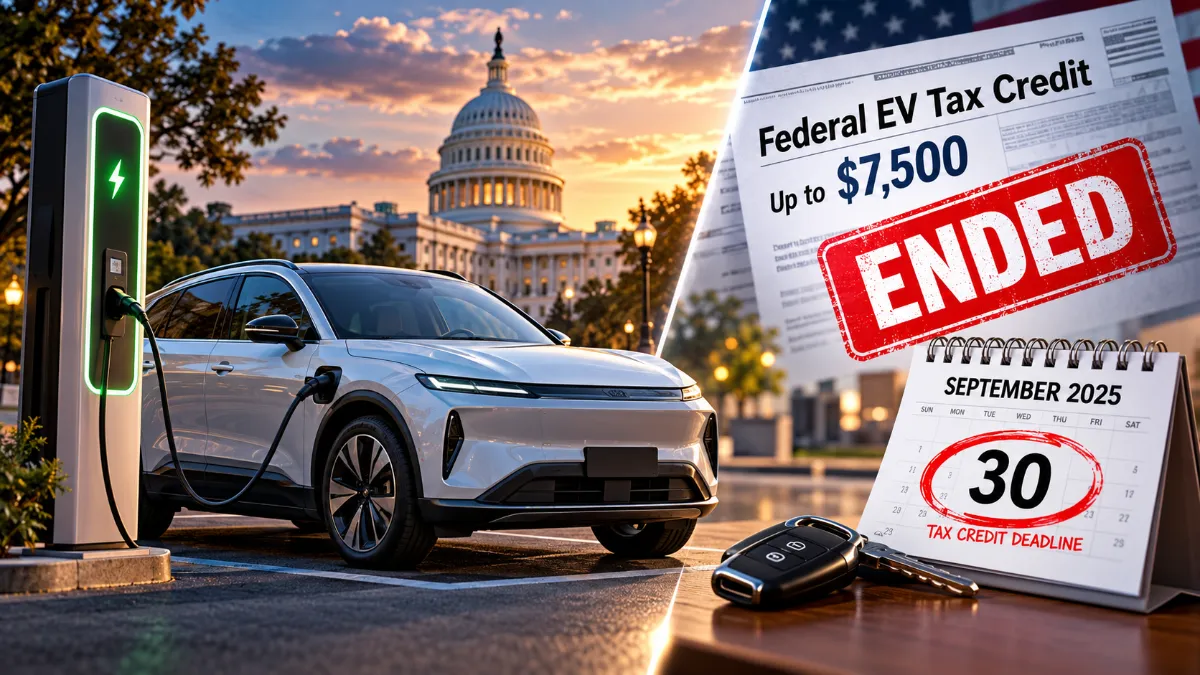
 What Happened to the Federal Tax Credit for Electric Vehicles After September 2025?
The federal electric vehicle tax credits that helped buyers save thousands of dollars ended for vehicles acquired after September 30, 2025. Here is what the change means for new EV buyers, used-car shoppers, 2025 purchases, home charging equipment, and state incentives in 2026.
For years, federal tax incentives helped make electric vehicles more affordable in the United States. Eligible buyers could receive a tax credit of up to $7,500 for a qualifying new electric vehicle or up to $4,000 for an eligible used EV. Some buyers could also transfer the credit to a participating dealer at the time of purchase, reducing the amount they needed to pay upfront.
That situation changed in 2025. Federal legislation known as Public Law 119-21, commonly called the One Big Beautiful Bill Act, accelerated the end of several clean-vehicle incentives. As a result, the federal new and previously owned clean vehicle credits are no longer available for vehicles acquired after September 30, 2025.
For consumers researching the federal tax credit for electric vehicles, the important distinction in 2026 is between credits that have ended for new purchases and potential claims relating to qualifying transactions completed before the deadline. A separate federal tax credit for EV charging equipment also had its own deadline, which passed on June 30, 2026.
The following guide explains the changes and what buyers should check before making a purchase or filing a tax return.
1. Are Federal EV Tax Credits Still Available in 2026?
No. The federal consumer tax credits for eligible new and previously owned clean vehicles are no longer available for vehicles acquired after September 30, 2025. The same cutoff applies to the federal qualified commercial clean vehicle credit.
The change came through Public Law 119-21, which amended the laws governing these incentives. Before the change, the relevant credits were scheduled to continue for longer. The new law brought the vehicle-acquisition deadline forward to September 30, 2025.
This means someone buying a qualifying electric vehicle in October 2026 cannot claim the former federal new-vehicle credit simply because the car meets the old eligibility rules. The same applies to a qualifying used EV acquired after the deadline.
The rule is not based solely on the model year of the vehicle. A 2025-model electric car purchased in 2026 does not qualify merely because it is an older model. What matters is whether the vehicle was acquired by the statutory deadline and whether all other applicable requirements were satisfied.
There is also an important distinction between acquiring a vehicle and taking possession of it. The IRS explains that a buyer could acquire a vehicle on or before September 30, 2025, through a binding written contract and a payment made by that date, then take possession later and potentially claim the credit. The buyer must still meet the other applicable requirements.
Consumers should consult the IRS Clean Vehicle Tax Credits guidance before relying on older articles, dealership advertisements, or tax-credit calculators. Some online information still describes the former incentives without making the 2025 cutoff clear.
2. What Happened to the $7,500 New EV Tax Credit?
The former New Clean Vehicle Credit, established under Section 30D of the Internal Revenue Code, allowed eligible buyers to claim a federal tax credit of up to $7,500 for a qualifying new clean vehicle.
The full amount was not guaranteed for every electric car. Eligibility depended on several factors, including the vehicle’s battery and sourcing requirements, final assembly, manufacturer suggested retail price limits, and the buyer’s income and tax circumstances under the rules in effect at the time of purchase.
The credit generally consisted of two components tied to qualifying battery critical minerals and battery components. Depending on whether a vehicle met the relevant requirements, a buyer could qualify for a partial credit or the full $7,500. Other qualifying clean vehicles, including certain plug-in hybrid models, could also be eligible under the former rules.
The program was intended to lower the effective cost of qualifying vehicles and encourage adoption of cleaner transportation. In some cases, eligible buyers could transfer the credit to a registered dealer rather than waiting to claim it on a tax return. That arrangement could reduce the purchase price or provide an equivalent benefit at the point of sale.
Why the $7,500 credit ended
Public Law 119-21 ended the credit for vehicles acquired after September 30, 2025. Consequently, the former $7,500 benefit is not available for a new EV acquired in 2026, even if that vehicle would have qualified under the earlier rules.
For example, imagine a buyer shopping for a new electric SUV in October 2026. The SUV might have met the old battery, price, and assembly requirements. However, those factors do not restore eligibility because the acquisition occurred after the deadline.
A buyer who acquired an eligible vehicle by September 30, 2025, may still be able to claim the credit if the transaction and vehicle meet the relevant rules. The fact that the credit has ended for later acquisitions does not automatically eliminate a valid claim for an earlier qualifying purchase.
The former credit should therefore be treated as a historical incentive for eligible transactions, not as a discount that new EV buyers can assume will be available in 2026.
3. What Happened to the $4,000 Used EV Tax Credit?
The federal Previously-Owned Clean Vehicle Credit, established under Section 25E, also ended for vehicles acquired after September 30, 2025.
Before the cutoff, eligible buyers could receive a credit worth up to $4,000 for a qualifying used electric vehicle or other eligible previously owned clean vehicle. The credit was generally calculated as 30% of the vehicle’s sale price, capped at $4,000.
The program had specific restrictions. Among other conditions, the vehicle generally had to be purchased from a qualified dealer, meet the applicable price limit, and satisfy age and eligibility requirements. Buyers also had to meet income restrictions and other statutory conditions. The credit was intended for eligible individuals, rather than businesses claiming the same previously owned vehicle credit.
Not every used EV qualified, and the age of the vehicle or the fact that it was electric was not enough on its own. Buyers had to check the vehicle, seller, sale price, and their own eligibility.
Can you claim the used EV credit for a car bought in 2026?
No, not for a vehicle acquired after September 30, 2025, under the former federal program. Buying a used electric car from a dealership in 2026 does not make it eligible for the old $4,000 credit.
For example, a buyer purchasing a used EV for $12,000 in November 2026 should not expect a federal used-clean-vehicle credit of $3,600 or $4,000 under the expired program. The previous calculation method no longer creates a benefit for a post-deadline acquisition.
However, someone who acquired an eligible used EV by September 30, 2025, may still have a claim to review. That person must satisfy all relevant requirements, including the acquisition and placed-in-service rules, and should check the IRS guidance and applicable filing instructions.
Consumers should also be cautious about advertisements that continue to promote the used EV credit without explaining its expiration. A vehicle advertised as “tax-credit eligible” may be referring to old program rules, a different incentive, or a qualifying transaction completed before the deadline. Ask the seller to clarify exactly which program is being referenced.
4. Can Buyers Still Claim a Federal EV Credit for a Vehicle Purchased in 2025?
Possibly. The key is whether the vehicle was acquired on or before September 30, 2025, and whether all applicable requirements were met. The calendar year alone does not determine eligibility.
Under IRS guidance, acquisition for the terminated vehicle credits generally required both a binding written contract and a payment on or before September 30, 2025. A payment could include a nominal down payment or a vehicle trade-in, subject to the applicable rules.
This distinction matters when a buyer signed paperwork before the deadline but collected the vehicle later. The IRS states that a vehicle acquired by the deadline under a binding written contract with payment could still qualify when it was subsequently placed in service. For these purposes, a vehicle is generally placed in service when the buyer takes possession.
For example, suppose a buyer signed a binding contract for a qualifying new EV on September 29, 2025, made the required payment that day, and took possession in October 2025. The buyer may be able to claim the credit if all other requirements are satisfied and the transaction is properly documented.
By contrast, signing a nonbinding reservation or placing an order without meeting the contract-and-payment requirements would not automatically establish acquisition before the cutoff. A deposit alone should not be assumed to guarantee eligibility without reviewing the terms and relevant IRS guidance.
Documents and requirements to check
Anyone claiming a credit for a qualifying 2025 transaction should review the following:
Purchase and contract records: Keep the binding written contract, proof of payment, trade-in documentation if relevant, and the final sales paperwork.
Vehicle eligibility: Confirm that the specific make, model, configuration, and vehicle identification number (VIN) met the rules applicable to the credit.
Seller reporting: The IRS says the seller must provide the buyer with the required vehicle qualification information and submit the required information to the IRS. Missing or incorrect reporting can affect eligibility.
Delivery or possession date: Keep records showing when the vehicle was placed in service, especially if possession occurred after September 30, 2025.
Tax-return requirements: Use the applicable IRS forms and filing instructions for the year of the transaction. Do not assume that a dealer’s statement by itself proves every requirement has been met.
The new and used vehicle credits had different eligibility rules, so buyers should not use the same checklist for both without checking the details. Commercial vehicle credits also followed separate requirements, even though they shared the September 30, 2025, acquisition cutoff.
If a buyer believes they qualify, the next step is to review the official IRS clean vehicle credit guidance and, if necessary, consult a qualified tax professional. This is particularly important when the contract date, payment date, delivery date, or dealer reporting is unclear.
5. Is the Federal EV Charger Tax Credit Still Available?
The federal tax credit for EV charging equipment was a separate incentive from the credits for purchasing a vehicle. It operated under Section 30C of the Internal Revenue Code, known as the Alternative Fuel Vehicle Refueling Property Credit.
The credit could help eligible taxpayers offset part of the cost of qualified charging equipment and installation. It was subject to specific requirements, including rules about the equipment, the installation location, and the date the property was placed in service.
The IRS states that qualifying property under the amended rules had to be placed in service before July 1, 2026. In practical terms, the final eligible date was June 30, 2026. As of October 2026, that deadline has passed.
What did the charger credit cover?
For eligible individual taxpayers, the residential credit generally covered 30% of the cost of qualifying equipment and installation, subject to a maximum credit of $1,000 per item of qualifying property under the applicable rules. Eligibility was not automatic for every home charger or every address.
Under the rules applicable to the credit, the property generally had to be installed in an eligible low-income community census tract or a qualifying non-urban census tract. Equipment also had to meet the relevant requirements, and the taxpayer needed appropriate records of the cost and installation.
The IRS explains that residential charging equipment is generally placed in service when it is operational and ready for use. Buying a charger before the deadline would not necessarily be enough if it was not placed in service by the required date.
For example, a homeowner who purchased charging equipment in May 2026 but did not have it installed and operational until July 2026 generally would not meet the deadline under the amended rules. A homeowner whose qualifying equipment was installed and operational by June 30, 2026, may still be able to claim the credit if all other conditions are satisfied.
Can you claim the charger credit in 2026?
A taxpayer may still be filing a tax return in 2026 for a qualifying installation completed in 2025, or may need to report an eligible installation placed in service during the first half of 2026 on the applicable return. The filing date does not replace the installation deadline.
However, an installation first placed in service after June 30, 2026, does not qualify under the terminated Section 30C rules simply because the equipment was ordered or paid for earlier.
For further details, consult the IRS’s Alternative Fuel Vehicle Refueling Property Credit guidance and the IRS Section 30C frequently asked questions. Confirm that the guidance applies to the tax year and installation date in question.
6. Are State and Local EV Incentives Still Available?
The end of the federal vehicle purchase credits does not automatically mean that every electric-vehicle incentive across the United States has ended. State governments, local authorities, utilities, and other organizations may offer separate programs, but the availability and terms vary considerably.
Depending on the location, a buyer may find incentives such as state rebates, reduced registration fees, utility discounts for home charging, special electricity rates for EV owners, or assistance with installing charging equipment. Some programs may be limited to lower-income households, particular vehicle types, eligible utility customers, or specific geographic areas.
These programs operate under their own laws and funding arrangements. A state incentive should not be confused with the former federal $7,500 new-vehicle credit or $4,000 used-vehicle credit. The end of a federal program does not establish whether a separate state or utility benefit is still available.
How to check local incentives
Start with your state’s official energy office, department of transportation, or revenue agency. If you are considering installing a home charger, check your electricity provider’s website for residential charging programs, rebates, or special time-of-use rates.
Before relying on a particular offer, verify:
Whether the program is currently accepting applications and has funding available.
Which vehicle models, purchase dates, household incomes, or customer categories qualify.
Whether the incentive applies to a purchase, a lease, a charger installation, or electricity use.
Whether the program can be combined with other available incentives.
The deadline, required paperwork, and whether the benefit is paid upfront or after purchase.
Be careful with third-party websites that display old incentive amounts without an update date. Incentives can close when funding runs out or change when state rules are revised. A program that was available last year may not be available for a new purchase today.
For buyers comparing the total cost of an EV in 2026, state and local programs are worth checking—but only after confirming the current rules with the organization that administers the program.
7. What Should EV Buyers Do Before Purchasing in 2026?
With the former federal purchase credits no longer available for new acquisitions, buyers should compare electric vehicles based on their actual price and ownership costs rather than assuming a federal tax benefit will reduce the bill.
Start by checking the vehicle’s purchase price, financing terms, insurance costs, expected maintenance, battery warranty, charging access, and electricity rates. Compare those costs with a comparable gasoline vehicle over the period you expect to own it. Savings will vary depending on how much you drive, where you charge, local electricity prices, and fuel costs.
Next, investigate any state, local, or utility programs that might apply. Get confirmation of eligibility before signing a purchase agreement, especially if the incentive is a major factor in your budget. If the offer comes from a dealer, ask for the official program name and a link to the administering agency’s current rules.
If you purchased a vehicle before the September 30, 2025, deadline, organize your records and check whether the transaction met the applicable federal requirements. For a home charger installed before July 1, 2026, keep the invoice, installation records, proof of payment, and information needed to establish that the equipment was eligible and placed in service on time.
Finally, use current official guidance when preparing a tax return. Tax rules are date-sensitive, and information written before the 2025 law change may no longer reflect the rules for new purchases.
Frequently Asked Questions
Is the $7,500 federal EV tax credit available in 2026?
No. The former New Clean Vehicle Credit ended for vehicles acquired after September 30, 2025. A new EV purchased in 2026 does not qualify for that credit under the former program.
Is the $4,000 used EV tax credit still available?
No. The Previously-Owned Clean Vehicle Credit also ended for vehicles acquired after September 30, 2025. A used EV purchased in 2026 is not eligible for the former federal credit.
What if I signed an EV contract before September 30, 2025, but received the car later?
You may still qualify if you entered into a binding written contract and made a payment by September 30, 2025, and meet all other applicable requirements. Keep the contract, payment records, seller documentation, and delivery records.
Can I claim the federal home EV charger credit for an installation in late 2026?
Generally, no. Under the amended rules, the Section 30C credit required qualifying property to be placed in service before July 1, 2026. An installation first placed in service after June 30, 2026, misses that deadline.
Are there still incentives for EV buyers in my state?
Possibly. State, local, and utility programs differ by location and can change over time. Check the relevant official agency or utility for current eligibility and funding.
The Bottom Line
The federal EV tax incentive landscape changed significantly in 2025. The former credit of up to $7,500 for qualifying new clean vehicles and the credit of up to $4,000 for eligible used vehicles ended for vehicles acquired after September 30, 2025. The separate federal tax credit for qualifying charging equipment also reached its deadline, with property generally required to be placed in service before July 1, 2026.
That does not rule out every possible incentive. Eligible transactions completed before the vehicle-credit deadline may still support a claim, and state, local, or utility programs may offer separate benefits. The safest approach is to verify the exact purchase or installation date, keep the relevant documentation, and rely on current official guidance rather than outdated incentive summaries.
This article is for general informational purposes and is not individualized tax advice. Eligibility depends on the facts of the transaction and the rules applicable to the relevant tax year. Confirm details with the IRS or a qualified tax professional.
🔹🔹 Follow us on Facebook 🔹🔹