
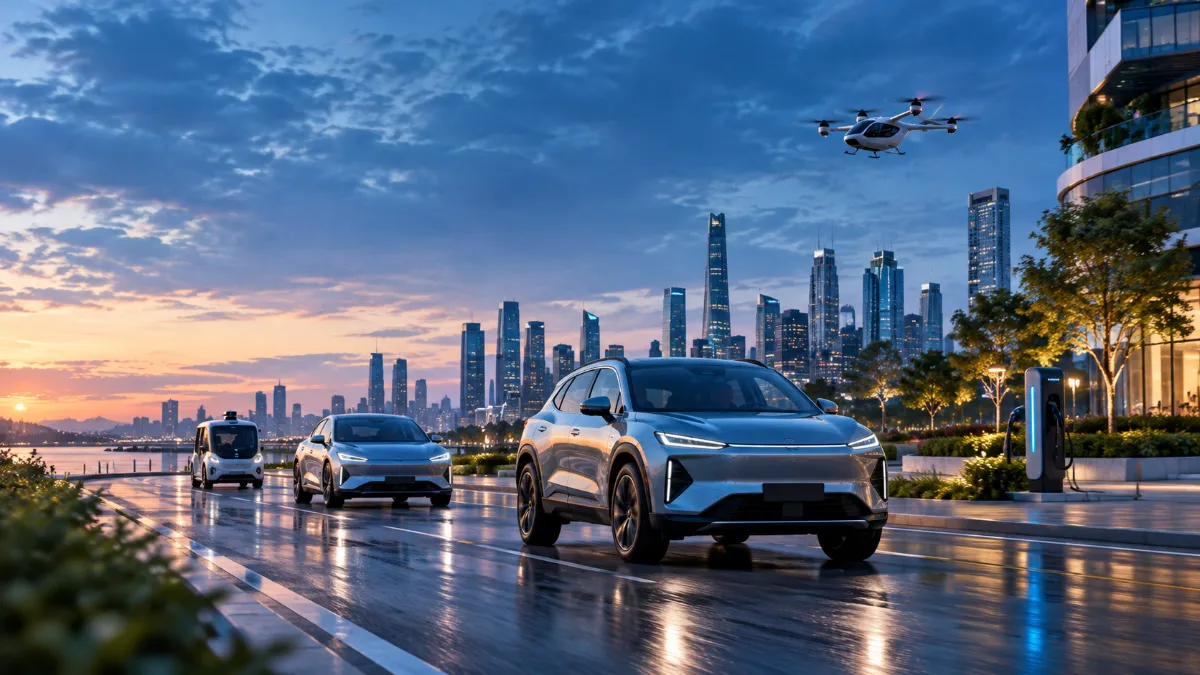
 A practical guide to which technologies are ready today, and what they mean for the future of mobility
Every few years, a new technology is declared the end of the car as Americans know it. Some of those declarations come true on a different schedule than promised, and some never do. The future of mobility is not a single breakthrough. It is a set of overlapping changes that arrive at different speeds in different places. Electric cars are on sale at every major dealership, but US sales have slowed since the federal tax credit ended. Robotaxis carry paying passengers in American cities. Solid-state batteries and air taxis are real engineering projects with real milestones, but they are still some way from everyday use.
This guide separates what is available now from what is still a promise. It is written for a US reader, so figures are in miles and dollars where the sources use them, and I draw on examples from Norway, China, the UAE, India and the UK to show what happens when a different set of rules or incentives is applied. Many sources date from 2026, and this field changes quickly, so check the latest status before you make a purchase decision. Company numbers are described as claims where I could not find independent verification, and nothing here comes from my own testing.
Where the US Stands Right Now
The best starting point is the sales data, because it shows how much of the future has already arrived.
Cox Automotive reported 247,226 electric vehicle sales in the US in the second quarter of 2026, according to InsideEVs. That is up from the first quarter (the sources put the gain between roughly 14 and 15 percent) but down 20.5 percent from the same quarter a year earlier. Kelley Blue Book put EVs at just 5.8 percent of new vehicles sold in the quarter. The federal EV tax credit ended in September 2025, and the market has been adjusting since.
New Cars to Watch in 2026: 7 Launches That Matter in India
Tesla still dominates the volume. The Model Y sold 84,863 units, more than one in three US EVs, followed by the Model 3 with 34,944. The Hyundai Ioniq 5 (10,940), Toyota bZ (7,524) and Ford Mustang Mach-E (7,032) trail far behind.
Meanwhile, hybrids are growing. Kelley Blue Book reported that hybrid sales rose 9 percent in the first half of 2026 while total new-vehicle sales fell 2.2 percent. It also noted that the Toyota RAV4, Toyota Camry and Jeep Cherokee were offered only as hybrids for the 2026 model year. Its headline claim, that America is going hybrid, rests on growth rates; the article did not give a hybrid market share.
The takeaway is not that EVs have failed. It is that the next phase in the US looks slower and more uneven than the first.
1. Electric Vehicles: Slower in America, Fast Where Policy Pushes
Norway is the clearest example of what a policy-driven market looks like. According to electrive, 95.9 percent of new passenger cars registered in Norway in 2025 were battery-electric, up from 88.9 percent in 2024, out of a record 179,550 registrations. The registration authority credited a long-term, targeted EV policy, including tax decisions, and linked a late-year rush to a VAT change effective January 1, 2026. In 2025, electric cars also overtook diesel cars in the national fleet.
The comparison with the US is instructive but should not be overstated. Norway is a small country with a long history of strong incentives, while the US has long distances, a huge pickup and SUV market, and a patchwork of state policies. The lesson is that adoption follows incentives and infrastructure at least as much as it follows technology.
Another case study comes from India, where electric two-wheelers dominate. JMK Research reports that India’s EV sales passed 2.5 million vehicles in the financial year ending March 2026, with two-wheelers making up 57.8 percent of the total. Small, cheap electric vehicles can scale quickly where a motorised vehicle is a major purchase, which is a different pattern from the US car market.
2. Faster Charging and the NACS Shift
For many American shoppers, the real obstacle is not range but charging confidence.
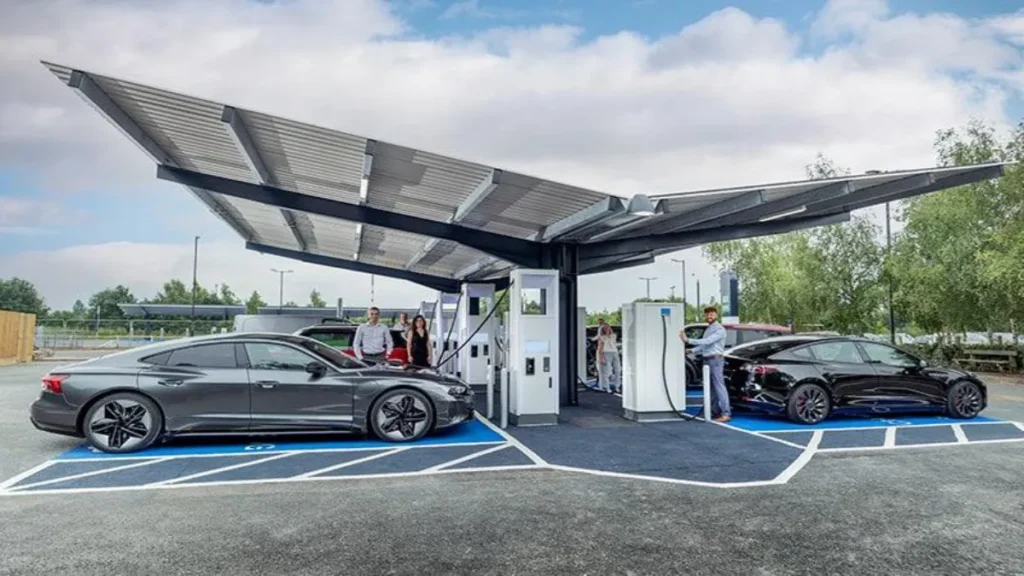
The US public DC fast-charging network reached 77,776 ports at 14,514 stations by the end of the second quarter of 2026, according to Paren data reported by EVwire. Operators added 4,382 ports in the quarter, which was a rebound from the seasonal low in the first quarter but about 10 percent behind the pace of a year earlier.
Two trends stand out. First, Tesla holds about half of all fast-charging ports (38,733, or 49.8 percent) and averages 12.1 ports per station, against 4.4 for other operators. More ports per station usually means shorter waits. Second, the connector is changing: the NACS plug (Tesla’s design) made up 22.9 percent of new non-Tesla ports in the quarter, more than twice its share a year earlier, though the older CCS plug still accounts for 70.8 percent of new non-Tesla builds. Power is also rising, with about 62 percent of new non-Tesla ports supporting 250 kW or more.
Overseas, the headline numbers are even bigger. BYD says its 1,000 kW “flash” charger can add 250 miles of range in five minutes, and it plans to install 300 of them in the UK in 2026, with the Denza Z9GT as the first compatible car. That is a company claim, and it needs both a car that can accept that power and a grid connection that can supply it. It is a signal of where charging is heading, not something a US driver can use today.
3. Battery Swapping: A Case Study From China
Instead of making charging faster, some companies make it unnecessary. Battery swapping replaces a depleted pack with a charged one in minutes.
China’s NIO is the best-known example. It completed its 100 millionth battery swap on February 6, 2026, nearly eight years after its first swap in Shenzhen in May 2018. It operates 3,729 swap stations in China, 1,020 of them on highways, and plans to add at least 1,000 more in 2026, which is a target and not a result. The company’s reported time and cost savings are its own figures, and I could not verify its swap time from the source.
I did not find a battery-swap network operating at scale in the US in the sources I read. My reading is that swapping works best when many cars share one battery design, and the NIO case shows what scale takes: one company controlling the cars, the batteries and the stations. An Indian guide I read also found home charging far cheaper per mile than swapping, which suggests swapping suits fleets and high-mileage drivers more than private owners with a home plug.
4. Solid-State Batteries: Real Progress, Not Yet Real Cars
Solid-state batteries replace the liquid electrolyte in a lithium-ion cell with a solid one. The promise is more energy in the same space, faster charging and better safety.
A February 2026 EEPower summary shows a mixed picture. QuantumScape, a US company, reported pilot production and sample shipments and planned to inaugurate its “Eagle Line” in February 2026. Samsung SDI has a pilot line in Korea and targets mass production in 2027. Toyota has aimed for a first all-solid-state electric vehicle in 2027 to 2028. Factorial Energy tested semi-solid cells in a modified Mercedes-Benz EQS that exceeded 745 miles on one charge. Almost all performance figures in that article, such as charging from 10 to 80 percent in around 12 minutes, are company claims that the article did not independently verify.
The sensible reading for a US buyer is that solid-state cells are moving from labs toward factories, but the first cars will probably be expensive and low-volume. Waiting for one before buying a car in the next few years is unlikely to pay off.
5. Hybrids: The Bridge That Is Winning the Present
Not every important technology is new. Hybrids are the quiet winner of 2026 in the US, and they matter because they remove two worries at once: range and charging.
The data point that best captures this is the one from Kelley Blue Book: hybrid sales rose 9 percent in the first half of 2026 while the overall market shrank, and several popular Toyota and Jeep nameplates moved to hybrid-only powertrains. The article also pointed to higher gas prices as one driver, though it did not quantify the effect.
For a household that cannot charge at home, or that regularly drives long distances, a hybrid is the technology that works today. Renault’s strong-hybrid Duster, due in India around Diwali 2026, is another example of the same bet overseas: a 1.8-litre petrol engine with two electric motors and a small 1.4 kWh battery, which Renault says can run in electric mode for up to 80 percent of city driving (a manufacturer claim).
6. Robotaxis: Scaling in American Cities
Autonomous driving is really two technologies on two timelines. Driver-assistance systems help a human who is still responsible for driving. Robotaxis remove the human driver within a restricted area. The second is where the US leads.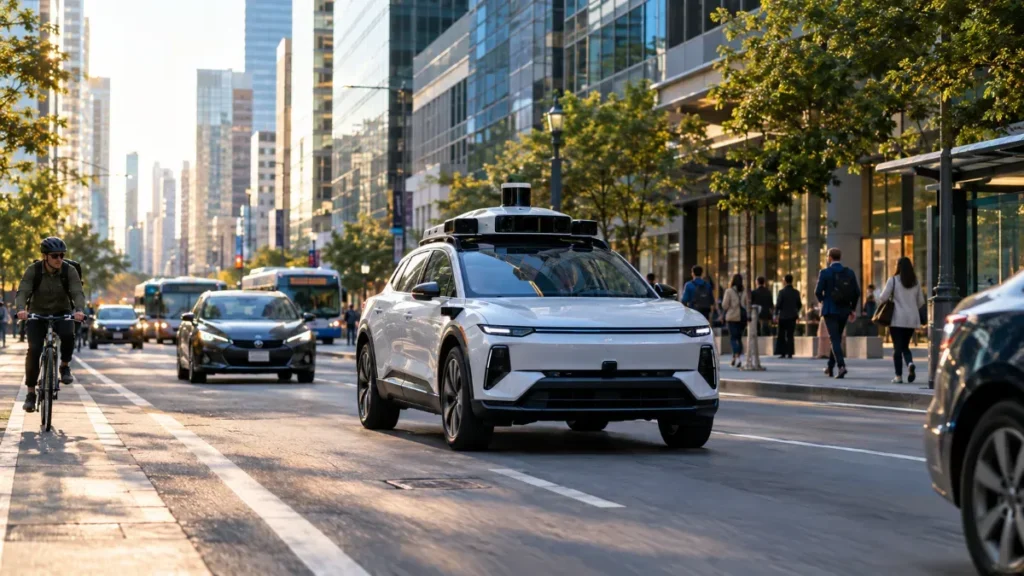
In February 2026, Waymo said it was handling about 400,000 paid rides per week across six cities and was aiming for one million weekly rides by the end of the year. A later report put it at 500,000 paid rides per week across 10 markets, which was double what it was in under a year, with Dallas, Houston, San Antonio and Orlando among the newer additions. Waymo’s plans for 2026 also included Washington, Detroit, Las Vegas, San Diego, Denver and Nashville, plus London and possibly Tokyo.
Zoox, Amazon’s robotaxi company, reached a different milestone. In late July 2026, NHTSA granted it an exemption allowing paid rides in purpose-built robotaxis that have no steering wheel or pedals, the first approval of its kind. The exemption is capped at 2,500 vehicles a year and lasts two years, and Zoox planned to start charging fares in Las Vegas the following month.
The technology is working for many trips, and it is still being tested on edge cases. US regulators opened two investigations in January 2026 after school-zone incidents, including one in which a Waymo vehicle struck a child at low speed in Santa Monica, and others involving vehicles passing stopped school buses in Austin and Atlanta. Waymo says it has deployed software updates, but incidents have continued. The pattern to watch is not the headline ride count but whether the safety record improves as the fleets get bigger.
7. Air Taxis: Impressive Engineering, Uncertain Timeline
Electric vertical take-off and landing (eVTOL) aircraft are the most futuristic item here, and the one where the gap between announcement and reality is largest.
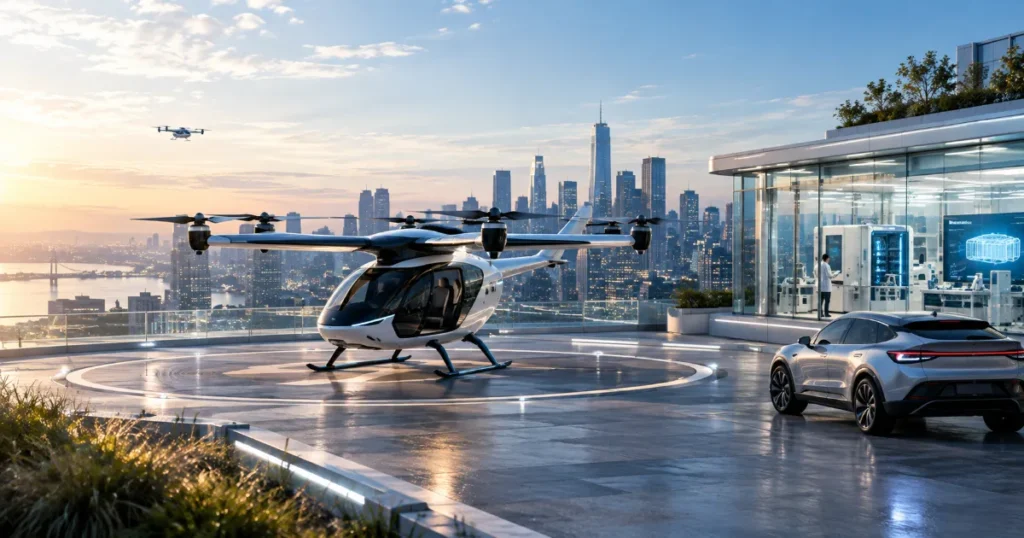
The regulatory path is clearer in the US than most places. In its first-quarter 2026 results, Archer Aviation said it had become the first eVTOL company to complete Phase 3 of the FAA’s four-phase type-certification process, in April 2026, and was working on Phase 4. It expects initial operations in US cities in 2026 under the White House’s eVTOL Integration Pilot Program, where it was selected as an air-taxi partner in three winning applications covering eight states, including Florida, Texas and New York. It has also said it will be the official air-taxi provider for the 2028 Los Angeles Olympics. Full FAA type certification had not yet been received.
The UAE shows how a different regulator can move first. In May 2026, Gulf News reported that Archer’s Midnight entered the UAE’s Restricted Type Certificate programme, which allows limited operations before full certification. The regulator listed eight workstreams still to finish before commercial launch, including pilot training, vertiports and airspace integration, and gave no launch date.
India offers a third case. In 2023, Archer and InterGlobe, the parent company of IndiGo, signed an agreement covering up to 200 Midnight aircraft for Delhi operations. A 2024 report said demonstration flights were planned for 2025 and commercial service for 2026, but I could not confirm that those dates still hold. The point for US readers is that air taxis are as much a regulatory and infrastructure project as an engineering one. They need vertiports, airspace rules, trained pilots and a business model that works at scale.
What the Future of Mobility Means for American Drivers
It helps to turn the technology into practical choices.
If you are buying a car in the next two years, the realistic options are gasoline, hybrid and electric. An EV makes the most sense if you can charge at home and your trips fit within its range. A hybrid fits households that want lower fuel use without changing habits. NACS adoption should make charging simpler for non-Tesla EVs over time, but it is still in transition.
If you live in a city with robotaxis, the technology is already a transport option. Try it for a short trip, and expect rules and coverage areas to change.
If you commute long distances, the question to ask is not which technology is newest but which one fits your charging access and mileage.
A Realistic Timeline for the Future of Mobility
| Technology | Status in 2026 | Realistic everyday use for most Americans |
|---|---|---|
| Electric cars | 5.8% of US new-vehicle sales in Q2 | Now, especially with home charging |
| Fast charging (250 kW and up) | Most new ports support it | Now, where stations exist |
| NACS connector | 22.9% of new non-Tesla ports in Q2 | Rolling out |
| 1,000 kW charging | UK rollout planned | Not in the US yet |
| Battery swapping | Large in China, rare in the US | Not for private owners |
| Hybrids | Sales up 9% in the first half | Now |
| Solid-state batteries | Pilot lines; targets of 2027 and later | Not for most buyers this decade |
| Robotaxis | Waymo in 10 markets; Zoox approved in July | Now in some cities |
| Air taxis | FAA certification in progress | Limited pilot operations at best |
How to Tell Hype From Progress
A few questions help whenever you read the next big announcement.
- Is it a claim or a measurement? Most solid-state and fast-charging numbers are company claims.
- Where is it available? A technology that works in Phoenix may not work in your city.
- Who is the first customer? A fleet is easier to serve than millions of private owners.
- What else must exist for it to work? Chargers, regulations, trained pilots and parts supply all matter.
- What happens when it fails? The Waymo investigations show that real-world edge cases decide how fast a technology scales.
Conclusion
The future of mobility will not arrive as a single revolution. For most Americans it is already visible in a hybrid that cuts fuel use, an EV with a growing charging network or a robotaxi ride in a handful of cities. Solid-state batteries and air taxis are further out and depend on certification, infrastructure and trust. Plan your next purchase around what you can use today, and treat everything else as a developing story.
Frequently Asked Questions
What is the future of mobility? It is the shift toward electrified, connected and increasingly automated transport, including EVs, faster charging, hybrids, robotaxis and, eventually, air taxis. These arrive at different speeds in different places.
How many electric vehicles are sold in the US? Cox Automotive reported 247,226 EV sales in the second quarter of 2026, down 20.5 percent from a year earlier. Kelley Blue Book put the EV share of new vehicle sales at 5.8 percent in the quarter.
Are hybrids more popular than EVs in the US? Hybrid sales rose 9 percent in the first half of 2026 while the overall market fell, according to Kelley Blue Book. I did not find a hybrid share figure in the sources I read, so I cannot give a precise comparison.
When will solid-state batteries reach cars? Samsung SDI targets mass production in 2027 and Toyota a first all-solid-state EV in 2027 to 2028, according to a February 2026 summary. These are targets, and most performance figures are company claims.
Are robotaxis available in the US? Yes, in a growing number of cities. Waymo reported about 500,000 paid rides a week across 10 markets in 2026, and Zoox received a federal exemption in July 2026 to charge for rides in vehicles without a steering wheel, starting in Las Vegas.
Will air taxis fly in American cities? Archer expects initial US operations in 2026 under a White House pilot programme, but it had not received full FAA type certification when its first-quarter results were released.
Should I wait for new technology before buying a car? For most buyers, no. Hybrids and EVs are available now, while solid-state batteries and air taxis are not close to mainstream use.