
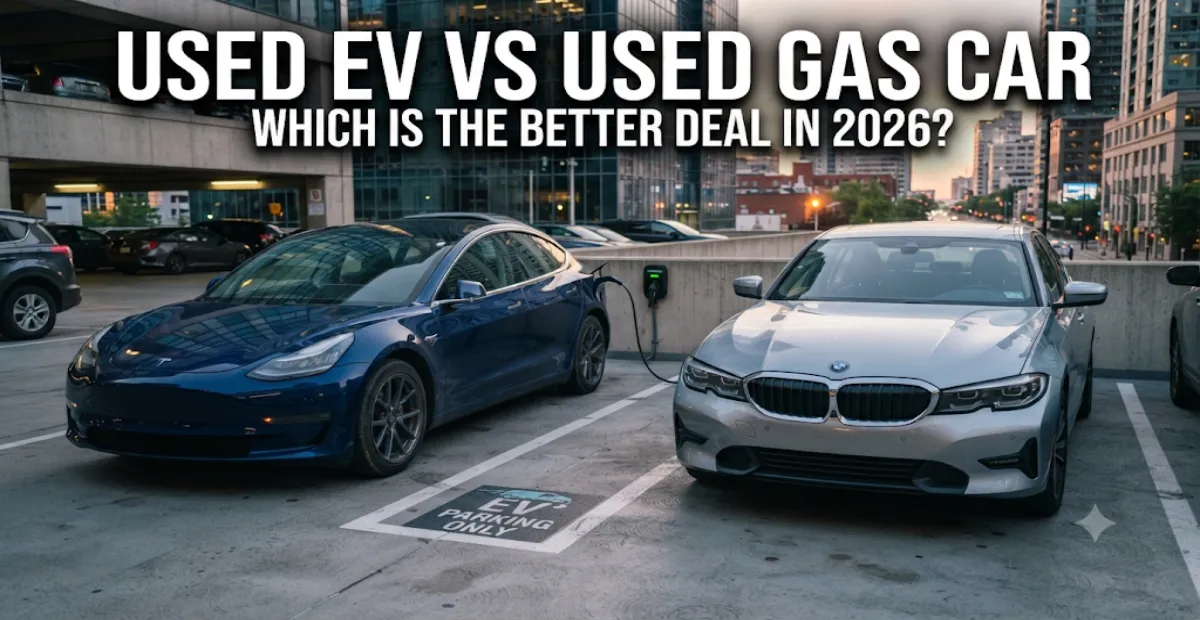
 Used Electric Cars vs Used Gas Cars: Which Is the Better Deal?
A year ago, used EVs were clear bargains. In 2026 that gap has closed. In September 2026 the average used EV cost $32,533, about $579 more than the average used gas car ($31,954), versus $2,227 cheaper a year earlier. A used EV can still be the better deal if you charge at home, drive a lot, and buy the right model with a verified battery. A used gas car wins if you can’t charge at home, drive little, or find a bargain price on a proven model. Compare total cost over your ownership period, not the sticker.
Best Electric Cars for the Money in 2026: Range, Comfort and Value Compared
Federal Tax Credit for Electric Vehicles: What Changed in 2026?
What changed in 2026
Used EVs spent 2025 getting cheaper. Then the market reversed.
| Measure (Sept 2026 vs Sept 2025) | Used EV | Hybrid | Gas |
|---|---|---|---|
| Average price, Sept 2026 | $32,533 | $34,476 | $31,954 |
| Change over the year | +9.8% (from $29,637) | +4.9% | +0.3% |
| Average days to sell | 41.9 | 48.6 | 54.8 |
The story in three lines
- Used EV prices fell year over year in early 2026 (including a 3.4% drop in March), turned positive in April, and September was the sixth straight monthly increase.
- A year earlier, used EVs were $2,227 cheaper than gas cars. Now they are $579 more expensive.
- iSeeCars’ Karl Brauer pointed to higher fuel prices as a likely driver, and said the EV segment had recovered from the loss of federal incentives a year earlier.
What it means for you: the old advice, “used EVs are a steal,” is out of date. The deal is now in the details: which model, what condition, what you pay to charge, and how long you will keep it.
Model matters a lot. EVs sold fastest when they were compact and practical (the Audi Q4 Sportback e-tron at 29.8 days, the Toyota bZ4X at 33.3, the Lexus RZ 300e at 34.3). Big electric trucks and SUVs sat longest (the Cadillac Escalade IQ at 128.7 days, GMC Sierra EV at 93.2, Chevrolet Silverado EV at 89.1). Slow sellers often mean more room to negotiate. Used Teslas rose sharply (Model 3 +15.4% to about $28,931, Model S +22.5%).
Purchase price
The sticker is no longer a clear win for EVs, but averages hide large differences.
| Factor | Used EV | Used gas |
|---|---|---|
| Average price (Sept 2026) | About $32,500 | About $32,000 |
| Choice | Narrower, but growing as 2021-2024 models hit the market | Huge |
| Negotiating room | Better on slow-selling models | Depends on demand |
| Pricing risk | Prices have been volatile | Stable |
Tips
- Compare the same size and class. An average mixes cheap compacts with expensive trucks.
- Look at slow sellers. Large EV trucks and luxury SUVs have long sale times and more negotiating room.
- Check market prices on several sites and watch for recent price cuts.
- Do not pay a “fast-seller premium” without a reason. A popular model may be worth it, but compare the alternatives.
- Cheaper, older EVs (small hatchbacks from a few years back) can still be good value, but battery health and charging speed matter more.
Incentives in 2026
The federal used EV tax credit is gone. The Section 25E credit (up to $4,000) ended on October 1, 2025, and it does not exist for 2026 purchases. The new-EV credit (up to $7,500) and the home-charger credit (for chargers placed in service after June 30, 2026) have also ended.
What can still help
| Incentive | Details |
|---|---|
| State programs | Some states offer used-EV or income-qualified rebates. Examples listed by one source: California (up to $14,000 for income-qualified buyers), Colorado, New Jersey, Connecticut and New York. Funding can run out |
| Utility rebates | Some utilities offer $500 to $2,500 for a used EV (for example PG&E, Xcel Energy and Eversource), plus cheaper overnight rates |
| Auto loan interest deduction | Up to $10,000 a year in interest on loans for U.S.-assembled vehicles, for loans from 2025 through 2028. It is a deduction, not a credit, and applies to gas and electric cars alike |
Check your state energy office and utility before buying. Programs change often, and this is one place where a short search can save $1,000 or more. Confirm federal rules with the IRS.
Running costs
This is where a used EV can pull ahead, if you can charge cheaply.
Fuel vs electricity
| Gas | EV (home charging) | EV (public fast charging) | |
|---|---|---|---|
| Cost basis | Price per gallon | Your electricity rate | Network price per kWh |
| Typical result | Highest per mile | Lowest per mile | Can be similar to or higher than gas |
| Note | Rises with fuel prices | Cheaper overnight on time-of-use plans | Idle and session fees can apply |
Key point: an EV’s cost advantage depends on where you charge. Home charging at a normal residential rate is usually much cheaper per mile than gas. Relying on public fast charging can erase the saving.
Do your own cost-per-mile math
- Gas car: (price per gallon) ÷ (miles per gallon) = cost per mile.
- EV: (price per kWh) ÷ (miles per kWh) = cost per mile. Most EVs return about 3 to 4 miles per kWh.
- Multiply by your annual miles.
Rising fuel prices, which analysts cited in 2026, widen the EV advantage. If gas gets cheaper, it narrows.
Other running costs
- Insurance. EVs can cost more to insure in some cases, so get quotes for the exact model before buying.
- Registration. Some states add an EV registration fee to replace fuel taxes.
- Home charger. A Level 2 charger and installation can add several hundred to a couple of thousand dollars, and the federal credit for it is gone for new installs. If you can charge from a normal outlet overnight, you may not need one.
- Tires. EVs are heavy and torquey, so tires can wear faster.
Battery health
The battery is the main worry on a used EV, and the data is more reassuring than the myths.
What the data says
Geotab’s 2026 analysis of more than 22,700 EVs across 21 makes and models found:
| Finding | Number |
|---|---|
| Average battery degradation | 2.3% per year (up from 1.8% in its 2024 findings) |
| Mostly AC or lower-power charging | About 1.5% per year |
| Heavy DC fast charging above 100 kW | Up to 3.0% per year |
| Hot climates | About 0.4% per year faster than mild climates |
What this means: a typical EV loses roughly 2 to 3% of its capacity per year. After five years, that is on the order of 10 to 15% lost, which still leaves most of the range. The spread between cars is large, so verify the specific battery.
Warranty: most manufacturers cover EV batteries for about 8 years or 100,000 miles (terms vary), and many guarantee a minimum capacity level. Check how much of the warranty remains, and whether it transfers to a second owner (it usually does).
How to check battery health
- Ask for a battery health report. Some services read the state of health (SoH) from the car for a fee, and dealers sometimes provide one.
- Check the range display at 100% charge versus the original rated range, remembering temperature and driving style affect it.
- Ask about charging habits. Mostly home AC charging is a good sign. A history of constant fast charging and heat exposure is less so.
- Look up the model’s known battery issues and recalls on NHTSA.
- Pay for a pre-purchase inspection by an EV-experienced shop.
Maintenance and repairs
| EV | Gas | |
|---|---|---|
| Oil changes | None | Regular |
| Brakes | Wear slowly (regenerative braking) | Normal |
| Moving parts | Fewer | Many (engine, transmission, exhaust) |
| Tires | Often wear faster | Normal |
| Battery | Biggest long-term risk | n/a |
| Cooling and electronics | Coolant loops, software, charging port | Engine cooling, spark plugs, belts |
| Repair access | Fewer qualified shops, more dealer reliance | Easy to find a mechanic |
| Collision repair | Can cost more, particularly if the battery is damaged | Generally lower |
The trade-off: an EV saves on routine maintenance, but a major repair (battery, drive unit, body damage) can be costly, and finding a specialist can be harder outside big cities. A gas car is easier to repair almost anywhere, but costs more in routine upkeep.AWD vs 4WD: Which Is Better for Snow, Off-Road & Everyday Driving?
Software matters. Check whether the car receives over-the-air updates, and that the infotainment, app and charging functions all work.
Depreciation and resale
EVs have depreciated faster than gas cars in recent years, which is why used EVs became bargains. That may now be changing, but the history matters when you buy and when you sell.
- Buying used avoids the steepest drop. The first owner has absorbed it.
- Resale prices have been volatile. EVs rose through 2026, but could fall again if incentives, fuel prices or new models change. Gas cars are steadier.
- Technology moves fast. A newer EV with faster charging and longer range can make older ones less attractive.
- Brand and model matter. Popular models with proven batteries hold value better.
- Plan your holding period. If you will keep the car for 8 to 10 years, resale matters less than running costs.
Charging access
This is the deciding factor for many people.
| Your situation | Likely best choice |
|---|---|
| House or garage with an outlet or charger | EV works well |
| Apartment with charging at work or in the building | EV can work |
| Street parking only, no workplace charging | Gas or hybrid is simpler |
| Frequent long road trips | EV works if fast-charging coverage is good on your routes. Otherwise consider a hybrid |
| Very low annual mileage | Gas, because savings on fuel are small |
Reality check: if you will rely mostly on public fast charging, the cost saving shrinks, and the time cost grows. See our checklist for public charging before you commit.
Worked example
This uses assumptions you should replace with your own, so treat it as a template.
Assumptions: 12,000 miles a year, 5 years, same size and class of car.
| Used gas car | Used EV (mostly home charging) | |
|---|---|---|
| Purchase price | $32,000 | $32,500 |
| Efficiency | 30 mpg | 3.5 miles/kWh |
| Energy price | $3.50/gal | $0.16/kWh |
| Energy cost per year | 400 gal × $3.50 = $1,400 | 3,430 kWh × $0.16 = about $550 |
| Energy cost over 5 years | $7,000 | about $2,750 |
| Routine maintenance (5 yrs, assumed) | $3,000 | $1,500 |
| Total of these items | $42,000 | $36,750 |
Result under these assumptions: the EV comes out about $5,000 ahead over five years, if it charges mostly at home, has a healthy battery and has no major repair.
What changes the result
- Public fast charging at 40 cents per kWh instead of 16 cents would raise the EV’s energy cost to roughly $1,370 a year, close to the gas car’s.
- A battery repair or replacement could erase the saving.
- Higher insurance or registration fees for the EV.
- Lower mileage shrinks the fuel advantage.
- Higher gas prices grow it.
How to inspect a used EV
Before you visit
Get the VIN and run a vehicle history report
Check open recalls and service bulletins on NHTSA
Ask for battery state-of-health data
Confirm warranty status and whether it transfers
Check charging port type (CCS, NACS or adapter) and what you will need
Compare insurance quotes
At the car
Check range at full charge against the original rating
Charge it (even briefly) at Level 2 and, if possible, DC fast to confirm it works
Look at the charging port for damage or burnt pins
Check the included charging cable and adapters
Test climate control, regen braking, driver aids and screens
Check tire wear, which can be uneven or fast on EVs
Look for underbody damage, which can affect the battery pack
Test all apps and software features
Get a pre-purchase inspection from a shop that works on EVs.
Which should you buy?
A used EV is likely the better deal if you…
- Can charge at home or work cheaply.
- Drive 10,000+ miles a year, so fuel savings add up.
- Plan to keep the car 5+ years.
- Found a well-priced model (consider slow-selling ones) with verified battery health and warranty left.
- Live in a state or utility area with used-EV rebates.
- Like low routine maintenance and quiet driving.
A used gas car is likely the better deal if you…
- Cannot charge at home or work.
- Drive little, or mostly make long road trips in areas with sparse fast chargers.
- Want the lowest purchase price and the widest choice.
- Want easy repairs anywhere and stable resale.
- Find a reliable, well-priced model that fits your budget.
- Do not want to deal with battery uncertainty.
Consider a used hybrid if you…
- Want lower fuel costs without changing your routine.
- Cannot charge reliably.
- Are not ready for a full EV.
Hybrids averaged $34,476 in September 2026, up 4.9% on the year, so compare prices.
Mistakes to avoid
- Assuming used EVs are still cheap. Check current prices.
- Skipping the battery report.
- Ignoring charging access. It decides the whole equation.
- Counting on a tax credit that no longer exists.
- Forgetting insurance and registration costs.
- Buying on range claims alone. Real range varies with temperature and speed.
- Overpaying for a popular model when a similar one costs less.
- Skipping the inspection.
- Not checking warranty transfer terms.
- Using only public fast charging and expecting big savings.
FAQ
Are used EVs cheaper than used gas cars in 2026? Not on average. In September 2026 the average used EV cost $32,533 versus $31,954 for gas, about $579 more, according to iSeeCars. A year earlier EVs were $2,227 cheaper.
Is there a federal tax credit for used EVs in 2026? No. The Section 25E used EV credit of up to $4,000 ended on October 1, 2025. Some state and utility incentives remain, so check yours.
How long do EV batteries last? Geotab’s 2026 analysis of more than 22,700 EVs found average degradation of 2.3% per year, with heavy DC fast charging above 100 kW up to 3.0% a year and mostly AC charging about 1.5%.
Is a used EV cheaper to run than a gas car? Usually, if you charge at home. Public fast charging can cost as much as gas, so your charging access matters most.
What should I check on a used EV? Battery health, warranty transfer, charging port and speed, recalls, tire wear, underbody damage and software. Get an inspection from an EV-experienced shop.
Why did used EV prices go up in 2026? iSeeCars attributed it largely to higher fuel prices and recovery from the loss of federal incentives. Used EV prices rose for six straight months through September 2026.
Which used EVs sell fastest? In September 2026 the fastest were the Audi Q4 Sportback e-tron, Toyota bZ4X and Lexus RZ 300e. The slowest were large trucks and luxury SUVs, which can mean better negotiating room.
Should I buy a used hybrid instead? If you cannot charge at home but want lower fuel costs, a hybrid is a good middle option, though used hybrids cost more on average than gas cars.
How to Buy Your First Car Without Overspending in 2026
Public EV Charging: 12 Things to Check Before Plugging In
Conclusion
The question is no longer “are used EVs cheap?” because the average price gap has flipped. The better deal depends on your charging access, your mileage, the specific model and a verified battery. If you can charge at home and drive a fair amount, a well-chosen used EV can still beat a gas car on total cost. If you cannot, a reliable used gas car or hybrid is the safer, simpler bargain. Run your own numbers, check the battery and get it inspected.
General information, not financial advice. The worked example uses assumed figures, so replace them with your own. Verify tax rules with the IRS and incentives with your state and utility.
🔹🔹 Follow us on facebook 🔹🔹