
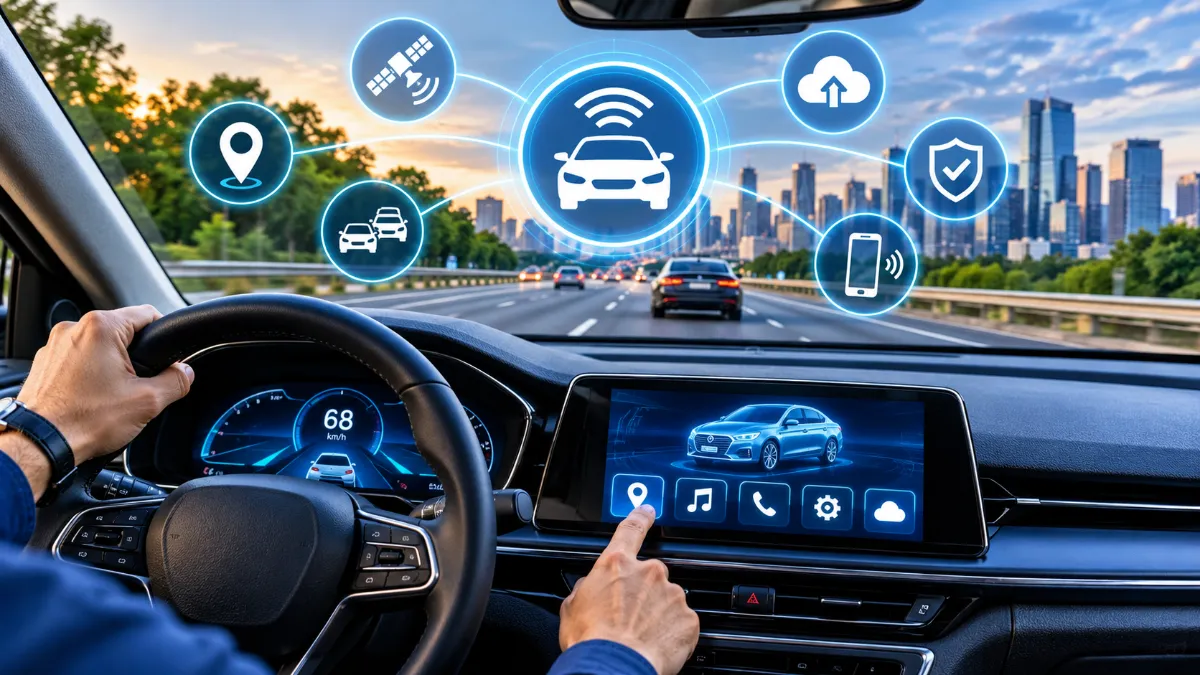
 Discover how connected car technology works, its smart features, safety benefits, and future of driving.
Cars are no longer defined only by their engines, transmissions, fuel efficiency, and safety equipment. Modern vehicles increasingly rely on software, internet connectivity, sensors, and digital communication systems to provide a more intelligent driving experience. These vehicles are commonly known as connected cars.
A connected car is a vehicle equipped with internet connectivity and communication technology that allows it to exchange information with external networks, smartphones, cloud-based services, other vehicles, and sometimes roadside infrastructure. This connectivity enables drivers to access services such as live traffic updates, online navigation, remote vehicle monitoring, emergency assistance, and software updates.
Future of Mobility: 7 Technologies That Could Change How We Travel
How Do Car Safety Ratings Work? Understanding Crash Test Results
In simple terms, a connected car can communicate with the outside world rather than operating entirely as an independent machine. It can receive information about road conditions, send vehicle performance data to connected services, and respond to commands through a smartphone application.
For example, a driver might use a mobile app to check whether the car is locked, locate it in a crowded parking area, check its fuel or battery level, or remotely activate the air conditioning. Inside the vehicle, the infotainment system can use an internet connection to provide updated maps, music streaming, weather information, and other online services.
Connected cars are an important part of the broader development of smart mobility. They are also helping automakers build vehicles that can receive new digital features and improvements after leaving the factory.
How Does a Connected Car Work?
A connected car works through a combination of hardware, wireless communication networks, software, sensors, and cloud-based platforms. These systems collect information, transmit it through an available connection, and make the resulting services accessible to drivers.
Although the technology can vary between manufacturers and vehicle models, most connected cars follow a similar operating process.
1. Sensors Collect Vehicle Information
Modern vehicles contain numerous sensors and electronic control units that monitor different systems. These components can collect information about vehicle speed, engine performance, tire pressure, fuel levels, battery condition, temperature, location, and other operating conditions.
The information helps the vehicle monitor its performance and identify potential problems. For example, a connected vehicle may detect a low tire pressure reading and display an alert on the dashboard. Depending on the manufacturer’s system, this information may also be accessible through a smartphone application.
2. A Connectivity Module Transfers Data
The connectivity module acts as a communication link between the vehicle and external services. Many connected vehicles use an embedded cellular modem and a SIM or eSIM to communicate through mobile networks.
Depending on the vehicle, connectivity may also be available through Wi-Fi, Bluetooth, or a smartphone connection.
The embedded cellular connection is particularly important because it allows a vehicle to communicate with online services without requiring the driver’s phone to remain connected.
For example, a car can send diagnostic information to a manufacturer’s cloud platform or receive updated traffic information while travelling.
3. Cloud Platforms Process Information
After vehicle information is transmitted, connected services may process it through cloud-based platforms.
These platforms can analyse information, store relevant vehicle data, provide navigation services, and support communication between the vehicle and the manufacturer’s applications.
Suppose a car reports an engine-related warning. Depending on the vehicle’s capabilities and the manufacturer’s services, the information may be transmitted to a connected platform. The driver could then receive a notification through the vehicle’s infotainment system or mobile application.
Cloud technology also supports features such as remote vehicle access, online entertainment, digital assistants, and software updates.
4. Drivers Access Connected Features
The final part of the process involves presenting information or services to the driver.
Connected features can appear on the vehicle’s infotainment display, digital instrument cluster, smartphone application, or other supported devices.
Drivers may receive navigation instructions, maintenance reminders, security notifications, and vehicle status updates. Some manufacturers also provide remote controls that allow users to lock or unlock doors, locate their vehicles, and start climate-control functions where supported.
This communication process happens continuously or whenever a particular connected service is requested.
Key Features of Connected Cars
 Not every connected vehicle offers the same technology. Features depend on the manufacturer, model, software version, subscription plan, and country where the vehicle is sold. However, several capabilities are becoming increasingly common.
Real-Time Navigation and Traffic Updates
Connected navigation systems can access online maps, traffic information, road closures, and route recommendations. Unlike traditional navigation systems that rely primarily on stored maps, connected systems can receive updated information through internet services.
For example, if an accident causes traffic congestion on a particular road, the navigation system may recommend an alternative route. Some systems also provide information about nearby fuel stations, parking facilities, restaurants, and charging stations.
Smartphone Integration
Smartphone connectivity is one of the most familiar connected-car features.
Systems such as Apple CarPlay and Android Auto allow compatible smartphones to connect with vehicle infotainment systems. Drivers can access supported navigation applications, music services, calls, messages, and voice assistants through the car’s display.
However, smartphone integration and a fully connected car are not exactly the same thing. CarPlay and Android Auto primarily extend smartphone functions to the vehicle, while built-in connected-car systems can operate through the car’s own connectivity hardware.
Remote Vehicle Access
Many manufacturers offer mobile applications that allow owners to control selected vehicle functions remotely.
Depending on the model, these functions may include:
Locking and unlocking vehicle doors.
Checking fuel levels or battery charge.
Finding the vehicle’s parking location.
Activating remote climate control.
Checking whether doors or windows are closed.
Receiving vehicle status notifications.
These features can be especially useful when a driver wants to check the vehicle without physically approaching it.
Over-the-Air Software Updates
Over-the-air (OTA) updates allow compatible vehicles to receive certain software improvements through wireless connections.
Instead of requiring a visit to a dealership for every software-related change, manufacturers can deliver supported updates directly to the vehicle.
Updates may improve infotainment functions, navigation systems, user interfaces, connectivity services, and certain vehicle software components. Some vehicles support updates to more important control systems, although these generally involve additional safety requirements and manufacturer-specific procedures.
OTA technology also allows automakers to fix certain software problems and introduce new features after a vehicle has been purchased.
Vehicle Diagnostics and Maintenance Alerts
Connected vehicles can monitor operating conditions and communicate selected diagnostic information.
For instance, a vehicle may display a warning about engine performance, battery condition, tire pressure, or another monitored system. Some manufacturer applications can also provide maintenance reminders based on mileage, vehicle condition, or service schedules.
This information can help owners identify potential problems earlier. However, connected diagnostics do not replace professional inspections or servicing.
Emergency Assistance and Vehicle Tracking
Some connected-car systems offer emergency assistance, roadside support, and vehicle-location services.
Depending on the system, a vehicle may be able to contact an emergency response service after a serious collision or allow an occupant to request assistance manually.
Vehicle tracking can also help owners locate their cars through an authorised application. Certain manufacturers provide additional stolen-vehicle assistance, although availability and procedures differ by market.
Types of Connected Car Communication Technology
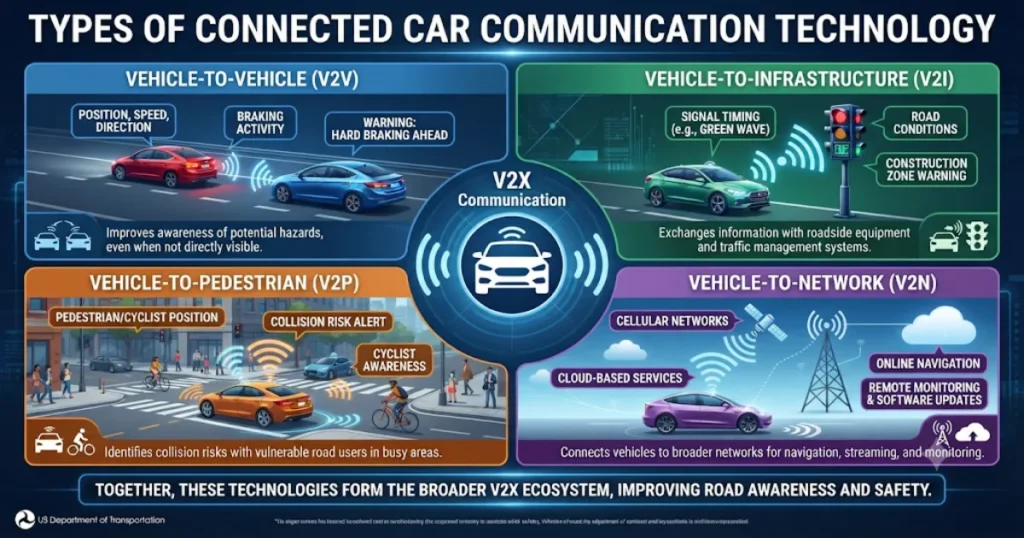 Connected cars use different wireless communication methods depending on the services they need to provide. One of the most important developments in this area is Vehicle-to-Everything (V2X) communication.
V2X allows vehicles to exchange information with other vehicles, infrastructure, pedestrians, and communication networks.
Vehicle-to-Vehicle (V2V)
Vehicle-to-Vehicle communication allows two or more compatible vehicles to exchange information wirelessly.
This information can include vehicle position, speed, direction, and braking activity. For example, if a vehicle ahead suddenly brakes, a connected vehicle may receive a warning about the situation.
The technology can improve awareness of potential hazards, including situations where another vehicle is not directly visible to the driver.
Vehicle-to-Infrastructure (V2I)
Vehicle-to-Infrastructure communication allows vehicles to exchange information with roadside equipment, traffic signals, and other transportation infrastructure.
For example, a compatible traffic signal system could communicate information about signal timing or road conditions. Vehicles may also receive warnings about construction zones, temporary road closures, and approaching hazards.
Vehicle-to-Pedestrian (V2P)
Vehicle-to-Pedestrian communication focuses on exchanging information between vehicles and vulnerable road users, including pedestrians and cyclists.
Compatible devices and systems can help identify potential collision risks and provide warnings. This technology is particularly relevant in busy urban areas where vehicles, cyclists, and pedestrians share limited road space.
Vehicle-to-Network (V2N)
Vehicle-to-Network communication connects vehicles with cellular networks and cloud-based services.
It supports online navigation, streaming services, traffic information, remote vehicle monitoring, and software updates. Many connected-car features that drivers use every day depend on this type of communication.
Together, these technologies form the broader V2X ecosystem. The US Department of Transportation explains that V2X communication can improve road awareness by allowing vehicles and infrastructure to exchange information about surrounding conditions.
Benefits of Connected Car Technology
 Connected car technology offers advantages beyond entertainment and convenience. It can improve vehicle monitoring, support safer driving, and make vehicle ownership easier.
1. Improved Road Safety
One of the most important potential benefits is better awareness of road conditions.
Connected vehicles can receive information about accidents, approaching emergency vehicles, road hazards, traffic congestion, and other potential dangers. V2X communication can also help vehicles identify risks that conventional cameras and sensors might not detect because of limited visibility.
However, these systems are designed to assist drivers rather than replace their attention or guarantee accident prevention.
2. Better Navigation and Traffic Management
Internet-connected navigation systems can use updated traffic information to suggest alternative routes. This can help drivers avoid congestion, road closures, and unexpected delays.
When connected vehicle information is also shared with transportation authorities, it can support better traffic management and more efficient use of road infrastructure.
3. Easier Vehicle Maintenance
Connected diagnostics can help drivers monitor vehicle health and receive maintenance notifications.
Instead of waiting until a minor issue becomes a major problem, owners may receive early alerts about certain vehicle conditions. Some manufacturers also offer remote diagnostic services that allow authorised service centres to review selected vehicle information.
4. Improved Driving Convenience
Remote access, voice commands, digital navigation, smartphone integration, and online entertainment can make everyday journeys more convenient.
For example, a driver can check the vehicle’s location through an app, prepare the cabin temperature before entering, or use voice commands to access supported services without manually operating the infotainment screen.
5. Support for Electric Vehicles
Connectivity is particularly useful in electric vehicles (EVs).
Connected EV systems can provide battery-status information, estimated driving range, charging-station locations, charging progress, and notifications through mobile applications.
Some vehicles can also help drivers identify compatible charging stations and plan routes around charging requirements. The exact functions depend on the vehicle and its connected services.
6. Software Improvements After Purchase
OTA updates allow manufacturers to deliver supported software improvements remotely.
This means a vehicle’s digital systems may receive new functions or improvements without requiring a traditional workshop visit for every software change. It can also help manufacturers address certain software-related issues.
Connected Cars vs Traditional Cars: What Is the Difference?
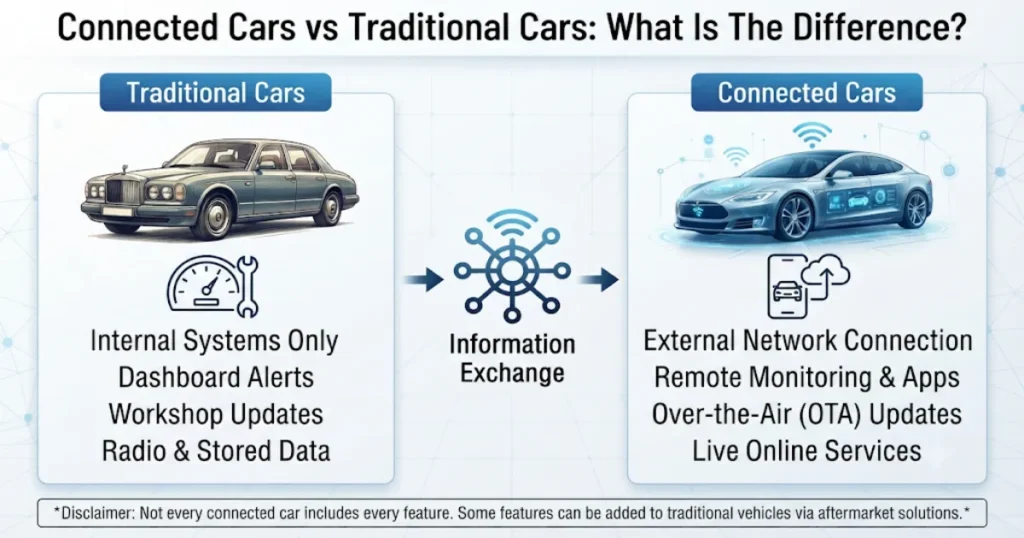 The main difference between a connected car and a traditional car is the ability to exchange information with external networks and devices.
Traditional vehicles can have electronic systems, navigation, sensors, and advanced safety equipment without necessarily having an internet connection. Connected vehicles add communication capabilities that make online services and remote vehicle functions possible.
Feature | Traditional Car | Connected Car |
|---|---|---|
Internet connectivity | Usually unavailable as a built-in feature | Available in supported models |
Navigation | Often uses stored maps | Can offer real-time online updates |
Vehicle monitoring | Mainly through dashboard alerts | May include remote monitoring |
Smartphone access | Limited or basic | Can offer app-based vehicle controls |
Software updates | Often require workshop assistance | Supported updates can arrive OTA |
Traffic information | May rely on radio or stored data | Can use live online traffic services |
Remote access | Usually limited | Available in supported vehicles |
Online entertainment | Limited | Can support internet-based services |
Not every connected car includes every feature listed above. Some conventional vehicles can also receive individual connected services through aftermarket devices or smartphone-based solutions.
Connected Cars vs Autonomous Cars: Are They the Same?
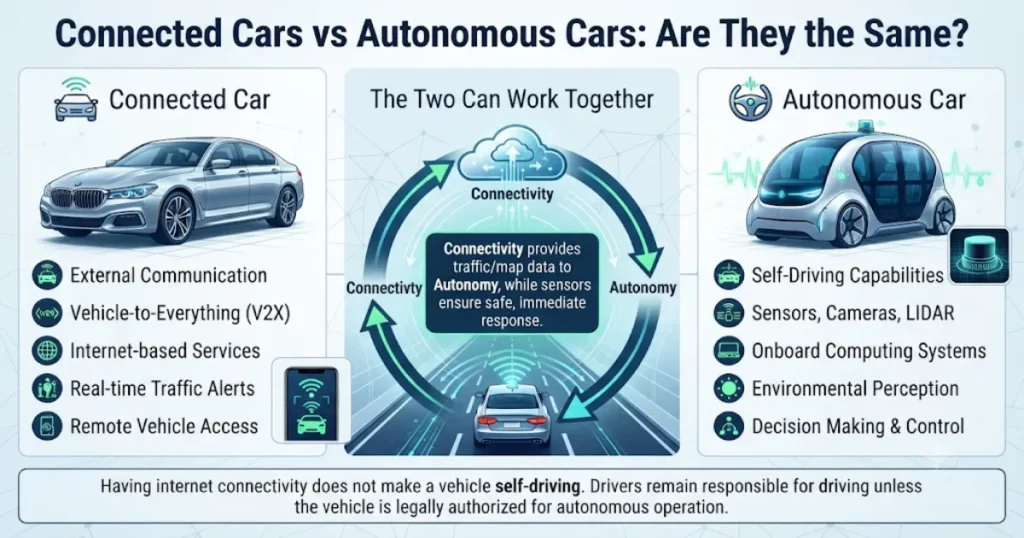 No. Connected cars and autonomous cars are related automotive technologies, but they serve different purposes.
A connected car communicates with external networks, vehicles, infrastructure, or digital devices. An autonomous car uses sensors, cameras, software, and computing systems to perform some or all driving tasks without continuous human control.
For example, a connected car may receive an alert about traffic congestion or a road hazard. An autonomous vehicle, depending on its automation capabilities, may use its sensors and software to respond to its driving environment.
The two technologies can work together. Connectivity may provide additional information to an automated driving system, while onboard sensors and computing systems remain important for detecting and responding to immediate road conditions.
It is also important to understand that having internet connectivity does not make a vehicle self-driving. Drivers must continue to follow the vehicle manufacturer’s instructions and remain responsible for driving unless the vehicle is specifically designed and legally authorised to operate autonomously under the relevant conditions.
What Are the Disadvantages of Connected Cars?
Despite their advantages, connected vehicles also introduce certain concerns. Drivers should understand these limitations before relying heavily on connected services.
Privacy and Personal Data Collection
Connected vehicles may collect different types of information, including location, driving behaviour, vehicle diagnostics, and information about connected devices.
Depending on the manufacturer and the services being used, some information may be transmitted to cloud platforms or shared with authorised service providers.
Drivers should review the vehicle manufacturer’s privacy policy and understand what information is collected, how it is used, and whether certain data-sharing features can be disabled.
Cybersecurity Risks
Internet connectivity creates additional potential entry points for cyberattacks. If vehicle software, communication systems, or connected applications are not adequately protected, attackers may attempt to exploit vulnerabilities.
Automotive cybersecurity is therefore an important responsibility for manufacturers. The US National Highway Traffic Safety Administration (NHTSA) highlights the need for strong cybersecurity protections as vehicle electronics and connectivity become more complex.
Subscription and Connectivity Costs
Some connected-car services are included for a limited period, while others require a paid subscription.
For example, manufacturers may charge separately for premium navigation, remote vehicle functions, Wi-Fi hotspots, or certain online entertainment services.
Drivers should check which features are included in the vehicle’s purchase price and which may require additional payments.
Dependence on Network Availability
Many connected services depend on mobile networks or internet access. If a vehicle travels through an area with poor cellular coverage, certain online features may become unavailable or stop receiving updated information.
Basic driving functions generally do not require a continuous internet connection, but individual connected services may be affected.
Compatibility and Software Limitations
Not all smartphones, applications, vehicles, and communication networks are compatible with one another.
Older vehicles may not support newer connectivity features, while some services may be restricted by the vehicle’s model year, operating system, location, or software version.
Are Connected Cars Safe from Hacking?
Connected cars are designed with security systems to protect communication between vehicle components, external networks, and digital services. However, no internet-connected technology can be considered completely immune to cyber threats.
Potential risks include unauthorised access to connected accounts, exposure of personal information, weaknesses in mobile applications, and vulnerabilities in vehicle communication systems.
Manufacturers use different security measures, including encrypted communications, authentication systems, software updates, and network separation. These protections help reduce risks, but their effectiveness depends on implementation and regular maintenance.
Drivers can also take practical steps to protect their vehicles:
Use strong, unique passwords for manufacturer accounts.
Keep vehicle software and connected applications updated.
Avoid sharing account credentials with others.
Review permissions granted to connected applications.
Remove access for devices or users who no longer need it.
Check the manufacturer’s privacy and security recommendations.
Connected vehicle security is an ongoing responsibility shared by automakers, technology providers, and vehicle owners.
What Should You Check Before Buying a Connected Car?
If you are planning to purchase a connected vehicle, do not focus only on the infotainment screen or the number of digital features. The quality and availability of connectivity services are equally important.
Here are some important things to consider:
Built-in connectivity: Check whether the vehicle has an embedded SIM or relies on a paired smartphone for internet access.
Supported features: Find out whether the vehicle offers remote locking, live navigation, vehicle tracking, emergency assistance, and remote diagnostics.
Subscription requirements: Ask the dealer whether connected services are free, available for a trial period, or require monthly or annual payments.
Smartphone compatibility: Check whether the infotainment system supports Apple CarPlay, Android Auto, or the manufacturer’s own mobile application.
Software update policy: Understand how frequently the manufacturer provides software updates and whether they can be installed remotely.
Privacy protection: Review the manufacturer’s data collection policy and understand how vehicle information is stored and shared.
Network availability: Check whether the vehicle’s connectivity services work reliably in the areas where you normally drive.
For buyers in India, it is particularly important to confirm which connected features are available in the Indian-market version of a vehicle. Features offered in international models may not necessarily be available locally.
The Future of Connected Car Technology
Connected car technology is expected to become increasingly important as vehicles become more software-driven and transportation systems adopt digital communication.
One major development is the expansion of 5G connectivity. Faster mobile networks and improved communication capabilities can support connected services that require the exchange of large amounts of information with low delays.
Another important development is the growth of V2X technology. As more compatible vehicles and roadside systems become available, communication between cars, traffic signals, pedestrians, and road infrastructure could improve traffic awareness and support road safety.
Artificial intelligence is also expected to play a growing role. AI-powered systems can help analyse vehicle information, identify patterns, improve predictive maintenance, and personalise certain driving and infotainment services.
Electric vehicles will also benefit from improved connectivity. Battery monitoring, intelligent charging, charging-station availability, and route planning can make electric vehicle ownership more convenient.
Over-the-air updates are another important part of this development. Automakers are increasingly treating vehicles as software-enabled products that can receive improvements throughout their operating life.
However, the expansion of connected technology will also make data privacy, cybersecurity, network reliability, and software support increasingly important considerations.
Frequently Asked Questions About Connected Cars
1. What is a connected car in simple words?
A connected car is a vehicle that uses internet connectivity and wireless communication technology to exchange information with external networks, smartphones, cloud services, other vehicles, or roadside infrastructure. It can offer features such as live navigation, remote vehicle access, online entertainment, and vehicle monitoring.
2. Does a connected car need the internet to work?
Not all vehicle functions require an internet connection. Basic driving functions, including steering, braking, and acceleration, generally operate independently of online services. However, features such as live traffic updates, online navigation, remote access, and cloud-based services may require internet connectivity.
3. What is the difference between a connected car and a smart car?
The terms are sometimes used interchangeably, but they are not necessarily identical. A connected car specifically refers to a vehicle with communication capabilities that allow it to exchange information with external networks and devices. A smart car is a broader term that may also include advanced driver-assistance systems, automation, intelligent sensors, and other digital technologies.
4. Can I make my existing car a connected car?
Yes, some connected features can be added to older vehicles through aftermarket GPS trackers, OBD-II devices, smartphone applications, and compatible infotainment systems. However, these solutions generally cannot provide every feature available in a vehicle with factory-installed connectivity hardware.
5. Do connected cars track their owners?
Some connected vehicles collect location and vehicle usage information to provide navigation, remote monitoring, security, and other services. The type of information collected and how it is used depend on the manufacturer, connected services, and privacy settings.
6. Are connected cars more expensive to maintain?
Not necessarily. Connectivity itself does not automatically increase routine maintenance costs. However, certain connected services may require subscriptions, and vehicles with more complex electronic systems can involve additional diagnostic or repair costs if components fail.
7. Is Apple CarPlay the same as connected car technology?
No. Apple CarPlay is a smartphone integration system that allows compatible iPhones to connect with a vehicle’s infotainment display. Connected car technology is broader and can include built-in cellular connectivity, remote vehicle monitoring, OTA updates, telematics, and V2X communication.
8. Are connected cars the same as electric cars?
No. A connected car can use a petrol, diesel, hybrid, or electric powertrain. Connectivity refers to the vehicle’s communication capabilities, whereas an electric car uses an electric motor and battery-based powertrain.
Final Verdict: Are Connected Cars Worth It?
Connected cars represent an important development in the automotive industry. By combining internet connectivity, onboard sensors, cloud platforms, and wireless communication, they offer features that can make driving more convenient and improve how owners monitor and manage their vehicles.
Real-time navigation, remote vehicle access, vehicle diagnostics, emergency assistance, and software updates are already useful features in many modern vehicles. Meanwhile, V2X communication could contribute to better road awareness and traffic management as the technology becomes more widely available.
However, buyers should also consider subscription costs, network availability, data privacy, and cybersecurity before choosing a connected vehicle.
Ultimately, connected car technology is not simply about putting an internet connection inside a vehicle. It is about creating a communication system that connects the car with its driver, surrounding environment, and the wider transportation network.