
 Find out whether the extra seats justify the higher price, reduced cargo space and potential fuel costs—or if a two-row SUV makes more sense for your family.
A three-row SUV sounds like a smart choice when you occasionally need extra seats. Family visits, school carpools and weekend trips can suddenly turn five-seat capacity into a limitation. But what happens during the other 95% of your driving, when those extra seats remain empty?
That is the real question behind buying a three-row SUV. You might gain room for seven or eight passengers, but you could also sacrifice everyday cargo space, deal with a larger vehicle and spend more on fuel than you would with a smaller alternative. The price difference, however, is not always as large as you might expect.
So, is a three-row SUV worth it if you rarely use the third row? The answer depends on how often you need the extra seats, what you carry in the vehicle and whether a two-row SUV or occasional rental would serve you better. Here’s how cargo capacity, purchase prices, fuel economy and towing compare, along with a practical way to make the decision.
Future of Mobility: 7 Technologies That Could Change How We Travel
New Cars to Watch in 2026: 7 Launches That Matter in India
Is a Three-Row SUV Worth It? The Short Answer
A three-row SUV can be worth buying if you regularly transport six or more people, expect your family to grow or need one vehicle that can handle both everyday driving and occasional group trips.
If you rarely carry more than five people, a two-row SUV may be the more practical choice. You can often get more usable cargo room behind the rear seats without paying for a seating arrangement you seldom need. A compact SUV may make even more sense if lower running costs and easier parking are priorities.
The biggest trade-off is not necessarily the purchase price. It is how well the vehicle fits your normal routine. With the third row upright, some SUVs leave surprisingly little room for luggage, groceries and family gear. With the seats folded, however, certain three-row models offer generous cargo capacity.
What Does a Third Row Cost You in Cargo Space?
The most useful cargo measurement is the space available behind the third row with every seat in use. Maximum cargo capacity tells you how much room you get after folding seats, but that number does not help much when all your passengers need to sit in the vehicle.
The following 2026 model figures were supplied from Edmunds specifications. They should be checked against the current specifications for the exact trim before publication.
| Model | Seating | Cargo with all seats in place | Maximum cargo |
|---|---|---|---|
| Volkswagen Atlas | 7 | 20.6 cu. ft. | 96.6 cu. ft. |
| Volkswagen Atlas Cross Sport | 5 | 40.3 cu. ft. | 77.6 cu. ft. |
| Honda Pilot | 8 | 18.6 cu. ft. | 86.5 cu. ft. |
| Honda Passport | 5 | 44.0 cu. ft. | 83.2 cu. ft. |
| Toyota Highlander | 7 | 16.0 cu. ft. | 84.3 cu. ft. |
| Toyota Grand Highlander | 7 | 20.6 cu. ft. | 97.5 cu. ft. |
| Toyota RAV4 | 5 | 37.8 cu. ft. | 70.4 cu. ft. |
The difference becomes clear when you compare the Volkswagen Atlas with the two-row Atlas Cross Sport. With all seats in place, the Atlas offers 20.6 cubic feet of cargo space, compared with 40.3 cubic feet in the Cross Sport. The Honda comparison shows a similar pattern: the Pilot offers 18.6 cubic feet behind its third row, while the Passport lists 44.0 cubic feet behind its rear seats.
That difference can matter more than the extra seats themselves. A stroller, several suitcases and a week’s worth of groceries can quickly fill the available space when the third row is upright. If you regularly carry passengers and luggage together, check the actual cargo area before deciding.
There is another side to the comparison. Fold the third row down and some three-row SUVs offer more maximum cargo space than their two-row counterparts. The Atlas lists 96.6 cubic feet at maximum capacity, compared with 77.6 cubic feet for the Atlas Cross Sport. The Pilot also lists slightly more maximum cargo room than the Passport.
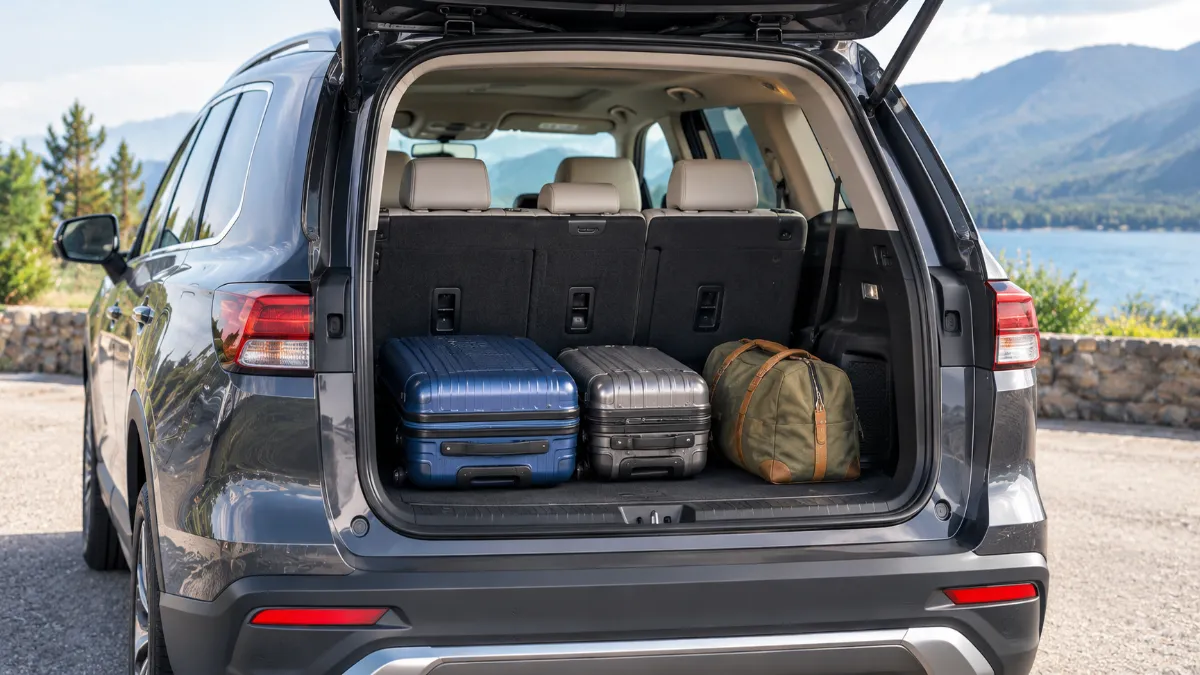
In other words, a third row does not automatically mean less maximum cargo capacity. The real compromise appears when you need every seat and enough space for your belongings at the same time.
Does a Three-Row SUV Cost More to Buy and Run?
Not always by a significant amount. The difference depends on the models and trims you compare, which is why buyers should look at actual prices rather than assume that a two-row SUV will always be cheaper.
The supplied Edmunds figures for selected 2026 models illustrate the point.
| Model | Starting price listed | Combined fuel economy |
|---|---|---|
| Volkswagen Atlas, three-row | $39,310 | 21 mpg |
| Volkswagen Atlas Cross Sport, two-row | $38,300 | 22 mpg |
| Honda Pilot, three-row | $42,395 | 21 mpg |
| Honda Passport, two-row | $44,950 | 20 mpg |
Source: Figures supplied from Edmunds listings. Prices, trim designations and EPA ratings should be verified before publication.
In this Volkswagen comparison, the three-row Atlas costs about $1,010 more than the Atlas Cross Sport and has a combined fuel-economy rating that is 1 mpg lower. The Honda comparison runs in the opposite direction: the Passport’s listed starting price is higher than the Pilot’s, and its combined fuel economy is slightly lower.
These examples show why removing a row of seats does not guarantee a lower purchase price or better fuel economy. Engine choices, standard equipment, vehicle size and trim levels can all affect the result.
There is also a wide range of prices within the three-row SUV category. The supplied Kelley Blue Book rankings list the 2026 Kia Sorento at $33,885, the Toyota Grand Highlander at $43,355 and the Toyota Highlander at $47,365, with some full-size models costing considerably more.
Fuel economy varies just as much. The supplied KBB figures list the Kia Sorento at 26 mpg combined, while the Honda Pilot and Kia Telluride are listed at 22 mpg. These numbers are not a substitute for comparing equivalent powertrains and trims, but they demonstrate that three-row SUVs are not all equally expensive to run.
Before buying, compare the purchase price, insurance quotes, fuel costs and expected maintenance for the specific vehicles on your shortlist. A small difference in advertised fuel economy may matter less than a large difference in how much you drive each year.
What About Towing?
If you tow a small boat or trailer, the third row may not be the deciding factor. The supplied Edmunds figures list towing capacities of up to 5,000 pounds for the Volkswagen Atlas, Atlas Cross Sport, Honda Pilot, Honda Passport, Toyota Highlander and Toyota Grand Highlander.
In the examples provided, the two-row and three-row Volkswagen and Honda models have matching listed capacities. That means choosing the two-row version does not necessarily mean giving up towing capability.
The compact Toyota RAV4 is listed at up to 3,500 pounds in the supplied comparison. That may be sufficient for some smaller trailers, but towing capacity varies by configuration and equipment.
Always confirm the rating for the exact vehicle you intend to buy. Check the trailer’s loaded weight, passengers, cargo and any applicable tongue-weight limits rather than relying on a model’s maximum advertised towing figure alone.
When a Compact SUV Makes More Sense
For shoppers who rarely need extra seats, changing vehicle size may produce a more noticeable difference than choosing between two-row and three-row versions of a similar SUV.
The supplied Edmunds figures list the 2026 Toyota RAV4’s lowest-priced trim at $31,900, with seating for five and 37.8 cubic feet of cargo space behind the seats. The cited listing also gives a combined fuel-economy figure of 41 mpg. Because that figure depends on the vehicle version, verify the applicable powertrain and rating before comparing it with another model.
A compact SUV can be a sensible fit for a household that usually carries two adults, two children and their everyday belongings. A smaller vehicle may be easier to park and could reduce fuel expenses, depending on the models being compared.
The trade-off appears when you genuinely need to carry seven people. A compact SUV cannot solve that problem simply by folding its rear seats differently. You would need another vehicle, a rental or a different travel arrangement.
That is why the best comparison is not simply three rows versus two. It is the cost and practicality of your everyday vehicle versus the cost of arranging extra seating on the few occasions you need it.
A Simple Way to Decide
Before paying for a third row, look at how you actually use your vehicle rather than how you imagine using it.
Start with the last 12 months. Count the trips when you genuinely needed more than five seats. Include carpools, family visits and holidays, but distinguish between trips when extra seats were essential and those when another arrangement would have worked.
Consider the next three to five years. A growing family, regular school carpools or relatives who frequently travel with you can make additional seating more valuable. If your household’s needs are unlikely to change, buying a larger vehicle may be harder to justify.
Compare the cost of occasional alternatives. Get rental quotes for the types of trips that require extra seats. Compare the total cost with the price difference, fuel expenses and other ownership costs of the larger SUV. The result will depend on local rental rates and how far you travel.
Check cargo space with the third row raised. Do not rely on maximum cargo figures alone. Bring the stroller, luggage or sports equipment you regularly carry and see whether everything fits when all passengers are seated.
Think about daily convenience. A larger SUV may be harder to park or manoeuvre in tight spaces. Test the vehicle on roads and in parking situations similar to the ones you encounter every week.
As a practical rule of thumb, needing the extra seats monthly is a stronger reason to buy a three-row SUV than needing them once or twice a year. This is a decision-making guideline, not a universal financial threshold. Your family size, budget and access to rental vehicles can change the answer.
When a Three-Row SUV Is Worth It
A three-row SUV is easier to justify when the additional seating solves a recurring problem. Larger families, regular carpools and households that frequently transport visiting relatives are the clearest examples.
It can also make sense if you need to carry passengers and tow a trailer on the same trip, provided the particular vehicle has the appropriate towing capacity. Some buyers may prefer having the flexibility of extra seats rather than arranging separate transport whenever more than five people need to travel.
Long-term plans matter, too. If you expect your family or regular passenger group to grow, buying a suitable vehicle now could be more practical than replacing it later.
The important point is to pay for useful flexibility, not simply for the largest seating capacity available.
When a Three-Row SUV Probably Isn’t Worth It
If you almost always carry five people or fewer, a third row may add little practical value. You might be better served by a two-row SUV that offers generous cargo room behind the seats.
The case for a smaller vehicle becomes stronger if you regularly drive in crowded cities, deal with tight parking spaces or prioritize fuel economy. If you rarely use the third row and do not need the larger vehicle’s other capabilities, the extra size may not justify its place in your driveway.
There is one more consideration: passenger comfort. A third row that works for children on short trips may not be comfortable for adults on longer journeys. Seating capacity on a specification sheet does not guarantee that every passenger will have enough legroom or easy access.
Test the Third Row Before You Buy
Specifications help narrow your choices, but they cannot tell you everything about comfort and everyday usability. Before buying, test the actual vehicle with your family and the belongings you regularly carry.
Check access. Move the second-row seats and see how easily passengers can enter and leave the third row.
Sit in the back. If adults might use the third row, sit there yourself with the second row adjusted for a normal passenger.
Raise and fold the seats. Make sure the mechanism is easy enough to use regularly, not just once in the showroom.
Inspect the safety equipment. Review the manufacturer’s specifications for seat belts, head restraints and applicable airbag coverage. Check the vehicle’s owner information for seating and child-restraint guidance.
Bring your usual cargo. Test the available room with the third row raised and with it folded.
If the vehicle is intended for long family journeys, take a proper test drive. A third row that feels cramped or awkward to access can quickly become less useful than you expected.
Alternatives to Buying a Three-Row SUV
You have several options if extra seating is only an occasional requirement.
A two-row midsize SUV can provide more cargo space behind the rear seats while retaining a relatively substantial vehicle and, in some models, strong towing capability. The Volkswagen Atlas Cross Sport and Honda Passport are examples from the comparisons above.
A compact SUV may suit a smaller household that values everyday practicality, lower purchase costs and fuel economy more than occasional passenger capacity.
A rental vehicle can be worth considering for the few weekends each year when you need seven seats. Compare realistic rental prices, availability and insurance costs in your area before deciding whether this approach saves money.
A minivan is another option for families that regularly carry several passengers and their belongings. Sliding doors and a passenger-focused interior may suit some households better than an SUV, although the right choice depends on the models and prices available to you.
Frequently Asked Questions
Is a three-row SUV worth it if I only need the third row a few times a year?
Often, a two-row SUV plus an occasional rental is worth considering if the extra seats are rarely essential. Compare the actual cost of those trips with the daily ownership costs and practical disadvantages of a larger vehicle before deciding.
How much cargo space do you lose with a third row?
It depends on the model. In the supplied figures, the Volkswagen Atlas has 20.6 cubic feet behind the third row, compared with 40.3 cubic feet behind the rear seats of the two-row Atlas Cross Sport. The Honda Pilot lists 18.6 cubic feet, compared with 44.0 cubic feet for the Passport.
Is a two-row SUV always cheaper than a three-row SUV?
No. The listed starting price for the Volkswagen Atlas Cross Sport is lower than that of the Atlas, but the supplied Honda Passport price is higher than the Pilot’s. Compare current prices for equivalent trims rather than assuming that fewer seats automatically mean a lower price.
Do three-row SUVs get worse fuel economy?
Not always. In the supplied figures, the Volkswagen Atlas is rated at 21 mpg combined compared with 22 mpg for the Atlas Cross Sport. The Honda Pilot is listed at 21 mpg, while the Passport is listed at 20 mpg. Ratings depend on the powertrain, model year and configuration.
Can a two-row SUV tow as much as a three-row SUV?
Yes, in some cases. The supplied comparison lists up to 5,000 pounds for both the Volkswagen Atlas Cross Sport and Honda Passport, matching their respective three-row counterparts. Always check the rating for the exact configuration you plan to purchase.
Are third-row seats comfortable for adults?
Comfort varies considerably by model. Check legroom, headroom, access and seat position in person, especially if adults will use the seats for more than short trips.
What is the cheapest three-row SUV?
The supplied Kelley Blue Book ranking lists the 2026 Kia Sorento at a starting price of $33,885. This is a historical snapshot from the figures used for this article, not a guarantee of the current lowest price. Check current listings and trim availability before buying.
Should I keep the third row folded when I am not using it?
Usually, folding the third row gives you more cargo space. Whether the seats fold easily and create a flat load floor depends on the vehicle. Remember that folding the seats does not eliminate the vehicle’s overall size or weight.
The Bottom Line
Is a three-row SUV worth it if you rarely use the third row? It can be, but only when the flexibility is valuable enough to justify the everyday trade-offs.
The biggest compromise may be cargo space when all seats are occupied, rather than a dramatic difference in purchase price. Some three-row SUVs cost only slightly more than their two-row counterparts, and some even have lower listed starting prices than the alternatives being compared. Fuel economy and towing capability also depend on the individual models.
If you regularly carry six or more people, expect your needs to grow or need extra seating alongside towing capability, a three-row SUV may be the right choice. If you need those seats only once or twice a year, a two-row midsize SUV, a compact SUV or an occasional rental may be more practical.
Before buying, count how often you genuinely need the extra seats, compare current specifications and prices, and test the cargo area with your normal gear. The best SUV is not the one with the most seats. It is the one that fits the way you actually drive.