
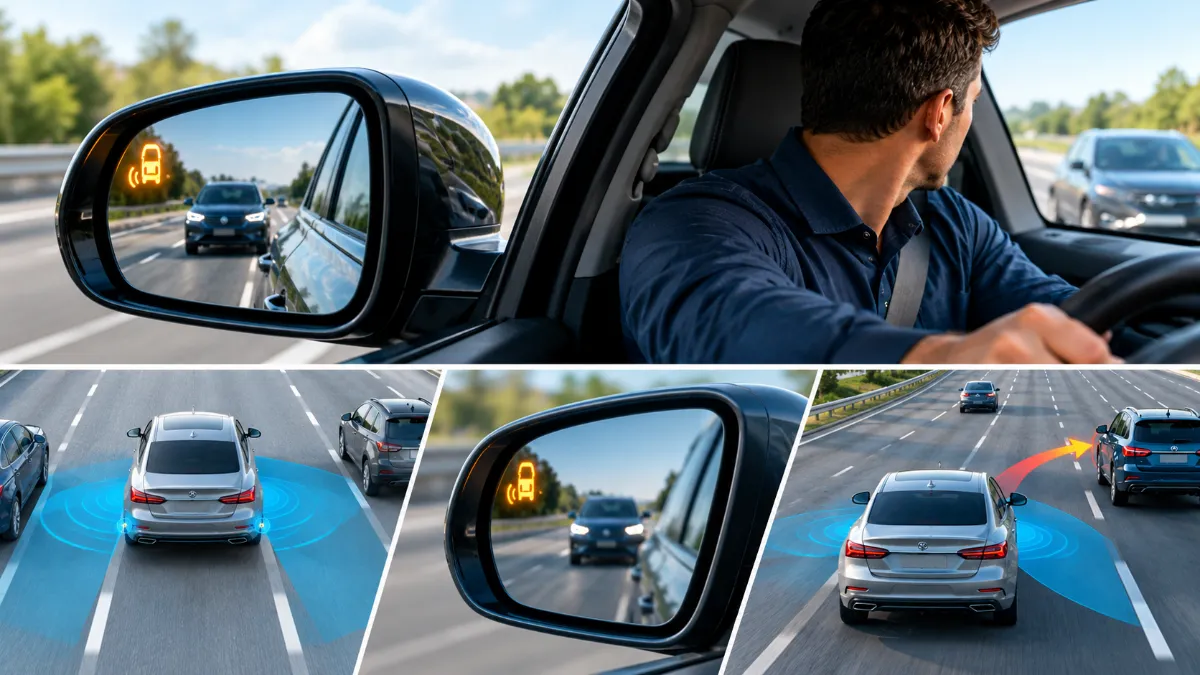
 How the names, alerts and automatic braking differ in blind spot monitoring vs blind spot warning
Shop for a new car in the United States and you will run into a small tangle of names. One brochure lists “Blind Spot Monitor.” Another says “Blind Spot Warning.” A third, from a different brand, uses “Blind Spot Information System” or “Blind-Spot Collision-Avoidance Assist.” They all promise to help with the same problem, which is the car you cannot see in the lane next to you.
So are they the same thing? Mostly, yes. In everyday use, blind spot monitoring and blind spot warning describe the same hardware doing the same basic job: sensing a vehicle beside or behind you and lighting up an alert. The difference that matters is not monitoring versus warning. It is between systems that only warn you and systems that also act on their own. This guide explains where the terms overlap, where they split, how the technology works, what the research says about its effect on crashes, and what to check before you buy.
Future of Mobility: 7 Technologies That Could Change How We Travel
The Cars and Motorcycles That Became Automotive Legends
Blind Spot Monitoring vs Blind Spot Warning: The Short Answer
Think of “monitoring” as describing what the system does all the time, and “warning” as describing what it does when it finds something. A blind spot monitor watches the zones beside and behind your car. When it detects a vehicle there, it issues a warning. Same system, two words for two stages of the job.
Published sources reflect that overlap. A Kelley Blue Book guide to the technology uses “blind-spot monitoring,” “blind-spot monitor” and “blind-spot warning” for the alert-only version, and it treats a system that can also steer or brake as a different, more advanced type. NHTSA’s consumer guide to driver assistance uses yet another label, “Blind Spot Detection,” and describes it simply as a feature that “warns you of a vehicle in your blind spot.”
So the honest answer is that the words are often interchangeable in marketing and conversation, but they are not defined by any single industry rulebook that every automaker follows. That is why the exact name on a window sticker tells you less than what the system actually does.
Where the Terms Come From
The technology is older than the confusion. KBB reports that Volvo introduced its Blind Spot Information System, known as BLIS, on the S80 in 2005. Since then nearly every major brand has built its own version, and each one picked its own name.
Here are some of the names you will see on US models, taken from manufacturer documentation:
| Automaker | Name used | What the documentation describes |
|---|---|---|
| Toyota | Blind Spot Monitor (BSM) | Rear-bumper radar, mirror indicator that flashes if you signal toward a vehicle |
| Honda | Blind Spot Information System | Rear-bumper millimeter-wave radar, mirror indicator, flashing and audible warnings when you signal |
| Ford | Blind Spot Information System (BLIS) | Offered on select vehicles; features vary by model year, trim and package |
| Hyundai | Blind-Spot Collision-Avoidance Assist | Warning while driving, plus braking help when exiting a parallel space |
| Volvo | BLIS | The original name for the technology, introduced on the S80 in 2005 |
Notice that two of those, Toyota and Honda, describe nearly identical behavior under different words. “Monitor” and “information system” are brand choices, not engineering categories.
How the Technology Works
Most blind spot systems rely on radar sensors hidden in the rear bumper corners. KBB explains that early systems used radar or ultrasonic sensors on each side of the rear bumper, and newer ones may add side-mounted cameras. A system needs at least two sensing units, one per side. Toyota’s owner’s manual says its monitor “uses rear side radar sensors installed on the inner side of the rear bumper on the left and right side.” Honda’s engineering page describes millimeter-wave radars inside the rear bumper that detect vehicles diagonally behind the car.
What the Detection Zone Looks Like
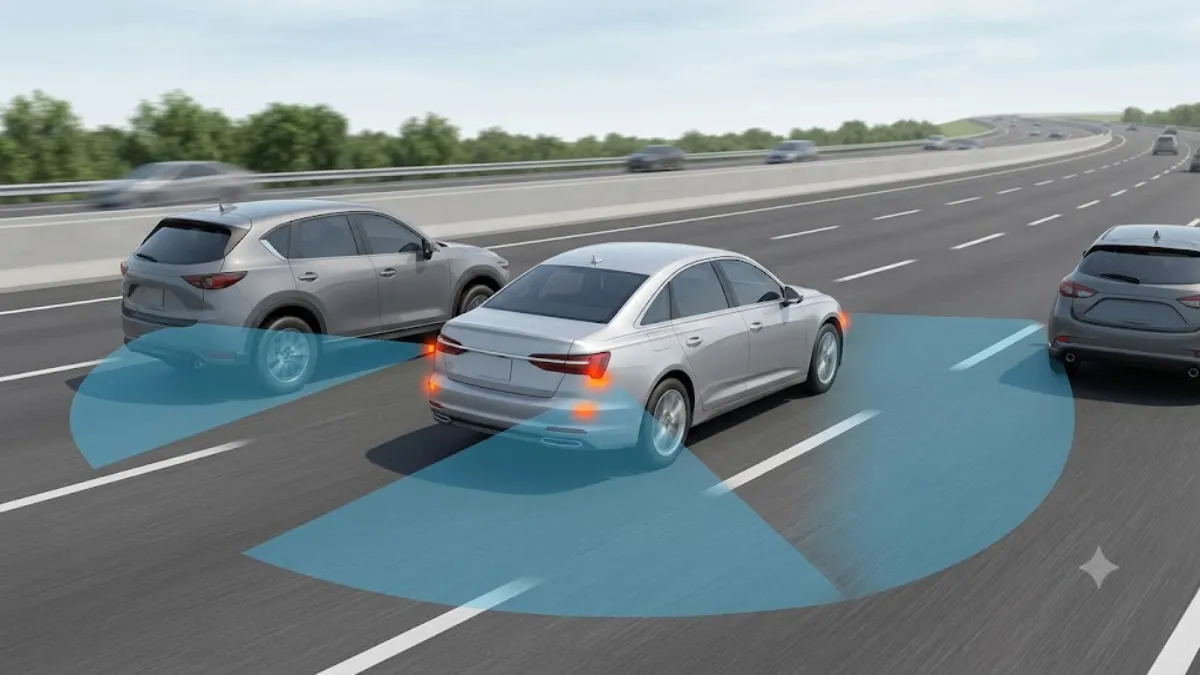
Toyota’s manual gives unusually specific numbers for its system, which show how much ground it covers and how much it leaves out:
- Detection runs from about 1.6 feet to 11.5 feet from either side of the vehicle. The strip closer than 1.6 feet cannot be detected.
- It reaches about 3.3 feet ahead of the rear bumper.
- It extends from about 9.8 feet to 197 feet behind the bumper, and faster-approaching vehicles may be detected farther back.
- It works when the vehicle is moving faster than roughly 6 mph and the car is not in reverse.
Other brands set different limits. Hyundai’s manual says its blind-spot warning needs your speed to be above 12 mph and the vehicle in your blind spot to be moving above 7 mph.
What the Alert Looks Like
The usual alert is a light in or near the outside mirror on the side where a vehicle is detected. KBB says this is typically a yellow light, though it can appear on the A-pillar, the driver display or a head-up display. A second stage typically triggers when you signal toward an occupied lane. Toyota says the indicator flashes in that case. Honda says the indicator flashes and warning sounds play. Hyundai says the mirror light blinks and an audible warning sounds when you signal toward a detected vehicle, and that turning off the signal cancels the warning.
The Real Dividing Line: Warning vs Intervention
If there is a distinction worth learning, this is it. Some systems only tell you something is there. Others will take action to keep you out of trouble.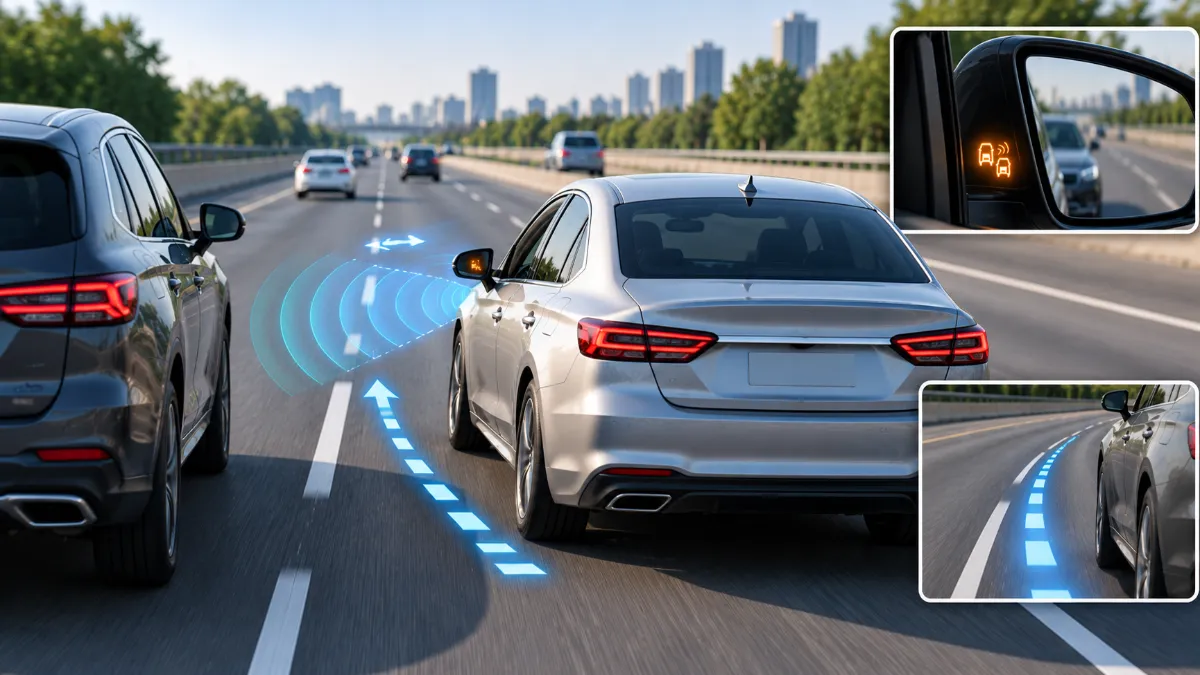
Honda’s engineering page describes only driver warnings, with no automatic braking or steering. Toyota’s manual describes an indicator and a signal-linked flash. These are alert-only systems.
Hyundai’s Blind-Spot Collision-Avoidance Assist is a step further. Its owner’s manual describes a warning mode while driving and an assist mode when the car is moving very slowly, below 2 mph, such as when pulling out of a parallel parking space. In that mode, the mirror light blinks, a message appears on the instrument cluster, an audible warning sounds, the steering wheel vibrates, and “emergency braking will be assisted to help prevent collision” with a vehicle in the blind spot. The manual page describes braking help only. It does not describe automatic steering.
KBB also describes more advanced “blind-spot warning with automatic emergency steering” systems that can nudge the car away from the lane marker or steer it back toward the lane center, by applying steering or brake pressure.
How NHTSA Uses the Terms
The federal government has begun to formalize the distinction. In its final decision on updating the New Car Assessment Program (NCAP), NHTSA added blind spot warning (BSW) and blind spot intervention (BSI) to its crash avoidance program, with the decisions effective for the 2026 model year.
Here is how the notice describes the two:
- BSW must issue a visual warning in the side mirror or A-pillar within a specified time. When the turn signal is on, it must add another warning mode or escalate the visual warning, for example from steady to flashing.
- BSI must prevent any contact between the test car and the other vehicle, and it must not cause a secondary departure on the opposite side of the lane. In false-alarm tests, it must not intervene.
The notice does not give a formal definition of either term. It describes what each system must do to pass. Testing is detailed: BSW has 20 tests in total, all of which must be passed, using a real mid-size passenger car as the other vehicle and speeds starting at 45 mph. BSI has 12 tests, using a specialized test target.
There is one more complication. Honda’s name for its feature uses the same initials, BSI, that NHTSA uses for “blind spot intervention.” The two are not the same thing. Honda’s page describes a warning system, while NHTSA’s BSI is an intervening system. If you see “BSI” in a spec sheet, read what it does rather than assuming.
Does Blind Spot Detection Actually Prevent Crashes?
Research suggests it helps, though the effect is modest and depends on the driver. In a 2017 study, the Insurance Institute for Highway Safety (IIHS) analyzed police-reported crashes involving vehicles from Fiat Chrysler, General Motors, Honda, Mazda, Mercedes-Benz and Volvo. Controlling for factors that affect crash risk, researchers found:
- The rate of lane-change crashes was 14% lower for vehicles with blind spot detection. That result was statistically significant.
- The rate of injury lane-change crashes was 23% lower. IIHS said this result was not statistically significant, though it moved in the expected direction for five of the six manufacturers.
IIHS noted that the system only provides information. The driver must still pay attention and act on it. The institute’s estimate of about 50,000 prevented crashes a year assumes every passenger vehicle has a system this effective, which is not the case today.
That study is from 2017, and the systems have changed since. Treat the percentages as evidence that the technology works as a safety aid, not as a guarantee for any specific car.
What These Systems Cannot Do
Every automaker is clear that blind spot systems are supplements, not replacements for your own checks. Toyota’s manual says, “Do not overly rely on the Blind Spot Monitor.” NHTSA’s guide notes that driver assistance technologies do not drive the car and that a human driver is still needed. Ford’s support page says driver-assist features “are supplemental and do not replace the driver’s attention, judgment” and sends readers to the owner’s manual for limitations.
The limitations lists in owner’s manuals are worth reading once. Between them they cover the following.
Things the sensors may miss. Toyota says its monitor is not designed to detect small motorcycles, bicycles and pedestrians, vehicles traveling in the opposite direction, following vehicles in the same lane, or vehicles two lanes away. Hyundai’s manual lists motorcycles and bicycles, low vehicles such as sports cars, flat trailers, large vehicles such as buses and trucks, pedestrians, animals, shopping carts and strollers among the objects it may not detect properly.
Conditions that degrade performance.
- Mud, snow, ice or stickers covering a sensor.
- Heavy rain, snow or fog.
- Bumper stickers, bumper guards or bike racks near the radar, which Hyundai lists specifically.
- A damaged bumper or a misaligned sensor after an impact.
- Towing a trailer. Hyundai’s manual says to turn the system off when towing.
- The first few seconds after the system starts up. Hyundai’s manual puts this at about three seconds.
Road layouts that confuse it. Hyundai’s manual says highway ramps, curves, inclines, merging lanes, and fixed objects close to the car, such as guardrails, walls, barriers and tunnels, can limit performance. It also warns that on narrow roads the system may alert on vehicles two lanes over, and on wide roads it may miss vehicles in the next lane.
Speed limits. None of these systems work at all speeds. Toyota’s threshold is roughly 6 mph, and Hyundai’s warning thresholds are higher at 12 mph for the basic alert and 25 mph for the signal-linked warning.
Related Systems That Get Mixed Up
Blind spot systems share sensors and screens with several other features, which adds to the confusion.
- Rear cross-traffic alert. KBB says it uses the same sensing tools but is a separate function that activates in reverse. It warns you about traffic crossing behind the car when you back out of a space.
- Lane departure warning. Alerts you when you drift out of your lane. NHTSA lists it alongside blind spot detection under “navigating lanes safely.” In the IIHS study, lane departure warning lowered the rate of relevant crashes by 11% and injury crashes by 21%.
- Lane keeping and lane centering assist. These actively steer to keep you in the lane, which is different from warning you about a vehicle beside you.
If a trim package advertises “blind spot monitoring with rear cross-traffic alert,” that is two features sharing hardware. Make sure you know which one you are getting.
A Practical Buying Checklist
You do not need to memorize the vocabulary. You need to ask the right questions at the dealership, and you should confirm the answers in the owner’s manual, not only from a salesperson.
- What does it do when it detects a car? A mirror light only, or also a chime or steering vibration?
- Does it intervene? If the answer is “assist” or “intervention,” find out whether it brakes, steers or both, and at what speeds.
- At what speed does it start working? Thresholds like 6 mph or 12 mph matter in stop-and-go traffic.
- Is it standard or part of a package? Ford’s own support page says features vary by model year, trim, options and packages, so the same model can come with or without it.
- How does it handle towing? If you tow, ask whether it needs to be switched off and whether the manufacturer offers trailer coverage.
- Can you see the indicator in sunlight? Toyota notes the mirror indicator may be hard to see in strong sunlight.
- Does the car have rear cross-traffic alert? It often comes bundled but is not the same thing.
During a test drive, change lanes on a highway with a safe gap and watch how the mirror indicator behaves. Then signal toward an occupied lane with another car beside you, and note how clearly the second-stage alert comes through.
Using Blind Spot Alerts Wisely
A few habits get the most from the technology.
- Set your mirrors properly. KBB advises aiming mirrors correctly and checking with your own eyes before reversing. The sensors back up the mirror, not the other way around.
- Keep sensors clean. Wipe the bumper corners in winter weather, when snow and road grime build up.
- Do not add accessories near the sensors. Stickers, bumper guards and bike racks can interfere with radar, according to Hyundai’s manual.
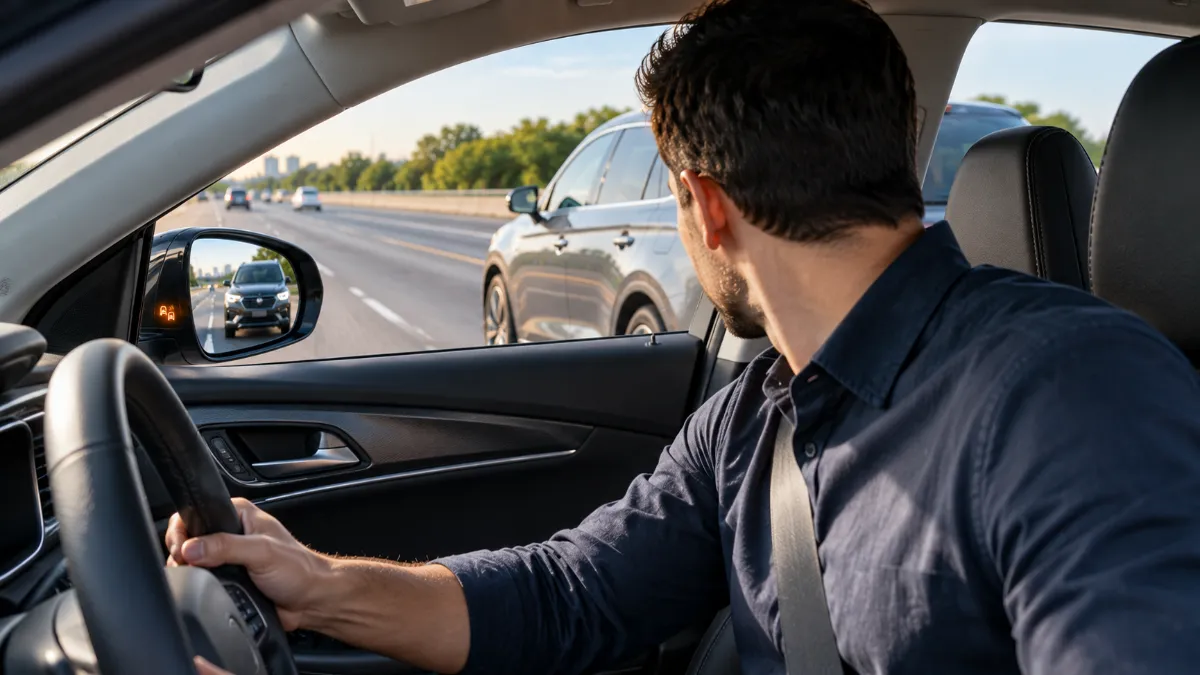
- Still turn your head. A shoulder check catches cyclists, motorcyclists and pedestrians, which several manuals say the system may not reliably detect.
- Know what a warning light is telling you. If the system displays a fault, treat the car as if it has no blind spot protection and have it inspected.
Frequently Asked Questions
Is blind spot monitoring the same as blind spot warning?
In most cases, yes. Both terms usually describe a system that senses vehicles in your blind spot and alerts you. Automakers use different names, and no single industry definition applies to all of them. The more important question is whether the system only warns you or also intervenes.
What is the difference between blind spot warning and blind spot intervention?
NHTSA’s updated New Car Assessment Program separates them. Blind spot warning gives the driver a visual alert, escalating when the turn signal is on. Blind spot intervention must act to prevent contact with the other vehicle without causing a secondary departure on the other side of the lane.
Does blind spot monitoring work at all speeds?
No. Toyota’s manual says its monitor operates above roughly 6 mph. Hyundai’s manual lists a 12 mph minimum for its warning and about 25 mph for the signal-linked warning. Check your own manual.
Can blind spot monitors detect motorcycles and bicycles?
Not reliably. Toyota says its monitor is not designed to detect small motorcycles, bicycles and pedestrians. Hyundai lists motorcycles and bicycles among objects it may not detect properly. Always check over your shoulder.
Does blind spot detection reduce crashes?
An IIHS study from 2017 found a 14% lower rate of lane-change crashes for vehicles with blind spot detection, a statistically significant result. It also found a 23% lower rate of injury lane-change crashes, which was not statistically significant.
Should I turn blind spot monitoring off when towing a trailer?
Check your owner’s manual. Hyundai’s manual says to turn the system off when towing a trailer or another vehicle. Ford offers a version it calls BLIS with trailer coverage on select vehicles, and its availability varies by model.
Is blind spot monitoring the same as rear cross-traffic alert?
No. KBB says rear cross-traffic alert uses the same sensing tools but is a separate function that activates in reverse.
Is blind spot monitoring standard on new cars?
It depends on the model and trim. Ford’s support page says features vary by model year, trim, options, packages and supply, and Honda’s page says its system is not installed in some areas. Check the window sticker for the exact car you are buying.
The Bottom Line
Blind spot monitoring and blind spot warning are, for practical purposes, the same technology under two names. The real distinctions are in what the system does after it sees a vehicle: a light, a chime, a steering vibration, or an actual brake or steering input. With NHTSA adding blind spot warning and blind spot intervention to its New Car Assessment Program for the 2026 model year, those categories may become clearer for American shoppers. Until then, read the description rather than the label, learn what your car’s system cannot see, and keep checking your mirrors and shoulder every time you change lanes.
Beyond the 2,000-Yard Club: Ranking the Best Rushing Seasons in NFL History