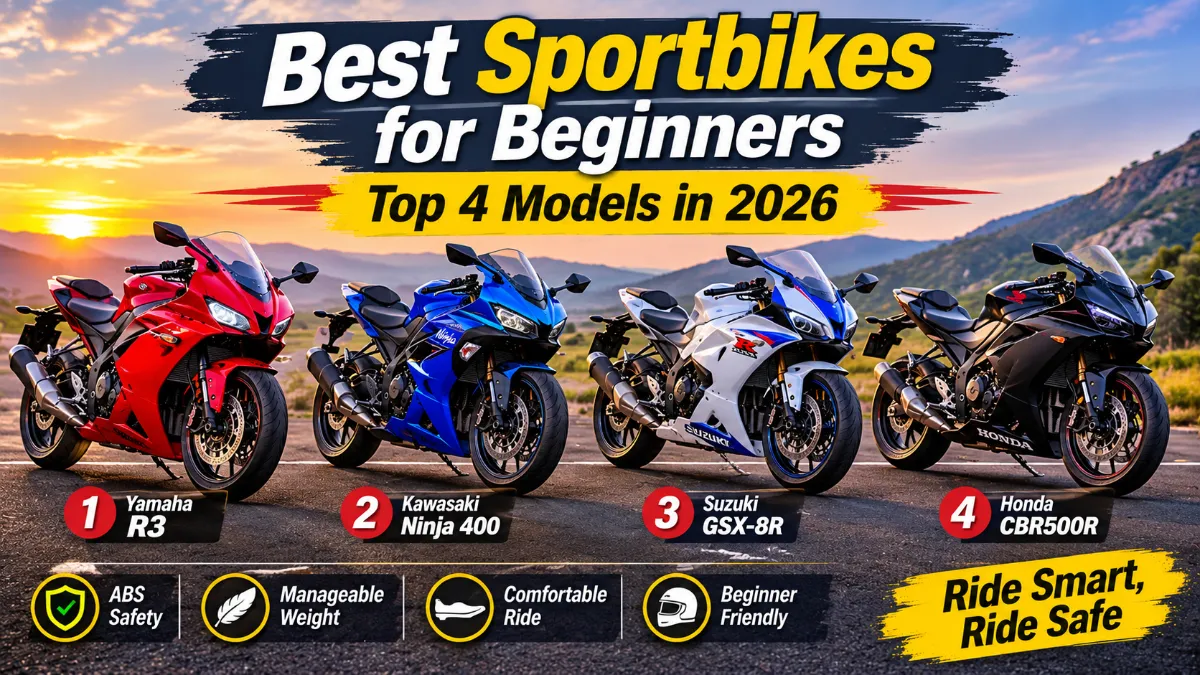
 Prices, weights and seat heights for four 2026 models, plus what federal crash data says about starting small, in a buyer’s guide to the best sportbikes for beginners.
A new rider can walk into a dealership in 2026 and buy a brand-new, fully faired sportbike with ABS for roughly $5,500 to $6,800 before fees. Choosing among the best sportbikes for beginners is the easy part. The harder part is the first season: NHTSA counted 6,228 motorcyclist deaths and an estimated 86,887 injuries in 2024, in a vehicle class that makes up about 3 percent of registered vehicles.
This guide compares four small-displacement models using 2026 manufacturer specifications and dealer-listed prices, then covers the factors that matter more than horsepower: training, licensing, braking technology, fit and gear. Figures were checked against official or primary sources as of November 7, 2026, and the text flags where a number comes from a dealer or a manufacturer rather than an independent test. The goal is not to crown a winner. It is to show which questions a first-time buyer should settle before signing anything.
Start With the Risk, Because It Shapes Every Other Choice
The National Highway Traffic Safety Administration’s 2024 data shows motorcyclist deaths fell 2.2 percent from 2023, from 6,366 to 6,228, while estimated injuries rose 5.2 percent to 86,887. The National Safety Council, analyzing the same federal data, calculates that motorcycles represent about 3 percent of registered vehicles and 0.6 percent of vehicle miles traveled, yet motorcyclists accounted for 16.2 percent of all traffic deaths in 2024. The IIHS, citing earlier NHTSA estimates, puts the per-mile death rate at nearly 24 times that of car occupants.
What Makes a Motorcycle Good for Long-Distance Riding? 7 Things to Check
Bike choice matters inside those numbers. A 2010 IIHS study in the Journal of Safety Research found that driver death rates for supersport motorcycles were four times as high as for cruisers and standards, and that larger engine displacement was associated with higher death rates within every motorcycle type. A separate 2007 IIHS analysis of 2005 registrations, republished by the U.S. Department of Transportation, found supersport riders dying at 22.5 per 10,000 registered motorcycles, against 10.7 for sport and unclad sport bikes and 5.7 for cruisers and standards.
Those figures come with limits. The underlying data comes from the 2000s, the 2010 study could not fully separate the effects of motorcycle type from rider age and behavior, and rates per registration do not account for how many miles riders cover. Even so, the direction is consistent with what most training programs teach: start with a lighter, lower-powered bike and let skill catch up before moving up.
NHTSA data also points to a licensing gap. According to a Michigan State Police safety summary citing NHTSA’s 2022 figures, 35 percent of motorcycle riders involved in fatal crashes were riding without a valid motorcycle license. Training and proper licensing are the cheapest safety investments a new rider can make, and they come before any purchase.
Get Licensed and Trained Before You Buy
Every state requires a motorcycle endorsement or license to ride legally on public roads, and the rules for earning one differ. The most common route for beginners is the Motorcycle Safety Foundation’s Basic RiderCourse. Training motorcycles are provided, so you do not need to own a bike, and the usual prerequisite is the ability to ride a bicycle. Course structure varies by provider, but published schedules run about 15 to 17 hours, typically around six hours of classroom or online work and 10 hours of riding. Some programs require 100 percent attendance, and some states require an online MSF course first.
In many states, completing the course waives some or all of the DMV’s skills test. Vermont’s program says you do not need a learner’s permit to take the course. New York requires a valid driver’s license for riders 16 and older, and its waiver applies only to riders licensed in states that accept it. One community college program notes that completing the course may also qualify you for insurance discounts, though that depends on your insurer. Check your state’s motor vehicle agency before registering, since the waiver rules are set locally.
What “Beginner-Friendly” Actually Means on a Sportbike
Marketing leans on horsepower and styling. For a first bike, five factors deserve more attention.
Weight and seat height. A lighter bike is easier to hold up at a stop, push around a garage and recover when it tips. Seat height determines whether you can plant both feet, which matters at intersections and during slow-speed practice. The models in this guide weigh between about 373 and 421 pounds with fluids and have seat heights from 30.7 to 31.5 inches, so fit differences are measured in fractions of an inch and a few dozen pounds.
Power delivery. Small parallel-twin engines in the 300 to 500 cc range make roughly 40 to 50 horsepower in published figures, enough for highway use without the abrupt throttle response of larger sportbikes. A slipper clutch, which limits rear-wheel hop on aggressive downshifts, is a useful forgiveness feature, and several of these models offer it.
ABS. Antilock brakes are the single most documented safety technology for motorcycles. A 2022 IIHS study covering 65 motorcycle models found fatal crash rates 22 percent lower on bikes with optional ABS than on the same models without it, and an earlier IIHS analysis estimated 31 percent. The U.S. still does not require ABS on new motorcycles, even though the European Union, United Kingdom, Japan, India and other markets do. All four bikes below offer ABS, but confirm it on the exact bike you are buying, because dealers can stock non-ABS versions of some models.
Ergonomics. Sportbikes put the rider in a forward lean with weight on the wrists. That is fine for a short ride and tiring for a long commute. If the position bothers you, naked versions of many sportbikes exist, such as the Aprilia Tuono 457, which Motorcycle.com describes as the unfaired sibling of the RS 457.
Electronics. Ride-by-wire throttles, selectable engine maps and traction control add forgiveness, but they are not substitutes for training. Treat them as a margin of error, not permission to ride faster.
Four 2026 Models Compared
The table uses manufacturer or dealer-listed 2026 specifications. Weights are not measured the same way across brands: Yamaha lists wet weight, Kawasaki and Honda list curb weight with a full tank, and Aprilia lists wet weight with the tank filled to 90 percent. Prices are base MSRPs or dealer-listed MSRPs before destination charges, taxes and dealer fees, and they vary by trim.
| Model | Engine | Seat height | Weight | Reported power | 2026 U.S. price |
|---|---|---|---|---|---|
| Yamaha YZF-R3 | 321 cc inline twin | 30.7 in | 373 lb wet | About 42 hp (estimate) | $5,499 |
| Kawasaki Ninja 500 SE ABS | 451 cc parallel twin | 30.9 in | 379 to 381.5 lb curb | About 51 hp | $6,499 |
| Honda CBR500R | 471 cc parallel twin | 31.1 in | 421 lb curb | About 46 hp | $6,399 |
| Aprilia RS 457 | 457 cc parallel twin | 31.5 in | 385 lb wet | 47.6 hp | About $6,800 (dealer-listed) |
Yamaha YZF-R3
The R3 is the lightest and least expensive of the four, with a base MSRP of $5,499 according to dealer listings of the 2026 model. Yamaha lists a 373-pound wet weight, a 30.7-inch seat and ABS as standard, along with an assist-and-slipper clutch and a claimed 56 mpg. For 2026, a dealer description of Yamaha’s materials notes a narrower seat and slimmer side covers intended to make reaching the ground easier. Its 321 cc engine is the smallest here, and Yamaha does not publish a horsepower figure in the sources reviewed, so the 42 hp number is an estimate from a third-party database. It is also covered by a one-year limited factory warranty.
Kawasaki Ninja 500 SE ABS
Kawasaki’s spec sheet lists the Ninja 500 SE ABS at $6,499, with a 30.9-inch seat, a 3.7-gallon tank and curb weights of 379 to 381.5 pounds depending on emissions equipment. The SE adds a color TFT display, push-button keyless start, a large windscreen, frame sliders, a tank pad and knee pads. Published U.S. specifications put its 451 cc twin at about 51 horsepower, the most of the four. Lower-priced Ninja 500 versions exist, so compare trims rather than assuming $6,499 is the entry price.
Honda CBR500R
Honda says the CBR500R carries a lower MSRP for 2026, and dealer listings show $6,399 before destination. It is the heaviest of the group at 421 pounds, has the tallest listed tank at 4.5 gallons and uses a 471 cc twin that made about 46 horsepower in 2025 listings. A heavier bike can feel steadier at highway speeds and harder to manage in a parking lot, so it is worth sitting on before deciding. Honda includes a one-year, transferable, unlimited-mileage limited warranty, and the bike has dual front discs with ABS.
Aprilia RS 457
The RS 457 has the richest electronics package of the group. Published specifications include a ride-by-wire throttle, engine maps and dual-channel ABS with an anti-roll-over function. It makes 47.6 horsepower, which Aprilia markets as the most possible within the European A2 license limit, and it comes with a 24-month warranty. The trade-offs are the tallest seat at about 31.5 inches and a higher price. Dealer-listed 2026 MSRPs run about $6,799 to $6,849, while one specification database lists $6,599, so confirm the figure locally. U.S. bikes are built in India.
The Real Cost: Price Tag Plus Everything Else
MSRP is a starting point. Honda’s listing notes that neither its MSRP nor its price includes destination charges, and one Honda dealer lists a $600 destination fee. A Kawasaki dealer’s sample sale included a $650 destination charge and a $398 documentation fee, before sales tax and registration. Those fees can add well over $1,000 to a bike advertised at $6,500.
Prices also move. Dealer listings tracked by MotoHunt showed one 2026 R3 discounted from $5,499 to $4,999 on July 29, 2026, and a 2025 CBR500R cut from $7,399 to $6,399 in June 2026. Shop across dealers and model years.
Insurance and gear are the other variables. Insurers price by motorcycle class, rider age and record, so get quotes on specific models before you buy. A riding-course completion card may lower the premium, but check with your agent instead of assuming. Budget for a helmet, jacket, gloves, pants and boots at the same time as the bike, since riding without proper gear defeats the point of choosing a forgiving machine.
Helmets: Where the Evidence Is Strongest
Helmets are the best-documented piece of equipment. The IIHS reports that helmets are about 37 percent effective in preventing motorcycle deaths and about 67 percent effective in preventing brain injuries, and that unhelmeted riders are three times as likely to suffer traumatic brain injuries. Only 17 states and the District of Columbia require all riders to wear helmets, 30 states cover some riders, usually those under 18, and three states, Illinois, Iowa and New Hampshire, have no helmet requirement.
Behavior follows the law. In 2023, NHTSA observed 94 percent helmet use in states with universal laws and 72 percent in states without them. Whatever your state requires, buy a helmet that carries the DOT label, which indicates it meets federal performance standards.
Common Mistakes When Shopping for a First Sportbike
The following is editorial guidance rather than measured data, but it reflects the evidence above.
Buying more bike than needed is the classic error. The 2010 IIHS analysis found that more displacement meant higher death rates within each motorcycle type, and nothing about a first season requires 600 cc or more. Another mistake is buying for looks and ignoring fit. Sit on each bike, check that you can touch the ground comfortably, and confirm the reach to the bars does not strain your wrists. A third is skipping ABS to save a few hundred dollars when the evidence favors having it. And a fourth is treating training as optional. The course is where most new riders learn the clutch, braking and cornering skills the bike cannot teach on its own.
Which Bike Fits Which Rider
Shorter riders or anyone nervous about weight may prefer the R3, which is the lightest and has the lowest seat. Riders who want features for the money may lean toward the Ninja 500 SE, since its price includes a TFT display and accessories. Taller riders or those who expect longer rides may find the CBR500R’s larger tank and extra mass more settled. Riders who value electronics and Italian styling, and who can handle the higher seat, will look at the RS 457.
None of these is the best sportbike for beginners in every case. A short test sit on each is more informative than any spec sheet, and a rider who is comfortable and trained on a modest bike usually has a better first season than one who is stretched across a faster one.
The Bottom Line
The four models here share a formula: small twin engines, weights under about 420 pounds, seat heights near 31 inches, ABS and prices between roughly $5,500 and $6,800. The choice among them is a matter of fit, features and budget. The choice that matters more is how you start: licensed, trained, helmeted and honest about how much speed you need.
Several developments are worth watching. The IIHS and its insurance-loss affiliate petitioned NHTSA in November 2023 to require ABS on all new U.S. motorcycles, and the agency had not acted as of the IIHS’s latest published materials. Prices and discounts also change quickly as dealers clear 2026 stock ahead of new model years. For now, a first-time buyer’s best protection is a short list of questions: does it fit, does it have ABS, and have I taken the course?
🔹🔹 Follow us on Facebook 🔹🔹