
From blacksmith’s son to global brand: a fact-checked Soichiro Honda biography for the next generation entrpreneurs
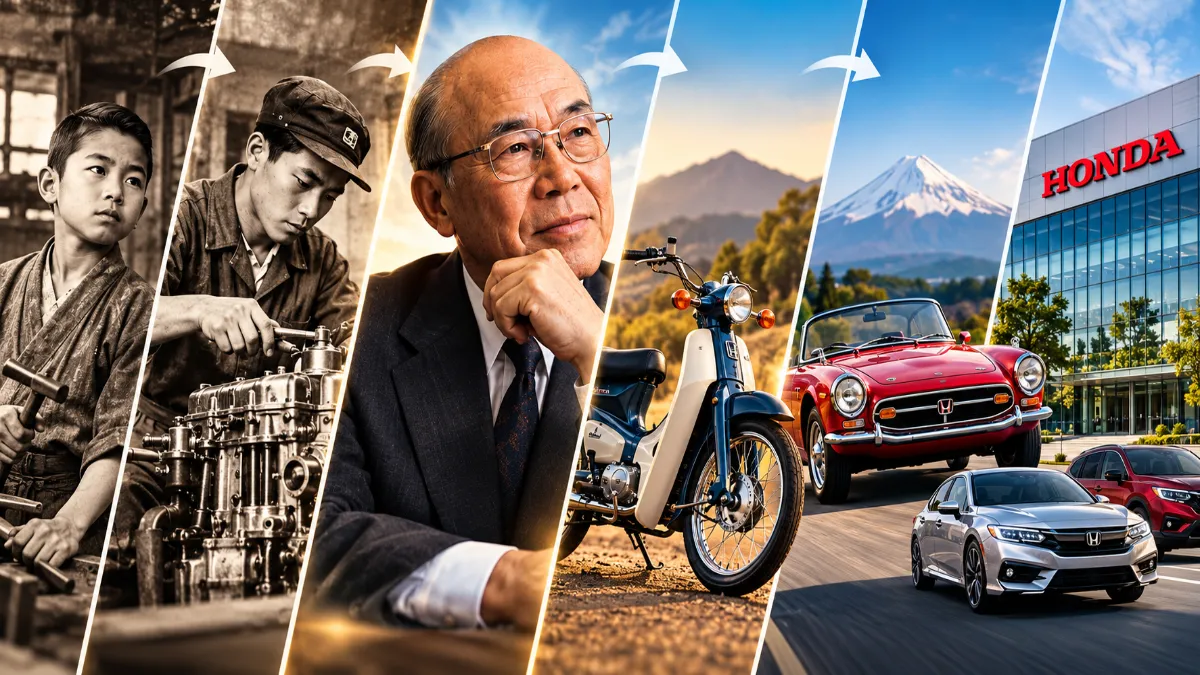
Soichiro Honda is often described as a man who succeeded because he refused to quit, but that summary leaves out the interesting part. Honda failed in specific, documented ways: a rejected first order, a factory destroyed in wartime, a first Isle of Man race that his team lost, and a slow, almost disastrous start in the United States. What set him apart was how he used each setback. He treated a failed part as a production problem to study, a lost race as an engineering test, and a bad market as a prompt to change the product and the pitch.
This guide is written for US readers, so it pays particular attention to how Honda reached American riders and drivers, and it uses examples from Japan and Britain where they explain the story. It relies on the sources listed at the end. Where those sources disagree on a date or a detail, I say so, and I leave out famous anecdotes I could not verify. I have not interviewed anyone or visited any archive, and nothing here is a personal recollection.
Soichiro Honda Biography in Brief: Key Dates
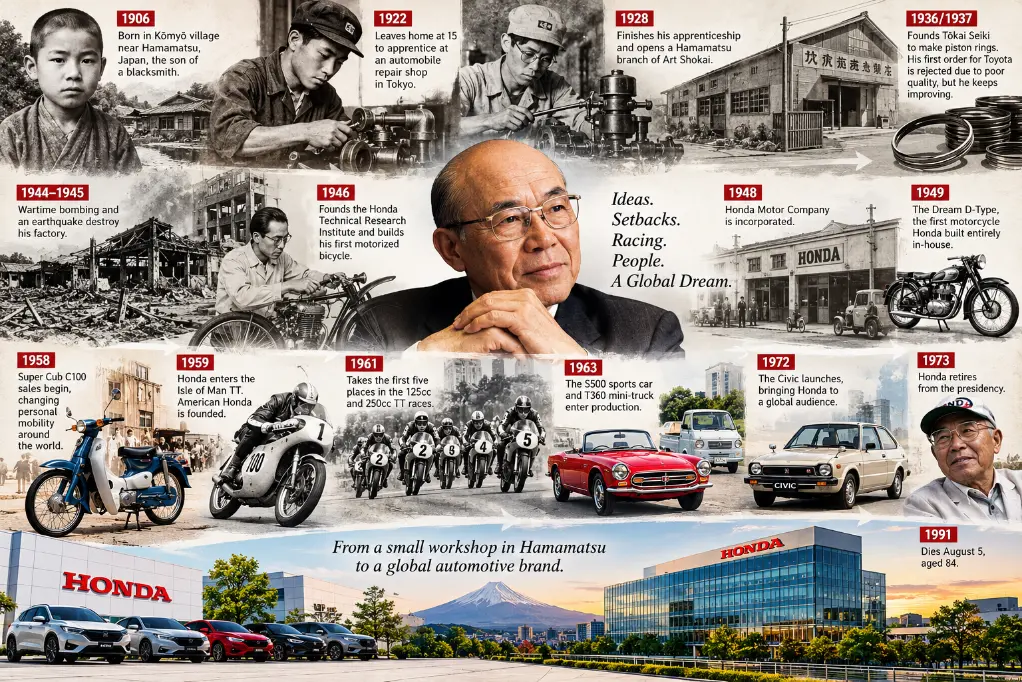
| Year | Event |
|---|---|
| 1906 | Born November 17, in Kōmyō village near Hamamatsu, Japan |
| 1922 | At 15, leaves home to apprentice at Art Shokai, a Tokyo repair shop |
| 1928 | Finishes his apprenticeship and opens a Hamamatsu branch of Art Shokai |
| 1936 or 1937 | Founds Tōkai Seiki to make piston rings (sources differ on the year) |
| 1944 to 1945 | Wartime bombing and an earthquake destroy his factory |
| 1946 | Founds the Honda Technical Research Institute and builds his first motorized bicycle |
| 1948 | Honda Motor Company is incorporated |
| 1949 | The Dream D-Type, the first motorcycle Honda built entirely in-house, arrives |
| 1958 | Super Cub C100 sales begin |
| 1959 | Honda enters the Isle of Man TT; American Honda is founded on June 11 |
| 1961 | Honda takes the first five places in the 125cc and 250cc TT races |
| 1963 | The S500 sports car and T360 mini-truck enter production |
| 1972 | The Civic launches |
| 1973 | Honda retires from the presidency |
| 1991 | Dies August 5, aged 84 |
A Blacksmith’s Son With a Restless Streak
Honda was born on November 17, 1906, in Kōmyō village near Hamamatsu, the son of a blacksmith and a weaver, according to The Engineer. The magazine also recounts two early stories: that he made a rubber family seal to fake his parents’ approval on school reports, and that he took his father’s bicycle to watch the pilot Art Smith give a flying demonstration. Both fit the pattern of a boy more interested in machines than in classrooms, though they come from a biographical account and not from contemporary records.
At 15, in 1922, he saw an advertisement in a magazine and left for Tokyo to apprentice at Art Shokai, an automobile repair shop. ASME dates that move to 1922 and The Engineer names his mentor as Yuzo Sakakibara. In April 1928, he finished his apprenticeship and opened a Hamamatsu branch of the shop. The Engineer says it was nicknamed “Edison of Hamamatsu” and employed more than 30 people by 1935.
He also raced. The Engineer says he crashed at the first Japan Automobile Race at Tamagawa Speedway in 1936, which ended his driving career. Honda’s own account, as the magazine tells it, was that his wife begged him to stop, though she said his father’s lecture was the real reason. The detail matters less than the pattern: Honda loved competition, and that instinct came back decades later in the company’s racing programs.
Piston Rings: The First Big Failure
In 1936 or 1937, the sources differ, Honda founded Tōkai Seiki to make piston rings. ASME says he did this while still working at Art Shokai, producing the rings at night. The Engineer says he founded the firm in 1937 to supply Toyota.
His first order, for Toyota, was rejected. The Engineer reports that early quality rates were as low as six percent, and that after two years of studying manufacturing methods the company was supplying Toyota and Nakajima Aircraft and had grown to over 2,000 employees.
This is the first clear example of Honda’s method. A six percent yield could have ended the business, but he treated it as a manufacturing problem to be solved. It also shows why he later insisted on making things himself: the piston ring episode taught him that quality depended on control over process.
War and Loss
During World War II the government took control of Tōkai Seiki. ASME says Honda developed a method of mass-producing wooden aircraft propellers, turning out two every half hour where hand production had managed one a week.
Then the plants were destroyed. The Association for Asian Studies says US bombing destroyed them in 1944, while The Engineer says air raids destroyed the Hamamatsu plant and that a 1945 earthquake followed. The Association for Asian Studies adds that Honda sold the business to Toyota after the war. I could not find a verified sale price in these sources, so I have not included one.
The point is not that Honda was fortunate to start over, but that his two largest factories were gone and his main customer ended up as the buyer. Many people would have taken the proceeds and retired. Honda used the remains of the plant and a bag of surplus generator engines to start again.
From Surplus Engines to Honda Motor Company
According to The Engineer, Honda founded the Honda Technical Research Institute after the war, funded by selling what remained of the plant, and fitted surplus generator motors to bicycles. Honda’s own corporate history says he used radio generator engines left over from the former Imperial Army as auxiliary engines for bicycles. The Association for Asian Studies puts the founding of the institute in September 1946 and the first motorized bicycle, the 50cc A-Type, in October of that year.
When the surplus supply ran out, he designed his own engines. Honda Motor Company was incorporated in September 1948, and in 1949 the Dream D-Type became the first motorcycle Honda built entirely in-house, including the frame. In 1951, the Dream E-Type introduced a four-stroke engine and, in Honda’s words, established the company as a complete motorcycle manufacturer.
Takeo Fujisawa: The Partner Who Made It Work
No account of Honda is complete without Takeo Fujisawa. The Association for Asian Studies says Honda was strong in invention and production but weak in finance and management, so Fujisawa took over strategic planning and became managing director. The sources differ on when he joined: The Engineer says 1948, while the Association for Asian Studies says Honda met him in 1949.
The partnership shows a lesson that is easy to miss. Honda was the engineer and Fujisawa was the businessman, and the company needed both. The two retired together in 1973, according to The Engineer.
The same source shows how aggressive that early growth was. It says the Korean War boom in 1950 led to a new Tokyo factory, and that Japan’s industry ministry (MITI) awarded a development grant of ¥400,000, later supplemented with ¥100,000, after Honda promised output figures far above its actual production. That is a reminder that the story was not all noble struggle; it also involved ambitious promises and heavy borrowing before a recession hit in 1953.
The Super Cub: A Motorcycle for People Who Did Not Ride
Honda’s best-known product was a very different machine from a race bike. Honda says sales of the first-generation Super Cub C100 began in August 1958. It used a 50cc four-stroke engine at a time when two-strokes dominated the market, a low-floor backbone frame that made it easy to step through, a centrifugal clutch that removed the need for a manual clutch and a large leg shield that kept riders cleaner. The company announced in October 2017 that cumulative Super Cub production had reached 100 million units, built at 16 plants in 15 countries.
The Cub is why Honda belongs in a story about setbacks. It was designed for people who had never ridden a motorcycle, and it turned out to be the vehicle that took Honda to a mass market around the world.
Racing: Learning From a Loss on the Isle of Man
Honda raced early and learned in public. The Association for Asian Studies says Honda’s team took first, second and fifth at the 1955 Mt. Fuji Ascent Race. In 1959 the team debuted at the Isle of Man TT and finished sixth through tenth, according to the same source, while RideApart describes the debut as a loss.
Two years later the result was very different. RideApart reports that in 1961 Honda swept the top five places in both the 125cc and 250cc Lightweight TT classes, with riders including Sadao Shimazaki, Jim Redman, Tom Phillis, Luigi Taveri, Mike Hailwood, Naomi Taniguchi and Kunimitsu Takahashi. The article credits years of preparation and Honda’s belief that failures teach as much as successes. It is an example of a company using racing as an engineering test: lose publicly, find the problem, fix it and return stronger.
How Honda Won America
Honda’s entry into the United States is the part of the story most relevant to American readers, and it did not start well.
American Honda Motor Co. was established on June 11, 1959, in Los Angeles, with a $250,000 investment, according to Rider Magazine. Because of limits set by Japan’s Ministry of Finance, half of that was cash and half was products and parts. A sales manager, Kihachiro Kawashima, led the new subsidiary with seven other employees from a former photography studio on West Pico Boulevard. The company launched with three models: the Honda 50 (the Super Cub), the 125cc Benly and the Dream in 250cc and 350cc versions.
The early results were poor. Rider says the company aimed to sell 1,000 motorcycles a month but sold only 170 in its first four months. It reached the 1,000-a-month goal in May 1961 and, by December 1962, was selling 40,000 motorcycles a year.
The change came from how Honda marketed the Cub. It was cheap, about $250, and it was sold in sporting goods and camping stores and advertised in general-interest magazines rather than only to traditional motorcyclists. In 1963, the advertising agency Grey created the “You Meet the Nicest People on a Honda” campaign, showing families, a young man with his dog and even Santa Claus on red Honda 50s. Rider reports that Honda sold 90,000 of its 50cc motorcycles after the campaign launched and notes that it is widely credited with changing the American motorcycle market. That is a claim about influence, and the article does not isolate the campaign from other factors.
Fighting the Government to Build Cars
Honda’s move into cars started with a conflict. The Association for Asian Studies says that in 1961 MITI drafted a bill to limit car production to a few companies and left Honda out. Honda responded by rapidly building prototypes: the S360 and S500 sports cars and the T360 mini-truck, shown at the 1962 Tokyo Motor Show.
MITI then tried to block the red paint on the sports cars, because only emergency vehicles were allowed that colour, and Honda responded with a critical editorial in the Asahi Shimbun. MITI backed down. The bill was submitted in 1963 and resubmitted in 1964, but it failed to pass and was eventually abandoned. The S500 and T360 entered production in 1963. A statement attributed to Honda from 1952 captures his stance: “Technological competition should be conducted by technological means.”
The Civic, CVCC and the American Market
Cars brought Honda back to the United States on a larger scale. ASME says the N600 sedan reached the US in 1969, and the Civic hatchback followed, with Honda’s CVCC engine letting the Civic meet strict US emissions standards without a catalytic converter. The Engineer dates the Civic’s launch to 1972 and says it eventually sold more than 14 million units, while ASME says the Civic won Japan’s Car of the Year from 1972 to 1974. The Association for Asian Studies reports that Civic sales reached 10 million in 1995. ASME also reports that Honda opened its first US plant in 1979.
The CVCC story shows the same method as the piston rings. Instead of waiting for a supplier to solve a regulatory problem, Honda treated emissions as an engineering challenge and used it to win customers.
Retirement and Legacy
Honda and Fujisawa retired together in 1973 after 25 years, handing the presidency to Kiyoshi Kawashima, according to The Engineer. ASME says he was inducted into the Automotive Hall of Fame in 1989 and received Japan’s Order of the Sacred Treasure, first class. He died of liver failure on August 5, 1991, aged 84. The Engineer notes that Ayrton Senna dedicated his win at the Hungarian Grand Prix that month to Honda’s memory.
Why This Soichiro Honda Biography Still Matters for American Riders
It would be easy to draw broad lessons from a famous founder, so it helps to separate what the sources show from what I infer.
What the sources show. Honda studied his failures, as with the piston rings and the 1959 TT debut. He paired his engineering with a financial partner in Fujisawa. He tested products in public through racing. And he entered the US market small, with a product designed for people who were not already motorcyclists.
What I infer. Honda’s habit of treating a setback as data is useful for anyone building a product, but it is easy to overstate. Many companies study failure and still fail. Honda also had advantages the sources describe, including surplus engines, a government development grant and the Korean War boom. I would not describe his story as proof that persistence alone works.
For American riders, the practical legacy is visible on the road: a Super Cub design that opened motorcycling to ordinary people, a Civic that helped redefine small cars and a racing tradition that still shapes the company’s image.
Common Misconceptions About Soichiro Honda
- “He never failed.” Honda’s own record shows rejected parts, a factory loss and a first TT result that was a loss.
- “He built everything alone.” The sources credit Fujisawa with finance and management, and the company’s growth involved government support and borrowing.
- “Every famous anecdote is documented.” Stories such as the rubber seal come from biographical accounts. I have flagged them as such, and I omitted popular details I could not verify.
- “All sources agree on the dates.” They do not. The founding of Tōkai Seiki, the timing of Fujisawa’s arrival and even the year of the Civic’s introduction vary between sources.
Frequently Asked Questions
Who was Soichiro Honda? He was the Japanese engineer and entrepreneur who founded Honda Motor Company. He was born on November 17, 1906, near Hamamatsu, and died on August 5, 1991, aged 84.
When was Honda Motor Company founded? Honda’s own history says the company was founded in 1948, and the Association for Asian Studies says it was incorporated in September 1948. The Honda Technical Research Institute came earlier, in 1946.
What was Soichiro Honda’s first big failure? His first piston ring order for Toyota was rejected, and early quality rates were as low as six percent, according to The Engineer. He kept working on the process until the company could supply Toyota and Nakajima Aircraft.
When did Honda enter the US market? American Honda was established on June 11, 1959, in Los Angeles, with eight employees. It started with the Honda 50, Benly and Dream models.
What was the “Nicest People” campaign? It was a 1963 advertising campaign by Grey, called “You Meet the Nicest People on a Honda.” Rider Magazine reports Honda sold 90,000 of its 50cc motorcycles after it launched.
How did Honda do at the Isle of Man TT? It entered in 1959 and finished sixth through tenth, according to the Association for Asian Studies. In 1961, it took the first five places in both the 125cc and 250cc classes, according to RideApart.
Future of Mobility: 7 Technologies That Could Change How We Travel
Paolo Maldini: Why He Remains Football’s Defensive Benchmark