
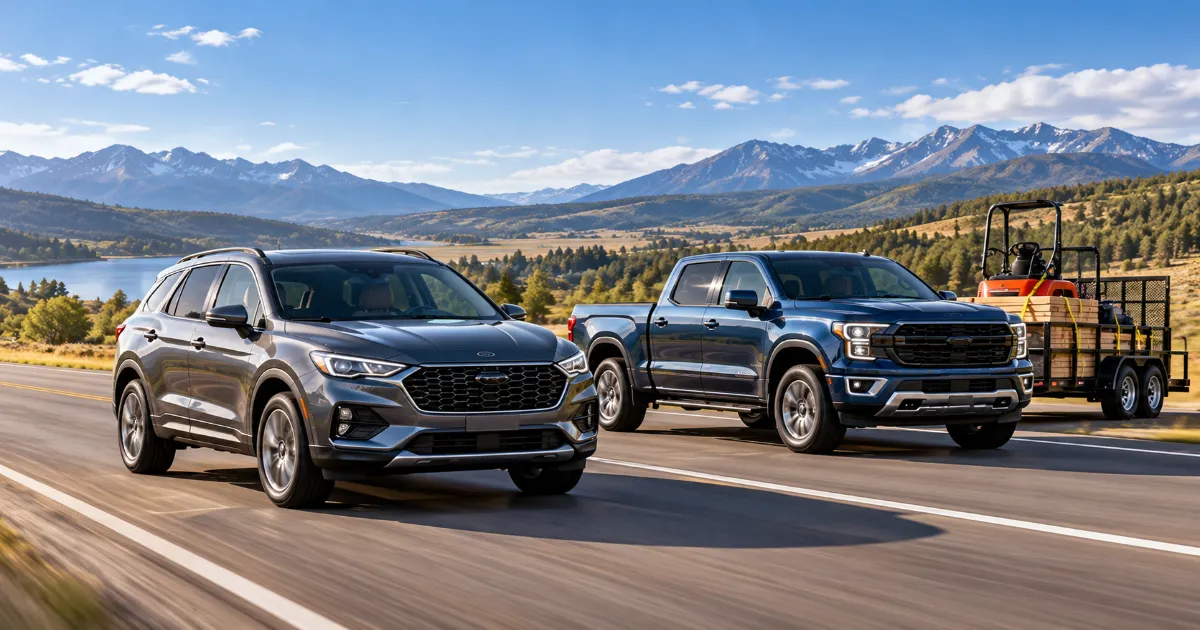
 Price, space, fuel economy and safety compared across four body styles to show which car type is best for you
Choosing a car starts with a question that comes before any brand, trim or color: what shape of vehicle fits your life? A sedan, an SUV, a hatchback and a pickup truck can all get you to work, but they differ a lot in price, fuel economy, cargo space, towing ability and even crash-safety statistics.
This guide compares the four body styles using current US data from Kelley Blue Book (KBB), the Insurance Institute for Highway Safety (IIHS), Edmunds and manufacturer pages, plus a few representative models for each type. It will not name one winner, because there is not one. It will show you what each type does well, where it falls short, and how to match a body style to the way you actually drive. Numbers change by trim, model year and market, so use them to compare types, then check the exact vehicle you are considering.
Should You Buy a New Car Now or Wait for 2027 Models? The Smart Buyer’s Guide
Biggest Auto Show Reveals of 2026: What Debuted in Detroit, New York and Beijing
Which Car Type Is Best for You? The Quick Match
| If you mostly… | Consider | Why |
|---|---|---|
| Commute and want the lowest running costs | Sedan or hatchback | Lower average prices and strong fuel economy |
| Need flexible cargo space in a compact footprint | Hatchback or compact SUV | Hatchback cargo area opens up through the rear |
| Carry family, gear and groceries and want an upright seating position | SUV | Space, available all-wheel drive and strong crash-test results by size class |
| Tow or haul bulky or dirty loads | Truck | Bed, payload and towing ratings no other type matches |
| Want a truck-like bed on a smaller budget | Compact pickup | Hybrid efficiency and a smaller price tag, with limits on payload and towing |
The rest of the article explains each row.
What Each Type Costs
Price is the biggest practical difference. KBB’s September 2026 data, published October 13, gives average transaction prices by segment:
| Segment | Average transaction price, September 2026 |
|---|---|
| Compact car | $27,977 |
| Subcompact SUV | $31,213 |
| Compact SUV | $37,614 |
| Mid-size SUV | $50,630 |
| Full-size pickup | $67,573 |
Those are what buyers actually paid on average, not MSRPs, and each includes everything from base to loaded trims. Even so, the pattern is clear: moving from a compact car to a compact SUV adds roughly $9,600 on average, and a full-size pickup costs about $39,600 more than a compact car. KBB’s analysts note that affordability pressure is pushing buyers toward lower-priced vehicles, so the cheapest end of each type is where much of the market is moving.
Sedans: Efficient, Affordable and Increasingly Hybrid
A sedan has a separate trunk and a lower, more car-like driving position. It is the traditional choice for commuting and highway driving.
A representative example: the Toyota Camry. Kelley Blue Book lists the 2026 Camry from $30,495 for the LE trim, notes that every 2026 Camry has a hybrid drivetrain, and gives fuel economy of up to 51 mpg combined, with higher trims at 43 to 47 mpg. Trunk capacity is 15.1 cubic feet and rear legroom is 38 inches. KBB’s expert rating is 4.8 out of 5. (KBB’s page lists a $30,195 price in its FAQ that conflicts with the pricing table, so confirm the number at a dealer.)
Strengths
- Lower average prices. Compact cars average $27,977 in KBB’s data, the lowest of the segments above.
- Fuel economy. The Camry example shows how far hybrid sedans have gone.
- Easy to drive and park. A lower, smaller body is simpler in tight spaces.
Trade-offs
- Cargo is limited by the trunk opening. A 15.1-cubic-foot trunk is fine for groceries and suitcases but not for bulky items.
- Safety depends on size. IIHS data on driver death rates shows a wide spread by size class, discussed below.
- Less versatility. A sedan cannot match an SUV or hatchback for loading tall or bulky items. The sources reviewed here do not give a current sedan share of US sales, so this guide makes no claim about how many models remain.
SUVs: The Do-It-All Default
An SUV, or crossover, sits higher, has a rear hatch and usually offers more flexibility than a sedan. KBB’s September data lists subcompact, compact and mid-size SUV averages from $31,213 to $50,630, so the category spans a wide price range.
A representative example: the Toyota RAV4. Edmunds’ 2026 spec page lists the RAV4’s lowest-priced trim, the LE, at $31,900. It offers seating for five, 37.8 cubic feet of cargo space behind the seats and 70.4 cubic feet at maximum, a towing capacity of up to 3,500 pounds and a combined fuel economy figure of 41 mpg, a number that the page does not tie to a specific powertrain.
Strengths
- Cargo room. A compact SUV’s 37.8 cubic feet behind the rear seats is more than twice the Camry’s 15.1 cubic-foot trunk.
- Ride height and visibility. Many drivers prefer the upright seating position.
- Range of sizes. From subcompacts to three-row models, there is an SUV for most households. If you are weighing a third row, see our comparison of two-row and three-row SUVs.
- Crash-test performance by class. IIHS finds SUVs dominate the lowest driver death rates, as explained below.
Trade-offs
- Higher prices. The compact SUV average of $37,614 is about $9,600 more than the compact car average.
- Lower fuel economy at the larger end. In KBB’s three-row list, combined mpg for full-size models runs from 16 to 18, though midsize models reach the low to mid 20s.
- Impact on others. IIHS finds larger vehicles hit other drivers harder, as discussed below.
Hatchbacks: The Small-Footprint Hauler
A hatchback looks like a compact car but has a rear liftgate and a cargo area that opens into the cabin. It is the choice for people who want hauling flexibility without paying for an SUV.
Representative examples. KBB’s hatchback list shows the 2026 Toyota Corolla Hatchback from $25,775 at 35 mpg combined, the 2026 Mazda3 from $25,885 at 28 mpg and a Honda Civic listed from $25,890 at 34 mpg, though KBB’s FAQ gives a conflicting $29,090 starting price for the Civic, so confirm it with a dealer. Honda’s own comparison page, which naturally favors the Civic, lists 24.5 cubic feet of cargo volume behind the second row for the Civic Hatchback versus 20.1 for the Mazda3 hatchback, and combined fuel economy of 34 mpg for the Civic Sport and 48 for the hybrids, versus 29 for the Mazda3 2.5-liter.
Strengths
- Price. All three examples start in the mid-$20,000s.
- Fuel economy. The Corolla Hatchback’s 35 mpg and the Civic hybrids’ 48 mpg are among the best in this comparison.
- Practicality in a small package. A rear liftgate makes bulky items easier to load than a sedan trunk.
- Easy parking. Smaller dimensions help in cities.
Trade-offs
- Less cargo than a compact SUV. The Civic’s 24.5 cubic feet is well below the RAV4’s 37.8, though the sources use different measurement points, so treat the comparison as a rough guide.
- Limited towing and rough-road ability. The sources reviewed do not list towing for hatchbacks, so check your vehicle’s rating if you plan to tow.
- Small-car safety statistics. IIHS groups vehicles by size, and small cars as a class have higher driver death rates, as explained below.
- Fewer models. KBB’s hatchback list is short, and it mixes performance models such as the Golf R at $48,325 with economy models.
Trucks: Capability First
A pickup is built to carry and tow. It also costs the most and uses the most fuel, with exceptions at the compact end.
Full-size example: the Ford F-150. KBB lists the 2026 F-150 Regular Cab XL from $40,085, with fuel economy of 19 to 23 mpg depending on engine and drivetrain. The Regular Cab’s maximum towing is 11,000 pounds, and across the lineup the review cites up to 13,500 pounds with a specific V6, four-wheel-drive crew cab and tow package. Maximum payload for the Regular Cab is 1,775 pounds, and up to 2,440 pounds across the lineup. It comes in three bed lengths (5.5, 6.5 and 8 feet) and three cab styles. KBB’s expert rating is 4.7 out of 5.
Compact example: the Ford Maverick. Ford’s page lists hybrid fuel economy of 38 mpg combined for front-wheel drive and 37 for all-wheel drive, a 54.4-inch bed, a maximum payload of 1,500 pounds for the front-wheel-drive hybrid and a maximum towing capacity of 4,000 pounds with the available tow package (2,000 pounds standard). It seats five in a four-door SuperCrew cab. Ford’s page does not list a starting price.
Strengths
- Towing and payload. The F-150’s ratings dwarf the 3,500 pounds of a compact SUV like the RAV4.
- Open bed. Wet, dirty or tall loads are easier in a bed than in a cabin.
- Compact option. The Maverick shows a truck can also be fuel-efficient.
Trade-offs
- Price. KBB’s average full-size pickup transaction price is $67,573, the highest in the table above.
- Fuel economy. The F-150 averages in the high teens to low 20s.
- Size. Parking and garage fit can be a challenge.
- Security and weather exposure. Items in an open bed are exposed unless you add a cover, though the sources reviewed do not discuss this.
What About Safety?
The safest body style depends on how you measure it, and the IIHS results show two different pictures: risk to you and risk to others.
IIHS’s July 30, 2026 study reports driver death rates per million registered vehicle years for 2023 models, based on fatalities from 2021 through 2024. The average driver death rate across all vehicles was 37.
| Vehicle size and class | Driver death rate | Other-driver death rate |
|---|---|---|
| Minicars | 158 | 55 |
| Small cars | 79 | 56 |
| Midsize cars | 67 | 65 |
| Large cars | 104 | 107 |
| Small SUVs | 38 | 46 |
| Midsize SUVs | 24 | 46 |
| Large SUVs | 26 | 67 |
| Very large SUVs | 20 | 70 |
| Small pickups | 31 | 55 |
| Large pickups | 29 | 67 |
| Very large pickups | 24 | 110 |
The pattern is consistent with common sense. Smaller, lighter cars have higher driver death rates than larger vehicles. IIHS found that 18 of the 20 models with the lowest driver death rates are SUVs. The highest driver death rates by model were the Kia Rio (170) and Nissan Versa (164), two small cars, followed by the Chrysler 300, Dodge Charger HEMI and Dodge Challenger, powerful models.
The other-driver column is the trade-off. Larger vehicles protect their own occupants better, but very large pickups have an other-driver death rate of 110, compared with 46 for small and midsize SUVs and 56 for small cars. In other words, the size that helps you can hurt the people you collide with.
Two cautions. These rates are for size classes and models, not body styles alone, so a small hatchback falls under “small cars” and a compact sedan does too. And they describe averages. Individual models vary widely, so check IIHS ratings for the specific vehicle you want.
How to Choose: Five Questions
- How many people do you carry regularly? Four or fewer on most days fits any type. If you often carry five or more, look at larger SUVs or crew-cab trucks.
- What do you haul or tow? Groceries and luggage fit a sedan or hatchback. Bikes, strollers and sports gear fit a hatchback or SUV. Trailers, lumber or equipment belong in a truck, so compare real towing and payload ratings.
- Where do you drive and park? City driving and tight garages favor smaller sedans and hatchbacks. Rural roads and mixed use may favor an SUV or truck.
- What is your total budget? Compare average prices by segment, then check the exact trims. Consider fuel, insurance and maintenance, which this article does not quantify.
- How do you weigh safety? Look at IIHS ratings for the specific model, not just the body style, and weigh the size trade-off above.
Hybrids Blur the Lines
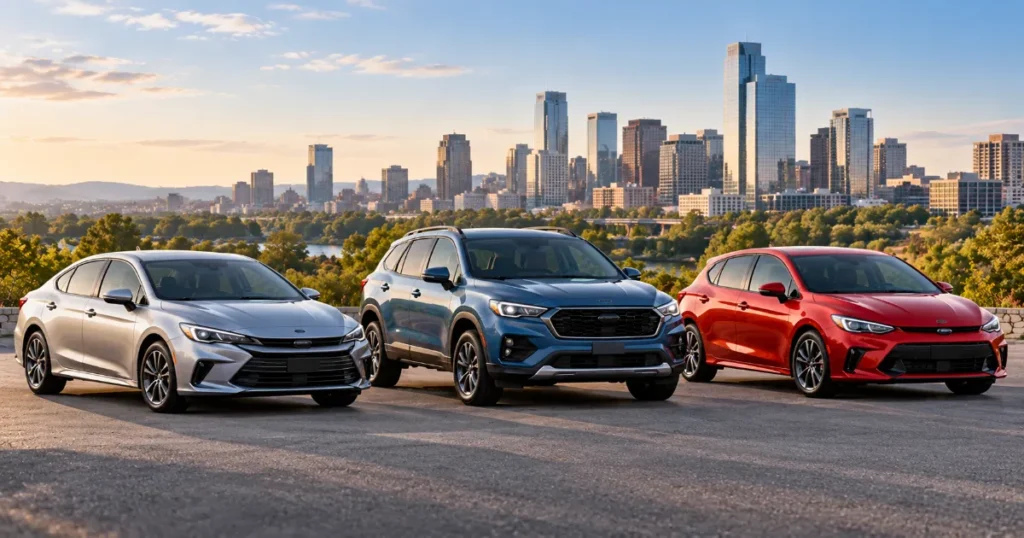
Efficiency used to be a point in favor of sedans and hatchbacks. Hybrids have changed that. Every 2026 Camry is a hybrid with up to 51 mpg combined, the Civic hybrids are listed at 48, the Maverick hybrid pickup at 38, and the compact RAV4 at a listed 41. If fuel cost is a priority, compare hybrid versions across body types, not just the types themselves.
Frequently Asked Questions
Which car type is best for a family?
It depends on size and cargo needs. SUVs are the most common choice because they combine space with a high seating position, and IIHS data shows SUVs make up 18 of the 20 models with the lowest driver death rates. A sedan or hatchback can work for smaller families.
Which car type is cheapest?
Compact cars, according to KBB’s September 2026 segment averages: $27,977, versus $31,213 for subcompact SUVs, $37,614 for compact SUVs, $50,630 for mid-size SUVs and $67,573 for full-size pickups.
Which car type gets the best gas mileage?
Hybrid sedans and hatchbacks lead the examples here: up to 51 mpg combined for the Camry LE, 48 for Civic hybrids, and 35 for the Corolla Hatchback. The RAV4 is listed at 41 mpg, and the Maverick hybrid at 38. The F-150 runs 19 to 23.
Is a hatchback better than a sedan?
For cargo flexibility, usually yes, because the liftgate opens the cargo area. For trunk security and sleek styling, some buyers prefer a sedan. The Camry’s trunk is 15.1 cubic feet, and the Civic Hatchback’s cargo area is 24.5.
Is an SUV safer than a sedan?
For the people inside, larger SUVs tend to have lower driver death rates than small or midsize cars, per IIHS: 20 to 38 for SUVs versus 67 to 79 for midsize and small cars. But larger vehicles carry higher other-driver death rates, and individual models vary.
Do I need a truck?
Only if you tow or haul regularly. The F-150’s towing ratings of 11,000 pounds or more are far above the RAV4’s 3,500 pounds. If you need only a small bed, the Maverick offers 1,500 pounds of payload and 4,000 pounds of towing with the tow package.
Which is better for city driving?
Smaller sedans and hatchbacks are easier to park and maneuver. A compact or subcompact SUV may suit city dwellers who also want cargo room.
Should I buy a hybrid?
Hybrids are now available in every body style in this guide. If you drive many miles, compare hybrid and gas versions of the same model, and check pricing for the exact trim.
The Bottom Line
The answer to “which car type is best for you” comes down to how you balance five things: price, space, fuel use, towing and safety. Sedans and hatchbacks cost less and, with hybrids, can be very efficient. SUVs offer the most flexibility and the best crash-test results by class, at a higher price. Trucks are unmatched for towing and hauling and cost the most. Match the body style to your real daily use, not your rare needs, then compare specific models, trims and IIHS ratings before you buy.
🔹🔹 Follow us on Facebook 🔹🔹