
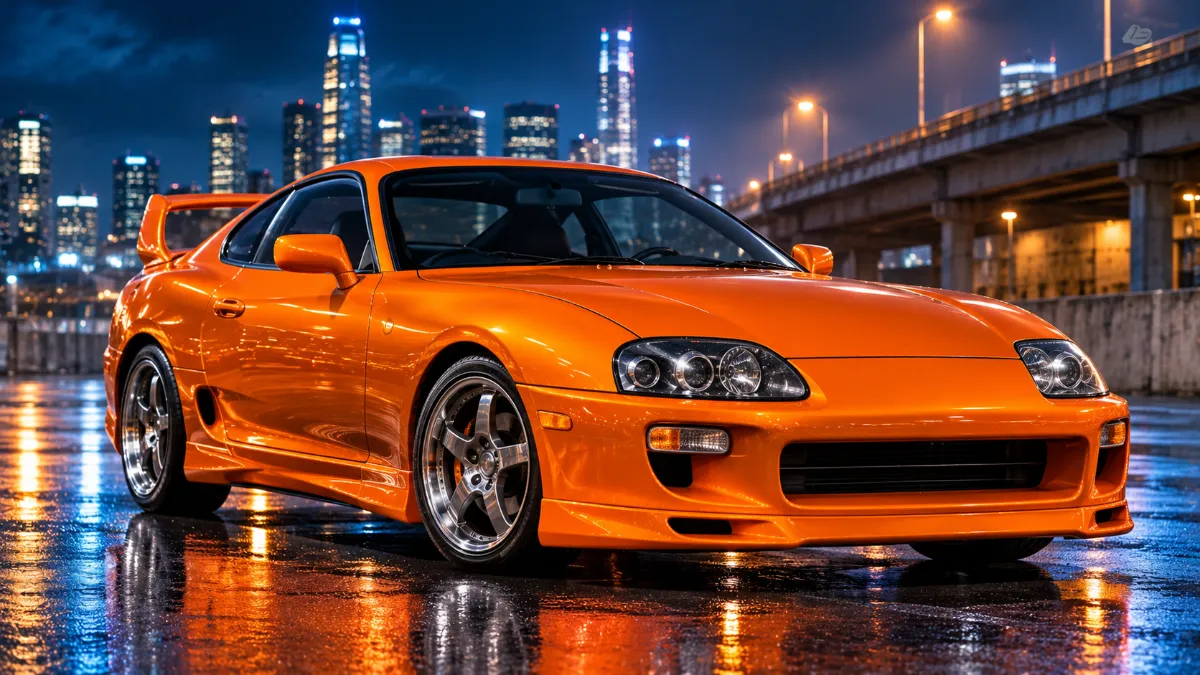
 A $550,000 movie car, a 2JZ engine and a Final Edition farewell explain why the story of the Toyota Supra from Fast and Furious is still being written.
In June 2021, a candy-orange 1994 Toyota Supra sold for $550,000 at Barrett-Jackson’s Las Vegas auction, then the most expensive Supra ever sold at auction. It was the hero car that Paul Walker’s Brian O’Conner drove in the first film of a franchise that has now run for nearly 25 years. Five years later, Toyota has built the last of its fifth-generation GR Supras, with production ending in spring 2026. The Toyota Supra from Fast and Furious sits at the center of both stories: a fourth-generation sports car that outgrew its era and a nameplate whose future is unannounced.
This guide covers the movie car, the real MkIV Supra Turbo behind it, the Supra’s history from 1978 to the 2026 Final Edition and what the legacy is worth today. It uses Toyota press material, auction records and trade reporting checked as of November 24, 2026, and it notes where figures differ between sources.
GTA 6 Cars List: Every Confirmed Car, Bike, Boat and Aircraft
12 Most Iconic TV Show Cars of All Time
Quick Facts
| Item | Detail |
|---|---|
| Movie car | 1994 Toyota Supra Turbo (MkIV, A80) in Lamborghini Diablo Candy Orange pearl |
| Films | The Fast and the Furious (2001) and 2 Fast 2 Furious (2003) |
| Engine | 3.0-liter twin-turbocharged 2JZ-GTE inline-six |
| Factory output | 320 horsepower and 315 lb-ft of torque |
| Auction | $550,000 at Barrett-Jackson Las Vegas, June 2021 (one outlet reported $555,000) |
| U.S. sales | 1993 to 1998 model years |
| Successor | A90 GR Supra, 2020 to 2026 model years |
What Made the Movie Car Special: The Toyota Supra from Fast and Furious
The car arrives early in the 2001 film. After Brian O’Conner’s Mitsubishi Eclipse is destroyed, he owes Dominic Toretto a “ten-second car” and finds a wrecked Toyota Supra Mark IV whose 2JZ engine is still intact. A junkyard rebuild, “overnight parts from Japan” and a lot of work produce the Candy Orange Supra that appears in the climactic street race against Dom’s Dodge Charger.
The real build was more of a Hollywood effort. The hero car sold in 2021 was built by Eddie Paul at The Shark Shop in El Segundo, California, and finished in Lamborghini Diablo Candy Orange pearl paint with a “Nuclear Gladiator” graphic designed by Troy Lee Designs. Craig Lieberman, a technical advisor on the first film, has said the Supra was one of eight used in production and that he supplied the car that was repainted and modified as the hero. The car appeared in both the 2001 film and 2 Fast 2 Furious.
Two details surprise many fans. The auctioned car has a factory twin-turbo 2JZ-GTE, but coverage describes it with a four-speed automatic, not the six-speed manual many people picture. And movie magic did much of the work on screen: one German outlet noted that buyers should not expect the heavy turbo upgrades and nitrous performance seen in the film. An earlier look-alike Supra from the production, with a naturally aspirated engine and fake nitro bottles, sold in 2015 for $185,000, which shows how much documentation and the right engine matter.
The Real Thing: MkIV Supra Turbo Specs
Strip away the paint and the movie car is a 1990s Toyota flagship. The A80 Supra, sold in the U.S. from the 1993 model year, was offered with a naturally aspirated 2JZ-GE making 220 horsepower and 209 lb-ft, or the twin-turbocharged 2JZ-GTE making 320 horsepower and 315 lb-ft. The Turbo offered Toyota’s first six-speed manual, and both versions could also be ordered with an automatic that had a manual shift mode.
| Specification | 1993 to 1998 Supra Turbo (U.S.) |
|---|---|
| Engine | 3.0-liter twin-turbocharged inline-six (2JZ-GTE) |
| Power and torque | 320 hp and 315 lb-ft |
| Transmissions | Six-speed manual or four-speed automatic |
| 0 to 60 mph | 4.6 seconds (official figure cited by Jalopnik); under five seconds per Hagerty |
| Top speed | 155 mph, electronically limited |
| Naturally aspirated option | 2JZ-GE, 220 hp and 209 lb-ft |
| Original price | About $40,000 in 1993, per a Hagerty report on one original owner |
Toyota briefly dropped the six-speed in 1996 because of emissions rules and brought it back in 1997. Turbos with California emissions were not offered for 1998, so cars from that final year are rarer.
A Short History of the Supra
The Supra began as a longer, six-cylinder version of the Celica. Toyota started building it in Japan in April 1978 as the Celica XX, and the U.S. got the Celica Supra for 1979. From mid-1986 the third-generation A70 became a separate model, and a turbocharged 7M-GTE six arrived for 1987 with 230 horsepower and 246 lb-ft.
| Generation | Years | Notes |
|---|---|---|
| A40 and A50 (first) | 1978 to 1981 | Celica XX in Japan, Celica Supra in the U.S. |
| A60 (second) | 1982 to 1985 | Sharper styling and pop-up headlights |
| A70 (third) | 1986 to 1992 | Became its own model; turbo 230 hp |
| A80 (fourth) | 1993 to 2002 | 2JZ engines; U.S. sales ended 1998, Japan 2002 |
| A90 (fifth) | 2019 to 2026 | BMW-sourced inline-six; production ended spring 2026 |
After U.S. sales stopped in 1998 and worldwide production ended in 2002, fans waited more than a decade for a successor. Toyota revealed the fifth-generation GR Supra at the 2019 Detroit auto show, as the first globally badged model of its Gazoo Racing performance brand. It shared its platform and powertrain with the BMW Z4.
The A90 Era and the 2026 Final Edition
The A90’s 3.0-liter turbocharged inline-six made 335 horsepower and 365 lb-ft at launch with an eight-speed automatic. Toyota raised output to 382 horsepower and 368 lb-ft for the 2021 model year and later added a six-speed manual. A 255-horsepower four-cylinder was offered for a time and disappeared from U.S. configurators after the 2024 model year.
For 2026, Toyota sold the GR Supra with the same 382-horsepower six and a choice of manual or automatic at the same price, plus a MkV Final Edition with chassis, suspension and braking upgrades but no extra power. The Final Edition costs $68,550 before destination and $69,745 with it, according to Carscoops, Edmunds and SlashGear. Published base prices vary by source, from roughly $58,000 to $59,500 including destination. Toyota said production would end in spring 2026 at the Magna Steyr plant in Graz, Austria, and CarBuzz reports it has ended.
Toyota has not announced a successor. Autoblog says a sixth-generation car could be as far out as 2030, and Carscoops has reported rumors of a 2027 return with a hybrid four-cylinder. Treat both as unconfirmed.
Why the Supra Became an Icon
Several forces made the fourth-generation Supra a legend. The first was film: Car magazine credits its long afterlife to appearances in The Fast and the Furious and in the Gran Turismo and Need for Speed games. The second was racing: the A80 finished 14th at Le Mans and won multiple Japan GT Championship titles between 1997 and 2005, according to the same source.
The third is the engine. The 2JZ-GTE’s reputation for handling large power increases is widely repeated by tuners, and it is the main reason the Supra became the car people build up in games and garages. That reputation is enthusiast consensus, not a Toyota claim. Together, these factors turned a $40,000 sports car into a collectible.
What an A80 Supra Is Worth Today
Values have climbed sharply and vary with condition, mileage, originality and documentation. A 1998 Supra Turbo sold at Mecum’s Kissimmee auction in January 2026 for $242,000 in one report and $220,000 in another, a gap consistent with the auction’s buyer’s premium. The record for a fourth-generation Supra at Bring a Trailer was $232,000 in 2022 for a 1994 Turbo six-speed, and reports say only three A80s had ever exceeded $200,000.
Most cars sell for far less. A 1994 Turbo sold on Collecting Cars in April 2026 for $150,500, a 1993 Turbo brought $126,726 on Bring a Trailer, and an aggregator of auction results lists many 2025 and 2026 sales between roughly $56,500 and $150,000 depending on mileage and modifications. Hagerty’s marketplace says unmodified, low-mileage Turbos with documented ownership are among the most aggressively collected Japanese performance cars, and one original owner who paid about $40,000 in 1993 sold his car for $128,000. These figures come from different platforms and dates, so treat them as ranges, not a price guide.
Buying an A80 or a Tribute Car
This section is editorial guidance. Movie fame has produced many tribute builds, and the 2015 sale shows that a car can look right and still be worth far less than the real hero car. If you are shopping, verify the engine and the VIN, ask for documentation of ownership and any modifications, and check whether the car is unmodified or heavily tuned, since originality drives price. For a screen-used car, insist on written provenance from the production or a recognized expert. For a modern alternative, the 2026 GR Supra remains available new or used, with production now over.
The Bottom Line
The Toyota Supra from Fast and Furious earned its place by combining a strong factory car with a story that fit the moment: a junkyard rebuild, a ten-second promise and a 2JZ that could take more power. The movie car’s $550,000 sale showed how far the legend had traveled, and the 2026 Final Edition closed the modern chapter.
For readers following the Supra, a few things are worth watching: whether Toyota announces a successor, how Final Edition cars hold value as production-end scarcity sets in, and whether fourth-generation prices keep climbing or flatten. The practical advice is the same as with any collectible: pay for originality and documentation, not for the badge alone.
🔹🔹 Follow us on facebook 🔹🔹