
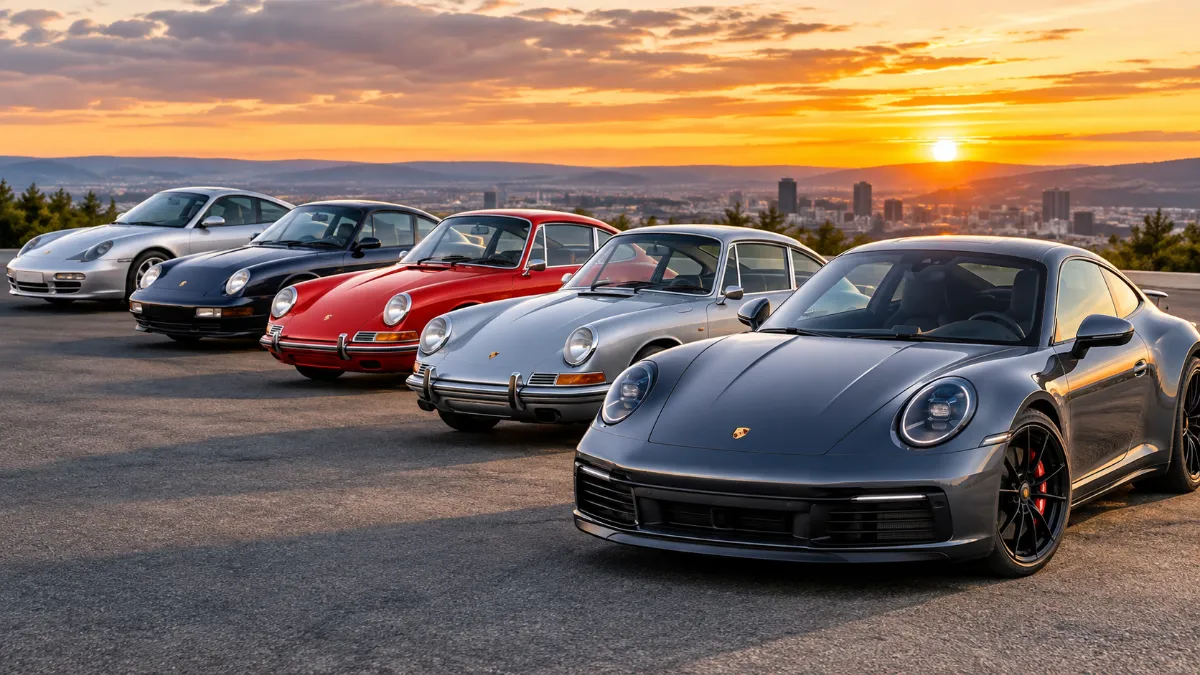
 Water cooling, turbochargers and now hybrid power have all arrived, yet the Porsche 911 set a delivery record in 2025 while the brand’s total fell 10 percent.
Porsche delivered a record 51,583 examples of the 911 in 2025, a one percent increase, in a year when the company’s overall deliveries dropped 10 percent to 279,449. That contrast is the shortest explanation for why the Porsche 911 has outlasted nearly every sports car that debuted beside it. A rear-engine coupe first sketched around 1959 now anchors a company that is rewriting its strategy around what it keeps and what it cuts.
Longevity alone does not make an icon, though. Plenty of long-running nameplates have faded into nostalgia. The 911 is different because it combines a shape that evolved rather than reset, engineering changes that Porsche made when it had to, a competition record that fed back into the road cars, and a business case that still works. This article walks through each of those pillars, using Porsche’s own records, sales data and reporting current as of November 3, 2026, and notes where the evidence is thinner.
A Shape That Evolved Instead of Being Replaced
Porsche unveiled the car at the Frankfurt Motor Show in September 1963 as the 901, the successor to the 356, with room for a rear seat and a flat-six engine. Its name changed before sales began. Peugeot claimed rights to three-digit model names with a zero in the middle, and Porsche’s solution, credited to chief designer Ferdinand Alexander “Butzi” Porsche, was to double the 1. The Petersen Automotive Museum lists the original engine at 130 horsepower.
What followed was less a series of redesigns than a long editing process. Each generation kept the same recipe: engine behind the rear axle, a fastback profile, and a flat-six. Porsche has numbered its generations by type, and the eighth generation, the 992, premiered in Los Angeles on November 27, 2018. The 2024 update to that generation is the one on sale now.
That consistency has a commercial logic. A buyer shopping for a 2027 model is looking at a descendant of the car shown in 1963, not at a new idea that happens to share a name. Few mass-market brands can claim that. It also explains why the 911’s changes tend to provoke argument: owners care about what stays the same.
The Hard Choices: Water Cooling and the 996
The most contested decision in the car’s history came in 1997. The fifth generation, the 996, was the first series-production 911 with water cooling. Porsche’s own history says new exhaust regulations required a four-valve cylinder head, which could not be reliably cooled by air in all conditions. The previous generation, the 993, built from 1993 to 1998, became the last air-cooled 911, and Porsche records 67,535 of them.
Purists objected, and some still do. The commercial result was clear, though. Porsche built 175,262 examples of the 996 between 1997 and 2005, roughly two and a half times the 993’s production run. The 996 generation also introduced the first car to wear a GT3 badge, a line that remains central to the 911’s performance reputation.
The episode shows how the 911 has stayed relevant. Porsche changed the engine’s fundamentals when regulation left little choice and kept the identity around it intact. The same pattern repeated with turbocharging and, more recently, with hybrid assistance.
What Racing Added to the Badge
Porsche has used competition to prove the 911 since its first full year on sale. A 911 finished fifth overall and won its class at the 1965 Monte Carlo Rally, its first appearance in top-level international rallying. In 1968, Vic Elford won the rally outright in a 911, which Porsche describes as the first overall Monte Carlo victory for the marque. Björn Waldegård repeated the win in 1969 and 1970, and in each of those years another rally-spec 911 finished second.
The road cars absorbed those lessons. In 1972, Porsche introduced the 911 Carrera RS 2.7, the first 911 to carry the Carrera name and the car that popularized the “ducktail” rear spoiler. The same year it built the Carrera RSR 2.8 for racing, a roughly 890-kilogram car with about 300 horsepower. The 1974 Carrera RSR 3.0 pushed output to about 330 horsepower, and the RS 2.7 came close to winning the East African Safari in 1973 and 1974, finishing second both years. A model like that gave enthusiasts a reason to believe the badge reflected real engineering, not just styling.
This is the part of the 911 story that is hardest to copy. A manufacturer can design a handsome coupe in a studio. It is much harder to build a record that spans rally stages, endurance racing and production-based GT series, then keep selling the same car to customers who can drive something close to it on the street.
| Milestone | Year | What it meant |
|---|---|---|
| Debut as the 901 at Frankfurt | 1963 | Replaced the 356; renamed 911 after Peugeot’s objection |
| Elford wins Monte Carlo Rally | 1968 | First overall Monte Carlo victory for Porsche |
| Carrera RS 2.7 introduced | 1972 | First 911 named Carrera; ducktail spoiler |
| 996 launches | 1997 | First water-cooled 911 |
| One-millionth 911 built | 2017 | Milestone built in Zuffenhausen |
| First hybrid 911 revealed | 2024 | Carrera GTS with T-Hybrid |
| Record deliveries | 2025 | 51,583 cars worldwide |
Built Where It Began, and Built to Last
All 911s are built at Porsche’s Zuffenhausen plant in Stuttgart, the same site where the first cars were assembled in 1963. On May 11, 2017, the one-millionth 911 rolled off the line there, a Carrera S in Irish Green, a color that dates to the 1960s, finished by Porsche Exclusive with details echoing the original.
At that milestone Porsche said more than 70 percent of all 911s ever built were still ready to drive, a figure that, if accurate, says as much about owner attachment as about engineering. It is a company statement rather than an independently audited count, so it is best read as a sign of how the car is treated, not a precise survival rate.
That ownership culture matters to the icon argument. Cars that are kept, restored and passed on keep their image alive in a way that disposable models do not. Every old 911 on the road acts as a reminder of what the current one descends from.
The Modern Lineup: Evolution at Higher Speeds
Today’s 911 spans a wide range on one basic platform. The standard Carrera uses a 3.0-liter twin-turbocharged flat-six making 388 horsepower, and the Carrera S version makes 473. Body styles include the coupe, Cabriolet and Targa, and the range stretches up to the GT3, which Cars.com lists at $235,800 for 2026. At the top, the GTS and Turbo S use Porsche’s T-Hybrid system.
Porsche revealed the first street-legal hybrid 911, the Carrera GTS, on May 28, 2024. It uses a newly developed 3.6-liter flat-six, an electrically assisted turbocharger, and an electric motor built into the eight-speed dual-clutch transmission. The engine alone produces 478 horsepower, and total system output is 532 horsepower. The turbocharger is wastegate-free and electrically assisted, so one turbo replaces the previous pair. Its motor spools the turbo almost instantly and can also act as a generator, recovering up to 11 kilowatts from the exhaust flow, which feeds a compact 1.9-kilowatt-hour battery. Porsche says the hybrid drivetrain adds about 50 kilograms compared with the previous model. The Turbo S also uses the system for 2026.
The product also shows that Porsche is listening to a core audience. For 2027, the company is bringing back a six-speed manual for the Carrera S in North America through an MT Package, citing what it calls overwhelming customer demand, according to Motor1. The 473-horsepower coupe is listed at $169,450 including destination, with deliveries expected by the end of 2026.
| Model | Powertrain | Output | Published U.S. price |
|---|---|---|---|
| 2027 Carrera | 3.0L twin-turbo flat-six | 388 hp | $132,000 MSRP (dealer-published) |
| 2027 Carrera S MT Package (coupe) | 3.0L twin-turbo flat-six, six-speed manual | 473 hp | $169,450 incl. destination |
| 2026 Carrera GTS (coupe) | 3.6L T-Hybrid flat-six | 532 hp (system) | $181,000 base MSRP |
| 2026 Turbo S (coupe) | T-Hybrid flat-six | Not verified here | $270,300 base MSRP |
Prices come from different sources, exclude options, and may or may not include destination charges, so confirm current figures with a Porsche Center.
The Business Case Behind the Badge
Icons survive when someone can afford to keep building them. The 911 appears to be doing that work for Porsche. The company’s 2025 results showed total deliveries falling 10 percent from 310,718 to 279,449, driven by weaker demand in China, supply gaps for some combustion models and slower electric-vehicle adoption. North America remained the largest region at 86,229 deliveries. Against that backdrop, the 911 set a record, and Porsche specifically credited the combustion-engined and T-Hybrid models. The contrast with the rest of the range is sharp: electrified cars made up 34.4 percent of Porsche’s 2025 deliveries, with 22.2 percent fully electric, while the 911 stayed combustion and hybrid. China deliveries fell 26 percent to 41,938, and Europe excluding Germany fell 13 percent. The 911 was one of only two model lines to grow, alongside the Macan, which rose 2 percent.
Porsche’s leadership has also drawn a line around the car. At the company’s annual general meeting on June 23, 2026, CEO Michael Leiters said, as reported by Motor1, that there will never be a fully electric 911, and described the performance hybrid as a fundamental building block for the model’s future. Leiters took over as CEO in January 2026, and Porsche has told shareholders it expects an operating return on sales of 5.5 to 7.5 percent for 2026, a reminder that the company needs its core product to perform. At a Capital Markets Day on October 7, Porsche presented a broader plan through 2035 that, according to Autocar Professional, includes a new mid-engine supercar positioned above the 911.
That last detail matters. By placing a halo model above the 911, Porsche is signaling that the 911 remains the center of the lineup, not its ceiling to be exceeded by an electric flagship. Still, a promise that something will never happen is a corporate statement, not a legal commitment, and strategies can change under new leadership.
Where the Icon Faces Pressure
The case for the 911 is strong, but it is not unqualified. Price is the most obvious limit. With base prices above $130,000 and higher trims well beyond that, the car is out of reach for most American buyers, and the icon is more admired than owned.
Technology is another tension. The T-Hybrid system improves performance and efficiency, but it adds weight, and some enthusiasts question whether electrification fits the car’s character. The return of the manual transmission suggests Porsche knows that. Regulatory pressure is a third factor. Emissions rules pushed Porsche to water cooling in the 1990s, and Leiters has said hybrid technology is how the 911 keeps its combustion engine, which implies that future rules will continue to shape the car.
Finally, “icon” is partly a matter of opinion. Claims that the 911 is the most versatile or most successful sports car ever are marketing claims, not measurable facts. What can be documented is longevity, a continuous production line since 1963, a long competition record, a million units built by 2017, and record sales in 2025.
The Bottom Line
The Porsche 911 has stayed iconic by changing slowly enough to stay recognizable and quickly enough to stay legal and competitive. The 996’s water-cooled engine, the turbocharged Carreras, the hybrid GTS and the revived manual all follow the same logic: protect the layout, the silhouette and the driving character, and update everything else when circumstances demand it.
Several developments will test that approach. Watch whether the T-Hybrid system spreads across the lineup, how the new mid-engine halo model changes the 911’s position, whether Porsche’s turnaround under its 2035 plan keeps the 911 at the center, and whether the manual Carrera S proves a one-off or a trend. For buyers, the practical takeaway is simple: the 911 is a car with a long, documented record, and what you are paying for is that continuity.
🔹🔹 Follow us on Facebook 🔹🔹