
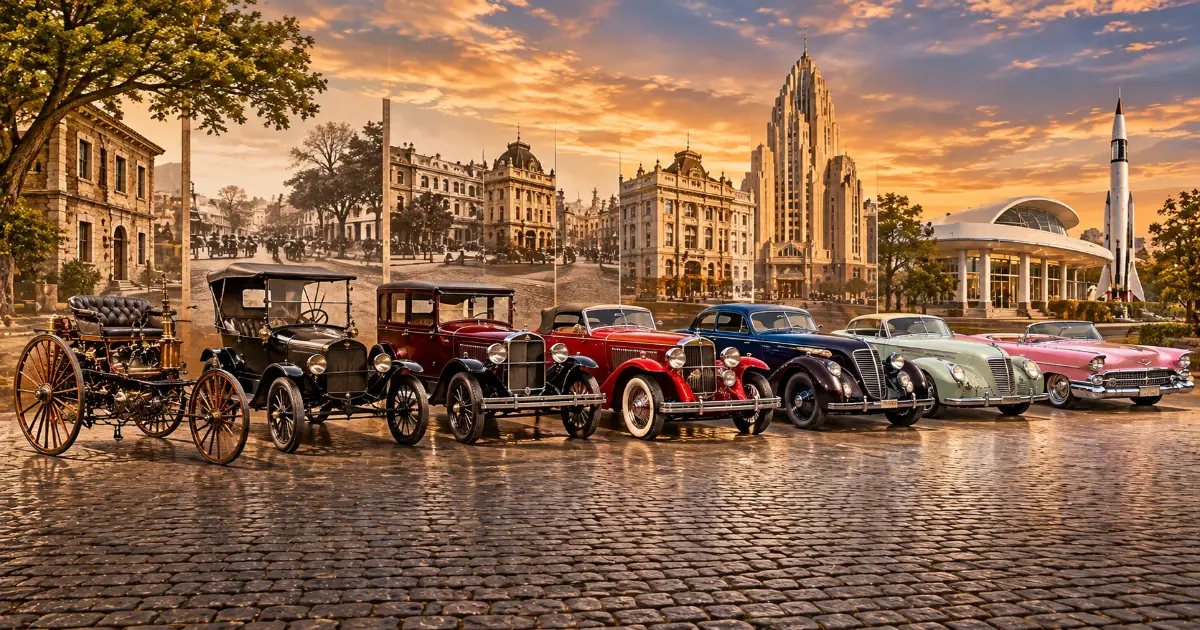
 Discover how engineering breakthroughs, Art Deco styling, streamlined bodies, and Jet Age innovations transformed early horseless carriages into the iconic classic cars that shaped automotive history.
Early cars were carriages without horses. Within about 60 years they became sealed steel bodies, then teardrops, then jet-age sculptures. Four forces drove the change: engineering (engines, steel, suspension), manufacturing (the assembly line), fashion (Art Deco, streamlining, the Jet Age) and a new profession, the car stylist. Learn the design eras and you can date a classic at a glance.
Why design history matters to classic car fans
Every classic car is a time capsule. The height of the roofline, the shape of the fenders, the position of the headlights, even the gear lever tells you what engineers could build, what factories could afford and what buyers wanted at that moment.
Understanding the evolution helps you:
- Date and identify a car by its shape.
- Judge originality, because changes in fenders, lights and bodywork reveal later modifications.
- Appreciate the stories behind famous designs, including the commercial failures that were ahead of their time.
- Know what is rare, since many of the boldest designs were produced in tiny numbers.
This guide covers the period before the modern car era, from the first steam and gasoline vehicles in the 1700s and 1880s to the Jet Age of the late 1950s.
12 Rare Classic Motorcycles That Became Valuable Collector’s Treasures
How to Find Classic Cars for Sale by Owner in the USA
The design eras at a glance
| Era | Approx. dates | Defining look | Key examples |
|---|---|---|---|
| Horseless carriage | 1769 to 1900 | Carriage body, tiller or wheel steering, exposed engine | Cugnot’s steam vehicle, Benz Patent-Motorwagen |
| Early motorcar | 1901 to 1914 | Front engine, higher bodies, open tourers | Mercedes 35 hp, Ford Model T |
| Closed-body era | 1919 to 1930 | Steel, enclosed, boxy | Hudson, Essex, Budd bodies |
| Styling is born | 1927 onward | Designer-led, colorful | LaSalle (1927) |
| Streamlined / Art Deco | 1930s | Teardrops, fastbacks, curves | Tatra T77, Airflow, Cord 810, Talbot-Lago |
| Pontoon / envelope | 1920s precursors, mainstream late 1940s to 1960s | Fenders merged into the body | Hanomag 2/10 PS, Thunderbolt, postwar sedans |
| Jet Age | 1948 to 1958 | Tailfins, chrome, wraparound glass | 1948 Cadillac, GM Le Sabre |
1. The Horseless Carriage (1769 to 1900)
Steam first
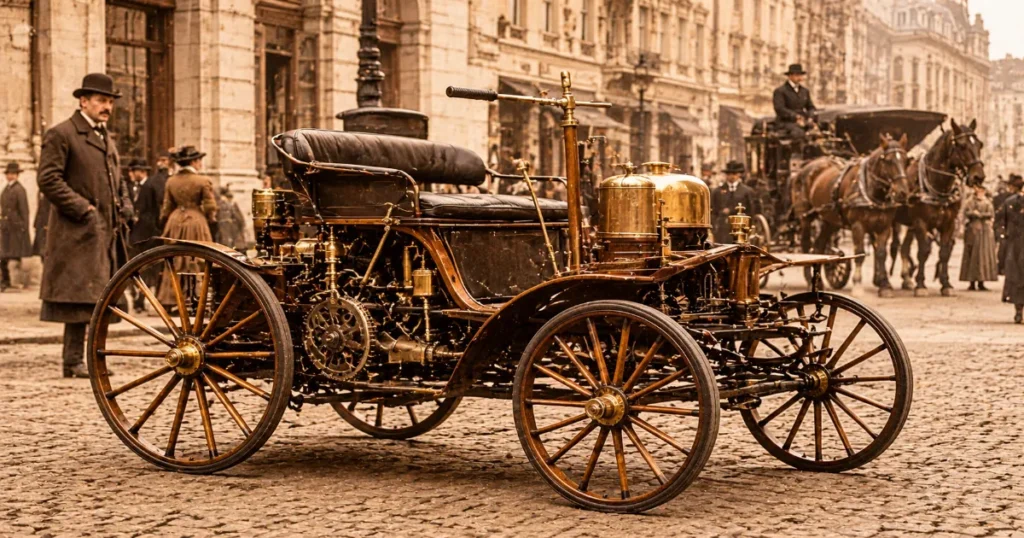 The first self-propelled road vehicles ran on steam. Nicolas-Joseph Cugnot’s steam-powered fardier of 1769 (a heavy artillery tractor) is usually cited as the first. In 1801, the “Puffing Devil” became the first steam car in some histories. These were machines, not designs: they were noisy, heavy and impractical.
Steam vehicles had their problems. A Dudgeon steam car (1857) in New York was reportedly so loud that the city confined it to one street, and in 1865 the UK set a national motorcar speed limit of about 4 mph (6 km/h).
The Benz Patent-Motorwagen
On January 29, 1886, Carl Benz applied for a patent for a “vehicle powered by a gas engine,” a filing Mercedes-Benz calls “the birth certificate of the automobile.”
Key facts:
- Three wheels.
- One-cylinder engine producing less than one horsepower (about two-thirds of a horsepower in another account).
- Top speed about 10 mph (16 km/h).
- Reported price of 600 imperial marks.
- Benz built over 500 by the end of the 19th century.
How these cars looked
Design was borrowed from carriages. Cars had:
- Tall, narrow bodies and wire or wooden-spoke wheels
- Tiller steering on some early machines
- Exposed engines and drive chains
- No windscreens, doors or roofs in many cases
- Bodies built by carriage makers, not car factories
Why it matters: the very name “horseless carriage” described how designers thought about the car, as a carriage with a motor. It took decades to unlearn that.
Early market: by 1900, over 100 companies were making automobiles in the US, and Oldsmobile sold over 3,000 cars in 1902.
2. The Car Finds Its Form (1901 to 1914)
 The Mercedes 35 hp (1901)
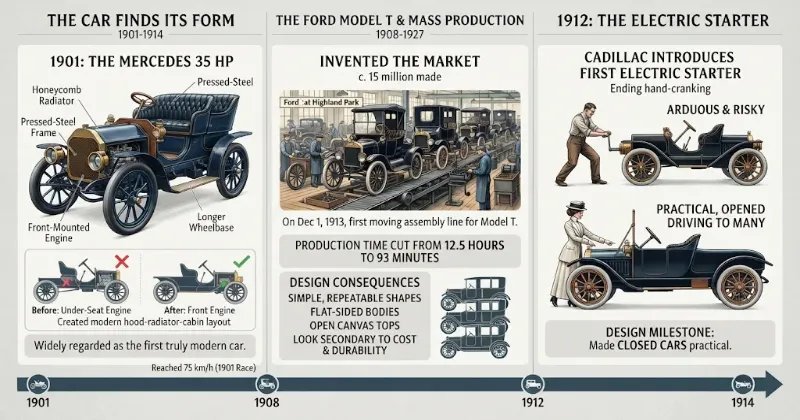
The 1901 Mercedes 35 hp, designed by Wilhelm Maybach for the Mercedes agent Emil Jellinek, is widely regarded as the first truly modern car. It combined a front-mounted engine, a pressed-steel frame, a lower center of gravity, a honeycomb radiator and a longer wheelbase. It is an important reference point because it moved the engine from under the seat to the front, which created the hood, radiator and passenger cabin layout that lasted for a century. (A Mercedes reached 75 km/h at a 1901 race in France.)
This paragraph relies on widely accepted history rather than a single source I could open. Verify details if you quote it as fact.
The Ford Model T and mass production
Henry Ford’s Model T (built 1908 to 1927, about 15 million made) did not invent a style. It invented the market.
- On December 1, 1913, Ford’s first moving assembly line for the Model T cut production time from 12.5 hours to 93 minutes.
- Mass production meant simple, repeatable shapes with few options.
Design consequences
- Bodies had to be easy to build, so shapes were upright and flat-sided.
- Cars were mostly open, with canvas tops.
- Look was secondary to cost and durability.
1912: the electric starter
In 1912, Cadillac introduced the first electric starter, ending the need to hand-crank engines. This is a design milestone as well as an engineering one: it opened driving to far more people and made the closed car, which is harder to crank from, practical.
3. The Closed Steel Body (1919 to 1930)
In the early 1900s, most cars were open, with canvas tops and side curtains. Closed bodies were expensive because they were built of wood and fabric on a separate frame. The 1920s changed this.
The shift from open to closed
| Year | Open cars | Closed cars |
|---|---|---|
| 1919 | 90% | 10% |
| 1924 | 57% | 43% |
| 1927 | 15% | 85% |
Source: John Gunnell, “Convertibles: The Complete Story” (1984), as presented by Automobile and American Life.
What drove it
- All-steel construction (pioneered by companies such as Budd) made closed bodies cheaper, stronger and quieter. A 1926 Budd advertisement told buyers to “put the protection of all-steel between you and the risks of the road,” citing “19,000,000 cars” on US roads.
- Hudson is credited with first mass-producing a closed car in 1921.
- Heaters began to appear on a mass basis around 1925.
- The word “convertible” was first used in 1927 and officially entered the Society of Automotive Engineers lexicon in 1928, a sign that open cars had become the specialty choice.
The look: tall, upright, square-shouldered sedans with separate fenders, running boards and exposed headlamps and spare tires: a “three-box” shape (hood, cabin, trunk) that anyone would recognize as a classic car.
Coachbuilding vs. mass production
At the luxury end, buyers still ordered a chassis from Rolls-Royce, Duesenberg or Bugatti and had a coachbuilder make the body to order. At the mass end, factories delivered complete cars at a fixed price. Over time, the economics pushed more brands to in-house bodies, and designers working inside the factory gained influence. That led directly to the next development.
4. The Birth of Styling (1927)
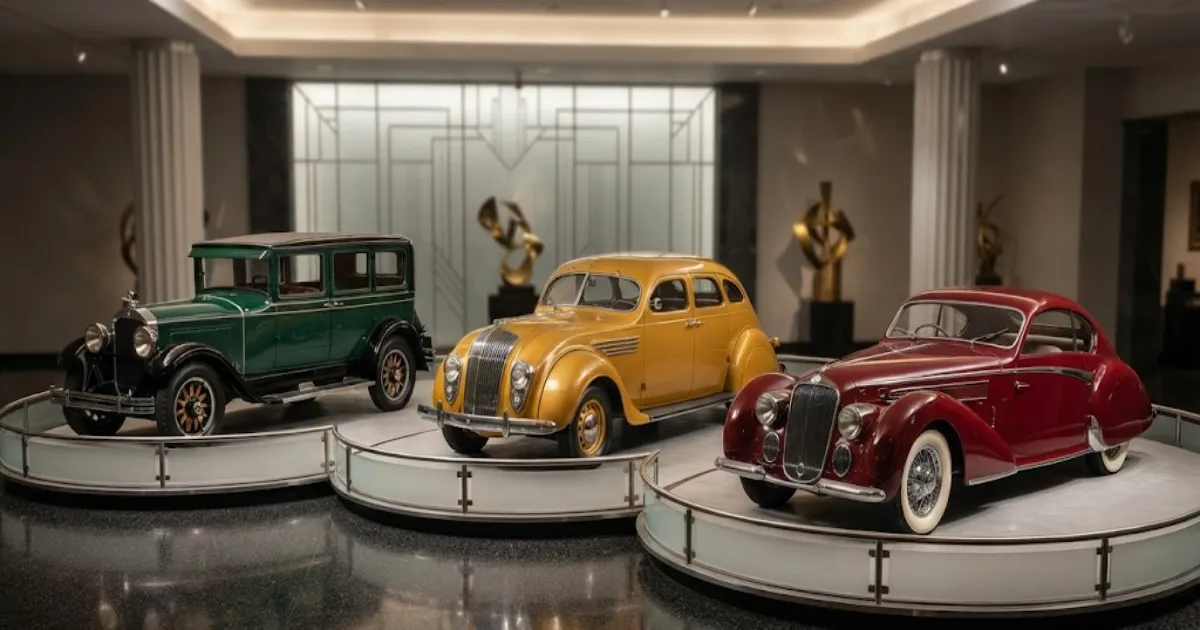 Until the late 1920s, the people shaping a car were mostly engineers and body builders. Harley Earl changed that.
Harley Earl (1893 to 1969)
- Born in Hollywood, California. His father’s Earl Automobile Works (founded 1908) was later bought by Cadillac dealer Don Lee, who kept Earl as director of its custom body shop.
- Lawrence P. Fisher commissioned him to design the 1927 LaSalle, Cadillac’s companion marque.
- Its success led GM president Alfred P. Sloan to create the “Art and Colour Section” in 1927, with Earl as its first director. It was renamed the Styling Section in 1937.
- Earl is also linked to the Buick Y-Job, called the industry’s first concept car (sources date it 1938 or 1939).
- He retired in 1958, at the mandatory age of 65.
Why it matters
- It established styling as a corporate function, separate from engineering.
- It brought annual model changes and fashion into automotive design.
- The LaSalle and its successors introduced the idea that a car’s appearance sells it.
5. Art Deco and Streamlining: The 1930s
The 1930s produced some of the most beautiful and most daring cars ever made. Designers borrowed from aircraft, airships, trains and ocean liners.
The science
- Early aerodynamics was driven by record cars. Camille Jenatzy broke the 100 km/h barrier on April 29, 1899, in the torpedo-shaped La Jamais Contente. The Golden Arrow (1928) was another experimental land-speed car.
- Paul Jaray, a Hungarian-born engineer, studied airship design at Luftschiffbau Zeppelin from 1915, using its wind tunnel. In the 1920s, he developed streamlining principles and tried to license them to car makers.
- Tatra was the only company to mass-produce a streamlined car with him. With designer Hans Ledwinka, it revealed the T77 in 1934: low and sleek, with a fin along the back. Its successor, the T97, influenced Ferdinand Porsche’s design for the KdF-Wagen (the Volkswagen Beetle).
The key cars
| Car | Year | Notable design facts |
|---|---|---|
| Chrysler Airflow | 1934 | Passenger compartment moved between the axles; sold 10,838 in 1934 and 7,751 in 1935; production ended after 1937 |
| Tatra T77 | 1934 | Streamlined, rear-engined, dorsal fin |
| Citroën Traction Avant | 1934 | Credited as the first mass-produced front-wheel-drive car |
| Pierce-Arrow Silver Arrow | 1933 | V12; five built; $10,000 price; shown at the 1933 Chicago World’s Fair; all five sold, at a loss on each |
| Cadillac V-16 Aerodynamic Coupe | 1934 | Styled at GM’s Art and Colour Section; eight built across 1934, 1936 and 1937 |
| Packard Twelve 1106 Sport Coupe | 1934 | LeBaron-bodied; fastback roof, pontoon fenders |
| Peugeot 402 | 1935 | “Sochaux spindle” shape; no running boards; built 1935 to 1942 |
| Lincoln-Zephyr | 1936 | Designed by John Tjaarda; unitized body-and-frame; priced around $1,300 versus $4,000+ for the Model K; about 15,000 sold in its first year |
| Cord 810 | 1936 | Front-wheel drive, independent front suspension, unitized body, pop-up headlights; designed by Gordon Buehrig; the Cord 812 appeared in MoMA’s 1951 “8 Automobiles” exhibition |
| Stout Scarab | 1936 | Rear Ford flathead V8, about $5,000, likely single-digit production |
| Tatra T97 | 1938 | Rear fin for stability; production of 4 (1937), 237 (1938), 269 (1939) |
| Talbot-Lago T-150C-SS Teardrop | 1938 | Figoni & Falaschi “Goutte d’Eau” body; about 2,100 labor hours per body |
The Airflow lesson
The Chrysler Airflow shows that great engineering does not guarantee sales. It debuted in January 1934, the same year as the Tatra T77, and the article I read notes a “dubious similarity” to ideas Jaray had tried to sell to Chrysler. Its sales fell from 10,838 (1934) to 7,751 (1935) and it was dropped after 1937. Its radical look is often blamed, though sources differ on exactly why it sold poorly.
Streamlining as a cultural movement
Streamlining spread beyond cars to pencil sharpeners, fans, hats, chairs, irons and meat slicers. Raymond Loewy’s 1930 Chart of the Evolution of Design presented it as a natural step in evolution. Much of the car styling of the era was fashion, not physics, an important point when judging which features were functional.
6. The Pontoon Body (1924 to the 1950s)
For decades, cars wore separate fenders (wings) over the wheels, with running boards between them. The pontoon or envelope body merges the fenders into the body, giving a smooth, slab-sided shape.
Milestones
| Date | Car | Note |
|---|---|---|
| 1923 | Bugatti T32 “Tank” | Four race cars with airfoil-shaped bodies |
| 1924 | Hanomag 2/10 PS | First pontoon production car; rear-mounted 500cc engine; about 15,000 made over five years |
| 1928 | Martin Aerodynamic | American rear-engined prototype with pontoon fenders |
| 1932 | Maybach DS 8 Stromlinie | Shown at the Berlin Motor Show; described as the first really big car with fully integrated fenders |
| 1933 | Pierce-Arrow Silver Arrow | Integrated front fenders |
| 1941 | Chrysler Thunderbolt | Early pontoon with hidden headlights |
| 1946 | GAZ Pobieda, Kaiser-Frazer, Crosley and others | “Everyone was at it” |
| Early 1960s | The pontoon had “decisively won” |
World War II slowed the change in America, delaying pontoon fenders on most cars until the late 1940s. Cars with separate fenders, such as the Citroën 2CV, Morgan and VW Beetle, lasted for decades, showing that tradition has staying power.
7. The Jet Age and the Tailfin (1948 to 1958)
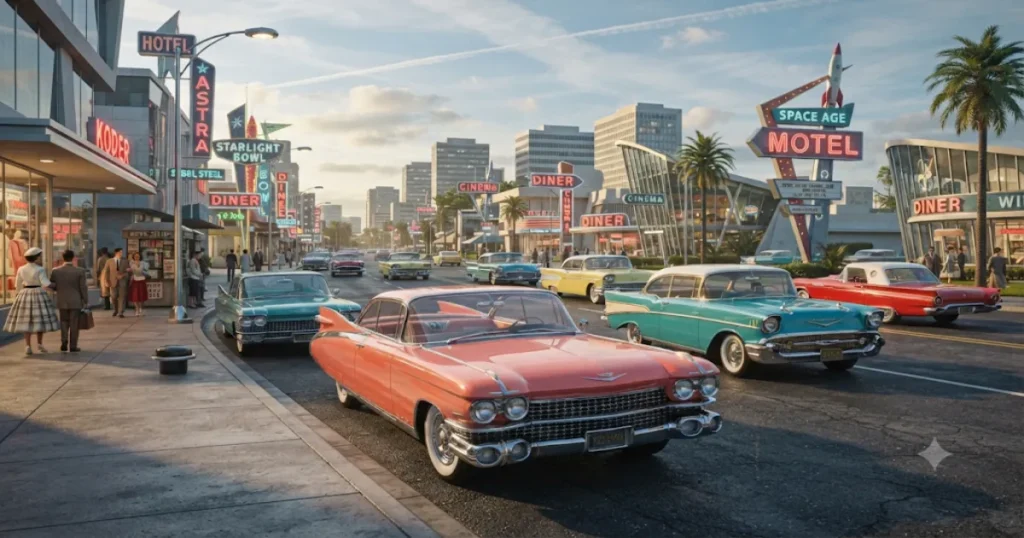 After the war, highways spread, and the jet airplane became the symbol of the future. Designers swapped streamlining for jet-inspired styling.
The first tailfin
- The 1948 Cadillac carried the first automotive tailfin, a design by Frank Hershey that Harley Earl authorized, inspired by the Lockheed P-38 Lightning. Cadillac’s purely decorative fins started a trend.
- GM’s Le Sabre concept (1951) followed the Y-Job.
- The Chevrolet Corvette went on sale in 1953.
- Designs gained “dagmar” bumpers, wraparound windshields and heavy chrome. The V&A article notes these had “nothing to do with actual speed.”
What it tells us: by the 1950s, styling had become the main reason to buy a new car. Fashion moved the market, and annual model changes made last year’s car look old.
How technology shaped the shape
Design did not change in isolation. These engineering advances made new shapes possible:
| Technology | When | Design effect |
|---|---|---|
| Front-mounted engine layout | Early 1900s | Created the hood and cabin proportions |
| Electric starter | 1912 (Cadillac) | Closed cars practical, more drivers |
| Moving assembly line | 1913 | Simple, repeatable shapes |
| All-steel closed bodies | 1920s | Enclosed cabins, quieter and safer |
| Heaters | About 1925 | Closed bodies comfortable in winter |
| Independent front suspension | Mercedes 1932; Cadillac, Buick, Oldsmobile, Chrysler 1934 | Better ride, lower hoods |
| Front-wheel drive | 1934 (Citroën Traction Avant), Cord 810 (1936) | Lower floors, no driveshaft tunnel |
| Unitized body | 1936 (Lincoln-Zephyr, Cord 810) | Lighter, lower cars, with less need for a separate frame |
| Cabin heating system | 1937 (Nash WeatherEye) | More comfort and cars used year-round |
| Column-mounted gear selector | 1939 (Plymouth P8 among early adopters) | Roomier front seats |
How to spot a classic’s era
Use this field guide at a car show.
| Clue | Likely era |
|---|---|
| Tall, narrow body, wooden spokes, exposed engine, brass trim | Pre-1915 |
| Tall closed body, separate fenders, running boards, upright grille | 1920s |
| Sloping grille, skirted fenders, fastback tail, hidden spare | 1930s streamlined |
| Headlamps built into the fenders, full-width body | Late 1930s to 1940s |
| Slab sides, no running boards, integrated fenders | Late 1940s to 1950s |
| Chrome, wraparound windshield, tailfins | Mid-1950s Jet Age |
Tips for buyers
- Compare the car with period photos and factory literature to spot replacement parts.
- Fenders and lights are the most commonly altered features.
- Rare coachbuilt cars should be documented, because replicas and re-bodied cars exist.
- Always get an expert inspection before you buy a pre-war car.
FAQ
What was the first car design? Cugnot’s steam-powered fardier of 1769 is usually cited as the first self-propelled road vehicle, and Carl Benz’s 1886 Patent-Motorwagen is regarded as the first practical gasoline-engined automobile.
When did cars stop looking like carriages? Gradually between about 1901 (Mercedes 35 hp) and the 1920s, as engines moved to the front and closed steel bodies replaced open wooden ones. By 1927, 85% of US cars were closed.
Who invented car styling? Harley Earl is credited with creating the first in-house styling department at General Motors, the Art and Colour Section, in 1927.
What was the first streamlined production car? It depends on the definition. Tatra’s T77 (1934) was a pioneering streamlined production car, and Chrysler’s Airflow also debuted in 1934. The Hanomag 2/10 PS (1924) is cited as the first pontoon production car.
Why did the Chrysler Airflow fail? Sales were weak (10,838 in 1934, 7,751 in 1935) and production ended after 1937. Its radical styling is often blamed, though the exact reasons are debated.
What are tailfins and who started them? Tailfins are decorative rear fins. The 1948 Cadillac, designed by Frank Hershey and approved by Harley Earl, carried the first, inspired by the Lockheed P-38 Lightning.
What is a pontoon body? A body in which the fenders are fully integrated into the main body, replacing separate wings and running boards.
Which classic design eras are most collectible? Collectors prize coachbuilt cars of the 1920s and 1930s, streamlined Art Deco designs and Jet Age icons, mainly because of rarity and design significance. Condition and provenance matter as much as era.
Conclusion
In a little over half a century, automotive design went from carriages with engines to sculpted, steel-bodied machines that reflected the technology, economics and fashion of their time. Engineering opened the door (front engines, starters, steel bodies, front-wheel drive), mass production set the rules, and stylists such as Harley Earl made appearance a selling point. Next time you walk past a classic, check the fenders, the roofline and the lights. The whole history is written in its shape.
AWD vs 4WD: Which Is Better for Snow, Off-Road & Everyday Driving?
Sportbike vs Cruiser: Which Motorcycle Fits Your Riding Style?
🔹🔹 Follow us on facebook 🔹🔹