
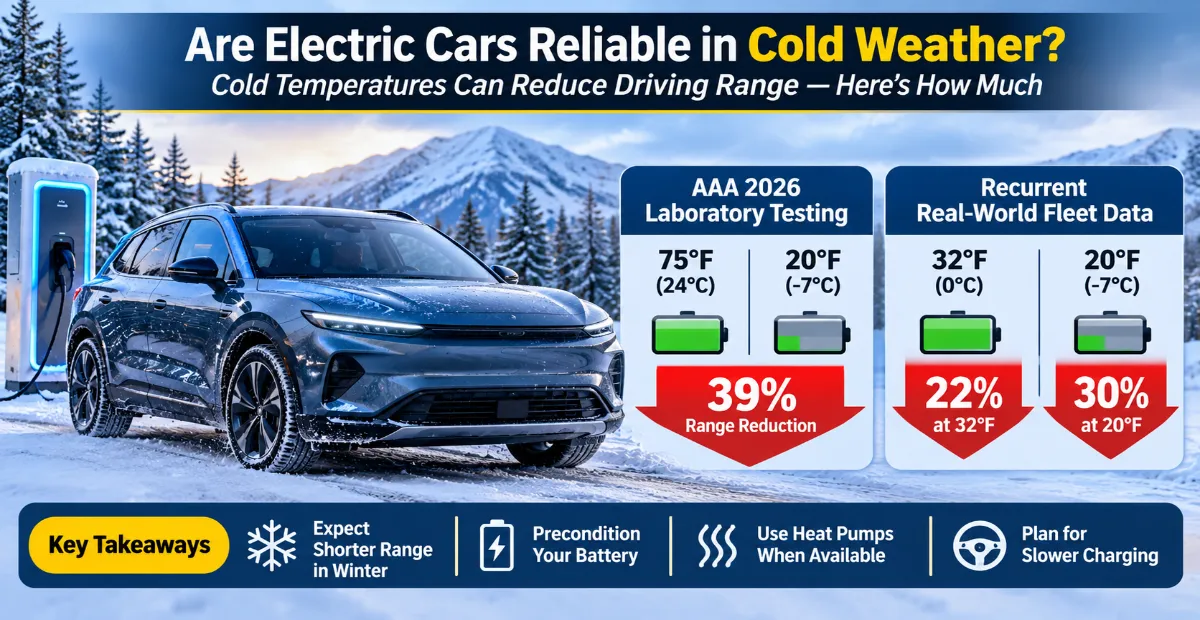
 Lab tests and fleet data disagree on winter range, which is why drivers who ask are electric cars reliable in cold weather get more than one answer.
AAA’s 2026 lab testing found that electric vehicles lose an average of 39 percent of their driving range at 20°F compared with 75°F, about the same as in its 2019 study. Real-world fleet data from Recurrent tells a milder story: roughly 78 percent of normal range at 32°F and about 70 percent at 20°F. Both are accurate, and the gap between them is where the real question lives: are electric cars reliable in cold weather?
The honest answer is that the cars start, drive and heat themselves, but range shrinks, fast charging slows and the penalty varies widely by model. This guide separates the temporary losses from the ones that matter, explains what heat pumps and preconditioning actually do, and ends with a checklist for buyers in cold states. Figures were checked against AAA, Recurrent, Idaho National Laboratory and Norwegian registration data as of November 16, 2026, and the text notes where evidence is older or comes from a single source.
The Short Answer: Reliable, but Range and Charging Speed Change
Cold weather does not make an electric car stop working. It makes the car less efficient, and that shows up in three places: driving range, charging speed and operating cost. The losses are real but, according to Recurrent, temporary: range returns when temperatures rise, and the company’s data shows no long-term harm to the battery from winter driving.
| What changes in cold | Size of the effect | Source |
|---|---|---|
| Range at 20°F (lab, heater running) | About 39% lower than at 75°F | AAA, 2026 |
| Range at 32°F (real-world fleet) | About 22% lower; models range from 12% to 31% lower | Recurrent, 2025-26 |
| Range at 20°F (real-world fleet) | About 30% lower | Recurrent, 2025-26 |
| Fast-charging speed | Slower; one 2018 study found about 36% less charge after 30 minutes at 32°F | Idaho National Laboratory |
| Winter operating cost | About $32 more per 1,000 miles at home, about $77 more on public fast chargers | AAA, 2026 |
How Much Range You Actually Lose
AAA tested vehicles on a chassis dynamometer with the cabin held at 72°F, so the heater ran continuously. At 20°F, EV efficiency fell 35.6 percent and driving range fell 39.0 percent compared with 75°F. In hot weather, at 95°F, range fell 8.5 percent. AAA notes the cold-weather penalty has barely changed since 2019, even as high-temperature losses shrank from 17 percent to 8.5 percent.
Recurrent’s numbers come from telematics. Its 2025-26 winter study of more than 30,000 U.S. vehicles found that the 34 models analyzed averaged 78 percent of normal range at 32°F, with the best retaining 88 percent and the worst 69 percent. At 20°F, vehicles maintained about 70 percent on a like-for-like basis. Tesla models led the ranking, with the Cybertruck, Model X and Model S at the top, while the Cadillac Lyriq, Chevrolet Equinox EV and Blazer EV lagged despite having heat pumps.
Why the gap between the lab and the road? AAA’s protocol is deliberately harsh, with the heater on the whole time, while fleet data reflects real driving patterns and temperatures that are often milder than the coldest lab setting. Treat the AAA number as a worst-case planning figure and the Recurrent numbers as a typical winter day.
A hybrid is not immune. AAA found hybrids lost 22.8 percent of their fuel economy at 20°F, because of engine warm-up cycles and cabin heating. Cold weather lowers efficiency in nearly every kind of car, and gasoline engines can warm the cabin with waste heat while EVs generally cannot.
Why Cold Hits Electric Cars Harder
The largest single cause is cabin heat. An EV has no engine waste heat to borrow, so it must produce warmth from the battery. AAA’s 2019 test found that at 20°F with climate control off, range fell only about 12 percent, but with the heater on the loss reached 41 percent, which suggests heating can account for most of the penalty.
The battery itself is the second factor. Cold slows the chemical reactions inside the cells, which reduces how efficiently stored energy reaches the wheels. A battery does not permanently lose capacity when it gets cold. The energy is diverted to heat and other loads, and the lost range returns once the pack warms. A 2025 laboratory study cited by MOTOR magazine supports that most cold-related capacity loss is reversible.
There is one exception that engineers highlight. MOTOR notes that DC fast-charging a pack that is below freezing can cause lithium plating and irreversible capacity loss. This is a reason to let the car precondition its battery before a fast-charge stop, and it is why modern cars limit charging speed when the pack is cold.
Heat Pumps and Battery Chemistry
A heat pump moves heat from outside air into the cabin, using far less energy than a resistive heater. Recurrent’s earlier analysis of about 18,000 vehicles across 20 models found that EVs with heat pumps retained an average of 83 percent of range in freezing weather, compared with 75 percent for those without. The company also found that cars with lithium iron phosphate batteries did not perform noticeably worse than those with NCA chemistry in freezing temperatures.
Heat pumps have limits. Their advantage shrinks as temperatures fall toward 0°F, where they become about as efficient as a resistive heater. A heat pump is also not a guarantee: the Equinox EV and Lyriq retained 74 and 72 percent in the earlier study despite having one, and Recurrent was still investigating why. In that earlier analysis the Volkswagen ID.4 retained the least, at 63 percent, while the Tesla Model X retained 89 percent. Check whether the specific trim you are considering includes a heat pump, since some trims do not.
Charging in the Cold
Charging is where cold weather becomes an inconvenience. Idaho National Laboratory analyzed about 500 DC fast-charging sessions by New York City taxis, all Nissan Leafs on 50-kilowatt chargers, at temperatures from 15°F to 103°F. At 77°F a fast charger might fill a battery to 80 percent in 30 minutes. At 32°F the state of charge after the same time was 36 percent lower, and in the coldest conditions the charging rate was roughly three times slower. The study is from 2018 and covered one vehicle type, so modern cars with active battery heating and faster chargers may do better, but the direction is consistent with what drivers report.
During an arctic blast in Illinois, Fox Weather found drivers waiting in lines of about 40 cars at a charging station, with one reporting that a fill that normally takes 10 to 15 minutes was taking an hour and 20 minutes. EVs slow charging deliberately when the pack is cold to protect the battery, and they may spend some incoming power warming the battery first. KBB notes that some cars precondition automatically when you set a fast charger as your navigation destination.
The cost of that cold also depends on where you plug in. AAA calculated that sub-freezing driving raised operating costs by about $32.11 per 1,000 miles for EV owners charging at home, but about $76.93 for owners who rely entirely on public fast chargers, using national average prices from March 2026. For comparison, hybrid drivers spent about $28.44 more per 1,000 miles on gasoline.
What Norway Does and Does Not Prove
Norway is the standard example of EVs working in the cold. In 2025, 95.9 percent of new cars registered there were fully electric, according to the Norwegian Road Federation, and the country’s automobile club runs an annual winter range test. In its 23-car test, MOTOR reports, losses of up to 32 percent compared with official range ratings were measured.
The lesson is useful but limited. Norway has long used tax policy to favor EVs, and buyers rushed to beat tax increases arriving in 2026. As an editorial note, charging and housing conditions there also differ from many American ones. Norway shows that EVs can function through sustained cold, not that every U.S. driver will have the same experience.
Starting Reliability: What Roadside Data Suggests
Range is not the only meaning of “reliable.” A car that will not start on a frozen morning is a bigger problem than one that goes 25 percent less far. Evidence on this point is thinner than the range data and comes from Norway. A summary of a January 2024 analysis by the Norwegian roadside service Viking, published by the charging company go-electra, says that in extreme cold electric cars had fewer starting problems than combustion vehicles, whose most common breakdown causes were weak 12-volt batteries and frozen diesel. That is a secondary account of a single country’s roadside calls, so it is a hint, not proof, but it points the same way as the broader data: the cold is mostly a range and charging problem, not a breakdown problem.
What to Do Before and During Winter
A few habits recover much of the lost range. Precondition the cabin and battery while the car is still plugged in, so the energy comes from the grid instead of the battery. Use heated seats and the heated steering wheel to warm yourself instead of the cabin heater alone, advice AAA and Electrify America both give, and, as Fox Weather’s guidance notes, leave the car on while it is plugged in so cabin heat does not draw on the battery. Park in a garage when you can, since a warmer battery holds charge and accepts it faster.
Plan more conservatively. As an editorial rule of thumb consistent with the data above, assume 25 to 40 percent less range than the rated figure on a cold day, and allow extra time at fast chargers. Keep a buffer in the battery so a slow charge or a closed station does not strand you.
A Worked Example: Planning a Winter Trip
Numbers make the planning rule concrete. Take a car rated for 250 miles. At Recurrent’s fleet figure of about 70 percent at 20°F, that is roughly 175 miles. At AAA’s laboratory loss of 39 percent, it is about 152 miles. Neither number is usable in full, because a driver who wants to arrive with a cushion and avoid the slowest part of a fast-charging session should not plan to run the battery near empty. Leave 20 percent in reserve and the usable range on a harsh day is closer to 120 miles, and on a typical freezing day closer to 140.
For a 100-mile one-way trip, that is the difference between arriving comfortably and needing a charging stop. The same trip on a 70-degree day would usually be a non-event. This arithmetic uses the published figures above and is illustrative, not a prediction for any particular car, so check the winter results for the model you are considering.
Who Should Think Twice
The data points to a few situations where cold weather matters more. Drivers without home or workplace charging rely on public fast chargers, which are slower in the cold and cost more per mile. Drivers with long rural routes and sparse charging have the least margin. And buyers of trims without a heat pump will see larger losses in the average winter.
Drivers who commute well within the car’s range and charge at home will mostly notice the loss as a smaller number on the dashboard. A 250-mile car that behaves like a 175-mile car in a cold snap still covers most daily trips.
A Buying Checklist for Cold Climates
Ask whether the exact trim has a heat pump. Ask whether the car preconditions its battery for fast charging, and whether it does so automatically when you navigate to a charger. Look up winter range results for the specific model, from Recurrent or the Norwegian tests, instead of relying on the sticker figure. Confirm you can charge at home with a Level 2 charger. Budget for winter tires, which are an editorial recommendation rather than something the studies above measured. And check how reliable the fast-charging network is along the routes you drive in winter.
The Bottom Line
Electric cars work in cold weather, but they work differently. Expect roughly 20 to 30 percent less range on a typical freezing day, up to about 40 percent in harsh conditions with the heater running, slower fast charging, and a larger penalty for models without heat pumps. The losses are temporary, and the habits and equipment that reduce them are well understood.
Several things are worth watching: Recurrent’s continuing winter data, whether more automakers standardize heat pumps and automatic battery preconditioning, the next Norwegian winter tests, and the reliability of public fast chargers during cold snaps. For most buyers, the practical answer comes down to charging at home, picking a model with a heat pump and planning for less range, not more.
🔹🔹 Follow us on facebook 🔹🔹