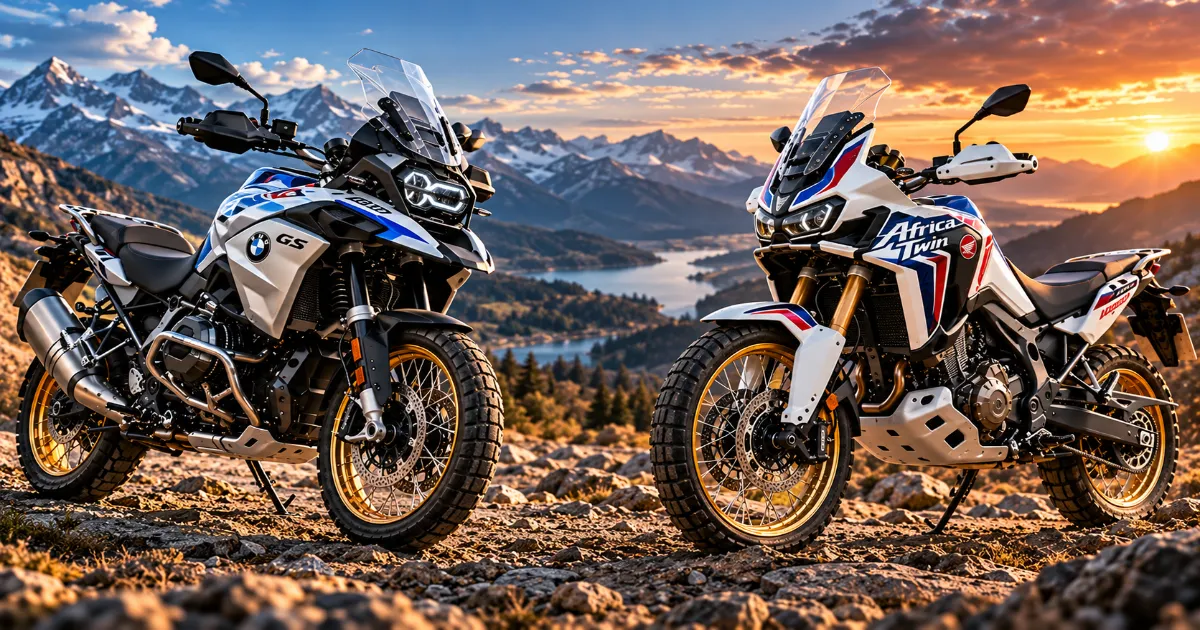
 Power, weight, price, comfort and service costs weighed up in the BMW GS vs. Honda Africa Twin showdown
The BMW GS and the Honda Africa Twin are two of the best-known big adventure motorcycles. The GS is a long-established name in the class, and the Africa Twin is Honda’s long-running answer, built around a tall front wheel, a parallel-twin engine and the option of a dual-clutch automatic. Both can cross a continent. They go about it in quite different ways.
This guide compares the current BMW R 1300 GS with the 2026 Honda Africa Twin on power, weight, seat height, price, off-road ability, touring comfort, electronics and servicing. It leans on spec listings, a 2026 comparison review, a BMW warranty document and two maintenance-schedule pages. Where sources disagree or I could not find a number, the article says so. Trim levels, options and destination charges change prices, so confirm everything with a dealer before you buy.
The Short Answer
Choose the BMW R 1300 GS if you want the most power and the most polished fast-road and highway experience, and you are comfortable paying more. Choose the Honda Africa Twin if you want a lower price, a 21-inch front wheel, a chain-drive layout, and the option of a DCT automatic.
A 2026 comparison on the Spanish island of Gran Canaria by the reviewers at 1000PS (a NastyNils review published January 31, 2026) called the result a near tie. They found the BMW better for highways and fast touring and the Honda better for winding, rough and off-road riding, with the reviewer leaning slightly toward the Honda, mainly for its suspension and reliability. That is one reviewer’s opinion on one test route, not a verdict on every rider.
BMW GS vs. Honda Africa Twin: Head-to-Head Specs
The table compares the base R 1300 GS with the 2026 Africa Twin DCT. The two bikes come from different spec sources, so treat small differences with care.
| BMW R 1300 GS (2026) | Honda Africa Twin DCT (2026) | |
|---|---|---|
| Engine | 1,300cc flat-twin | 1,083cc parallel twin |
| Power | 145 hp | 102 hp |
| Torque | 149.1 Nm | 112 Nm |
| Seat height | 33.4 in | 34.3 in |
| Wet weight | 523 lb | 535 lb |
| Fuel tank | 5 gal | 5 gal |
| Wheels | 19-inch front, 17-inch rear | 21-inch front, 18-inch rear |
| Final drive | Shaft (cardan) | Chain |
| ABS | Standard | Standard (linked brakes) |
| MSRP | $20,395 | $15,599 (plus $775 destination) |
Notes on the numbers:
- Sources. Seat height, weight, tank, wheels and price for both bikes come from Motorcycle.com’s listings, which give the BMW’s 145 hp and 149.1 Nm but no power figures for the Honda. The Honda’s 102 hp and 112 Nm come from 1000PS, whose 2026 review also lists 145 hp and 149 Nm for the BMW.
- Price conflict. Torquepedia lists the BMW at US$21,515 rather than $20,395. The gap may reflect destination charges or a different trim, but the sources do not say. Either way, the BMW costs roughly $4,800 to $5,900 more than the base Honda on listed MSRPs.
- Weight and seat height conflicts. Torquepedia lists 237 kilograms (522 lb) for the BMW and 231 kilograms (509 lb) for the Honda, and 1000PS lists the Honda at 231 kilograms as kerb weight, versus Motorcycle.com’s 535-pound wet figure. Those are different measurement bases. The seat height for the Honda is listed at 850 mm (up to 870) at 1000PS and 34.3 inches at Motorcycle.com, so the two bikes are close and the exact number depends on the setting and version.
- Honda trims. The Africa Twin comes in more than one version. A dealer listing for the Africa Twin Adventure Sports ES DCT shows an MSRP of $18,599, a 33.7-inch seat height and a 6.6-gallon tank, plus a $775 destination charge and a $398 dealer doc fee. That listing does not give weight or power. The BMW GS also has an Adventure sibling, not covered in this article’s table.
Engine and Performance
On paper, the BMW wins this round clearly. It makes about 43 more horsepower and 37 more newton-meters of torque than the Honda. Using the listed figures, the BMW has roughly 0.28 horsepower per pound against about 0.19 for the Honda, my calculation mixing two sources, so treat it as approximate.
In the 2026 comparison, the reviewers said the BMW pulls harder on fast roads and feels stable when pushed hard, especially above about 120 km/h (75 mph). They also noted the Honda’s power was rarely the deciding factor on the island’s twisty routes, where its DCT and suspension helped it hold its own and even feel quicker on tight roads.
Practical translation:
- If you ride mostly fast highways, canyon roads or two-up with luggage, the BMW’s extra power and torque are a real advantage.
- If you ride mixed terrain at moderate speeds, the Honda has plenty, and the extra power matters less than weight and suspension.
Weight, Seat Height and Ergonomics
Both bikes weigh over 500 pounds by wet-weight listings (523 and 535 pounds), so neither is light. Their seat heights are close: 33.4 inches for the BMW and 34.3 inches for the Honda in the Motorcycle.com listings. The 2026 reviewer described the Honda as heavy but easy to handle thanks to its low seat height, and noted the BMW’s electronics include a height adjustment that lowers the bike when stopped. The same review mentions a slide-back option on the Honda’s seat.
If you are under about 5’8″, sit on both. A bike’s seat height number tells only part of the story, because seat width, suspension sag and how the bike feels when it leans over decide whether you can flat-foot it.
Off-Road Ability
The Honda has the more traditional off-road layout: a 21-inch front wheel and 18-inch rear, against the BMW’s 19/17 road-oriented wheel sizes in the listing. The 2026 review credits the Honda’s Showa suspension (210 mm front, 200 mm rear travel) with handling rough surfaces, potholes and gravel with composure, while the BMW’s Telelever and Paralever setup (190 mm front, 200 mm rear) works best on predictable terrain.
The base Honda Africa Twin and the BMW R 1300 GS both lean toward adventure touring rather than hardcore trail riding at this weight, and neither is a lightweight dirt bike. In my judgment, that makes either one better suited to dirt roads and gravel than to technical single-track, and tire choice matters as much as the bike. The Honda listing shows Bridgestone Battlax Adventure A41 tires, so check what tires any bike you test is wearing.
Highway and Touring Comfort
For long days on pavement, the 2026 review found the BMW’s padded seat better suited to long highway rides, while Honda’s seat is firmer. The BMW’s controls were described as more intuitive, with a rotary wheel for navigating menus.
The same review had criticism for the BMW’s front collision warning system, which gave false alarms, and for the Honda’s many buttons and the need for a cable to use Apple CarPlay. These were the reviewers’ experiences with specific test bikes and software at the time.
An older review of a previous-generation Honda, the CRF1000L DCT (a 2017 RideApart review republished on Motor1), called it a strong long-distance bike with smooth power and a plush ride, and noted limited wind protection and no standard heated grips. That is a different generation, so use it only as background and check what the 2026 version includes.
Electronics and the DCT Option
The BMW R 1300 GS in the Motorcycle.com listing has standard ABS, but the page does not list ride modes or electronic aids, so this article does not describe them. Check BMW’s current spec sheet for the exact equipment on the trim you want.
The Honda offers a dual-clutch transmission (DCT) option, a dual-clutch automatic with no clutch lever in the 2017 review’s description. The 2026 reviewers said the DCT helped on twisty roads. The older CRF1000L review had mixed experiences with the DCT, including early shifts in some modes and a missing clutch lever that took getting used to, and the reviewer felt it diminished the riding experience for him while acknowledging it suits many riders. Try the DCT before you commit, because some riders love it and some do not.
Price and Running Costs
On listed MSRP, the Honda is the cheaper bike: $15,599 for the base DCT model versus $20,395 for the base BMW GS in the Motorcycle.com listings. The higher-spec Africa Twin Adventure Sports ES DCT is listed at $18,599 at one dealer, which narrows the gap with the BMW. Destination charges, dealer fees and options make the real gap vary.
For running costs, service schedules are the most concrete data the sources provide:
| Item | BMW R 1300 GS Adventure | Honda Africa Twin CRF1100L (2020+) |
|---|---|---|
| Oil change | Every 6,000 miles or 12 months | Every 8,000 miles or 1 year |
| Valve check | Every 12,000 miles | 16,000 miles |
| Final drive | Rear bevel-gear oil at 12,000 and 24,000 miles | Chain: inspect and lube every 600 miles |
| Brake fluid | After 1 year, then every 2 years | Not listed in the source’s summary |
Both schedules come from maintenanceschedule.com, which says its tables follow the owner’s manuals. The BMW schedule is for the R 1300 GS Adventure, not the base GS, and the Honda schedule is based on the 2020 owner’s manual for the CRF1100L generation, so check the manual for your exact model and year. The pattern is that the BMW calls for shorter intervals on oil and valve checks and has shaft-drive service items, while the Honda has a chain that needs regular cleaning, lubing and eventual replacement, with chain and sprocket wear called out in its schedule. Dealer labor rates and parts costs are not in the sources reviewed, so I cannot compare actual dollar costs.
Warranty and Reliability
BMW’s US warranty document for 2025 models lists 36 months or 36,000 miles on new motorcycles, covering defects in materials or workmanship, plus roadside assistance for 3 years with unlimited miles. Exclusions include tires, maintenance items and damage from lack of maintenance. I could not retrieve Honda’s current warranty terms, so the article does not compare them. Check both manufacturers’ terms for the model year you buy.
On reliability, the sources reviewed here give opinion, not data. The 2026 reviewer leaned toward the Honda partly for reliability, but I found no independent owner-survey or failure-rate data for either bike. Treat any claim about either bike’s reliability, including that one, as anecdotal until you check owner reports for the exact model year.
Who Should Buy Which?
| If you… | Lean toward |
|---|---|
| Ride fast roads, highways and two-up with luggage and want maximum power | BMW R 1300 GS |
| Want the lower purchase price | Honda Africa Twin |
| Prefer a 21-inch front wheel and more off-road emphasis | Honda Africa Twin |
| Want an automatic option | Honda Africa Twin DCT |
| Value a more intuitive menu system and padded seat for long days | BMW R 1300 GS |
| Prefer shaft drive over chain maintenance | BMW R 1300 GS |
| Plan to keep servicing intervals longer on oil and valves | Honda Africa Twin |
A Test-Ride Checklist
- Sit on both. Check your feet on the ground and the reach to the bars.
- Ride both on roads you know. A bike that feels great on a demo loop can feel different in your daily traffic.
- Try the DCT if you are considering the Honda automatic.
- Use the electronics. Scroll the menus, connect your phone and see if you like the interface.
- Price the exact trims, including destination, dealer fees, luggage and protection.
- Ask for the service schedule and an estimate for the first two services.
- Read the warranty for the model year you are buying.
Frequently Asked Questions
Is the BMW R 1300 GS faster than the Honda Africa Twin?
On the listed figures, yes: 145 hp and 149.1 Nm against 102 hp and 112 Nm. The 2026 review also found the BMW pulls harder on fast roads, though the Honda held its own on twisty roads.
Which is cheaper, the BMW GS or the Africa Twin?
The Africa Twin on listed MSRPs: $15,599 for the base DCT model plus $775 destination, against $20,395 for the base R 1300 GS in Motorcycle.com’s listing (another source lists $21,515). The higher-spec Africa Twin Adventure Sports ES DCT is listed at $18,599.
Which is better off-road?
The 2026 reviewers favored the Honda for rough surfaces, citing its suspension, and described the BMW as best on predictable terrain. The Honda also has a 21-inch front wheel. Both are heavy, so treat them as adventure tourers, not trail bikes.
Which is more comfortable for long highway rides?
The 2026 review favored the BMW for long highway rides, citing its padded seat, while the Honda’s seat was firmer. Seat comfort is personal, so ride both.
Is the Africa Twin lighter than the BMW GS?
Listings are close and measured differently: 535 pounds (wet) for the Honda DCT and 523 pounds (wet) for the BMW at Motorcycle.com. Neither is light.
Which has lower maintenance costs?
The sources reviewed do not give dollar costs. The schedules show the Honda with longer oil and valve intervals but a chain to maintain, and the BMW with shorter intervals and shaft-drive oil services.
Is the Honda Africa Twin more reliable than the BMW GS?
I found no independent reliability data. One reviewer leaned toward the Honda partly for reliability, but that is an opinion. Check owner reports for the model year you want.
What warranty does BMW offer on a new GS?
BMW’s 2025 US warranty document lists 36 months or 36,000 miles, plus roadside assistance for 3 years with unlimited miles. Confirm the terms for the model year you buy.
Should I buy the DCT version of the Africa Twin?
Try it first. The 2026 reviewers said it helped on twisty roads, but an older review of the previous generation had mixed feelings about it.
The Bottom Line
In the BMW GS vs. Honda Africa Twin matchup, there is no universal winner. The BMW offers more power, a more polished highway experience and a higher price. The Honda offers lower prices, a tall front wheel, a DCT option and a simpler, chain-driven layout. Pick the one whose weight, seat and personality feel right on your own test ride, then compare the exact trims, fees and service costs before you sign.
🔹🔹 Follow us on Facebook 🔹🔹