
 Mileage, drivetrain and EV guidance on when to rotate your tires
For most cars, SUVs and crossovers, the usual answer is every 5,000 to 7,500 miles, roughly every other oil change or about every six months. The exact number depends on your vehicle’s drivetrain, your tires and how you drive, and the owner’s manual outranks any general rule. If you want your tires to wear evenly, last longer and keep their tire warranty intact, it pays to rotate your tires on a schedule instead of waiting for a problem.
This guide pulls together recommendations from tire makers (Bridgestone, Michelin), a tire retailer (Tire Rack), the National Highway Traffic Safety Administration (NHTSA), AAA and other published sources. Because they do not all agree, I show the ranges side by side and say where figures are secondhand or come from marketing pages.
Can You Rent a Car in One City and Return It in Another?
Used Electric Cars vs Used Gas Cars: Which Is the Better Deal?
The Short Answer
Every source I checked lands in roughly the same neighborhood, with some variation at the edges:
| Source | Recommended interval |
|---|---|
| NHTSA | Every 5,000 to 8,000 miles if the manufacturer recommends rotation, or sooner if uneven wear appears |
| Bridgestone | Every 5,000 to 8,000 miles or every 6 months, or as the vehicle manufacturer recommends |
| Michelin | 5,000 to 7,000 miles, or every other oil change (its FAQ also gives 6,000 to 8,000 miles) |
| AAA | Every oil change on synthetic oil, typically every 5,000 to 6,000 miles |
| J.D. Power | 5,000 to 7,500 miles for front- and rear-wheel drive; 3,000 to 5,000 miles for all-wheel drive |
| Tire Rack | Every 3,000 to 5,000 miles |
Michelin’s page is internally inconsistent (5,000 to 7,000 miles in one place, 6,000 to 8,000 in its FAQ), and J.D. Power’s article is from October 2022, so I treat the ranges as a guide rather than a rule.
My practical takeaway: if your owner’s manual gives a number, use it. If it does not, rotating every 5,000 to 6,000 miles, or at every oil change, sits comfortably inside what most of these sources recommend. Drivers of AWD vehicles, performance cars and trucks should lean toward the shorter end.
Why You Should Rotate Your Tires
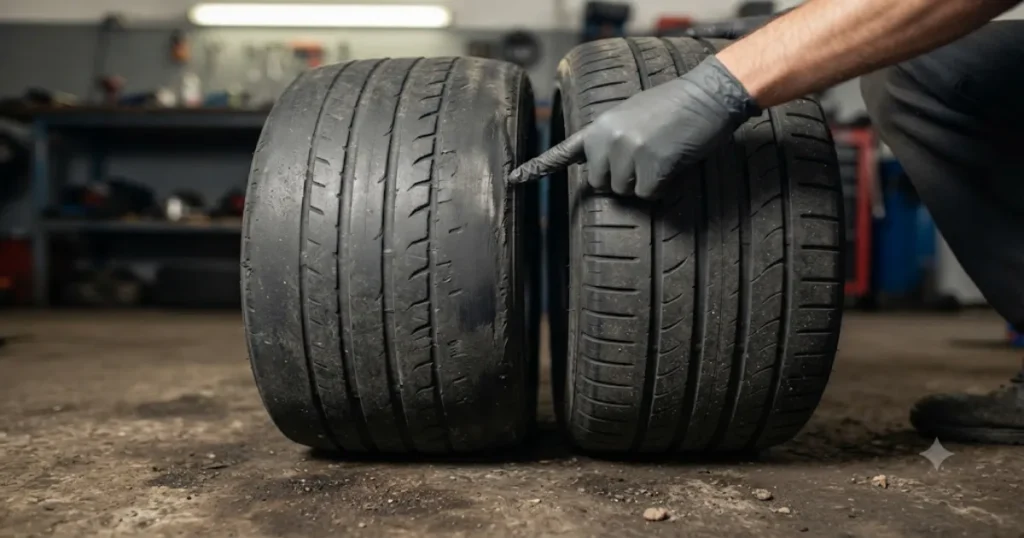 Tires on different corners of a car wear differently. Michelin says front tires wear faster because they handle steering, braking and cornering forces. Rotation moves each tire to a new position so that wear evens out.
Bridgestone and Tire Rack list the benefits:
- Longer tread life. Wear is spread across all four tires instead of concentrating on one axle.
- More consistent grip. Even tread depth supports steadier traction, handling and braking.
- Quieter ride. Tire Rack says rotation reduces tread-pattern noise; Michelin says skipping it can bring more road noise or vibration.
- Easier replacement. With even wear, Tire Rack notes you can replace a full set at once and pick a newer tire instead of matching a partly worn pair.
- Warranty protection. Many tread-life warranties require documented rotation (more on that below).
- AWD drivetrain protection. Bridgestone says even wear reduces stress on drivetrain components on all-wheel-drive vehicles.
Skipping rotation does not cause an immediate problem. The cost shows up gradually as uneven wear that you cannot reverse.
Rotation Patterns by Drivetrain
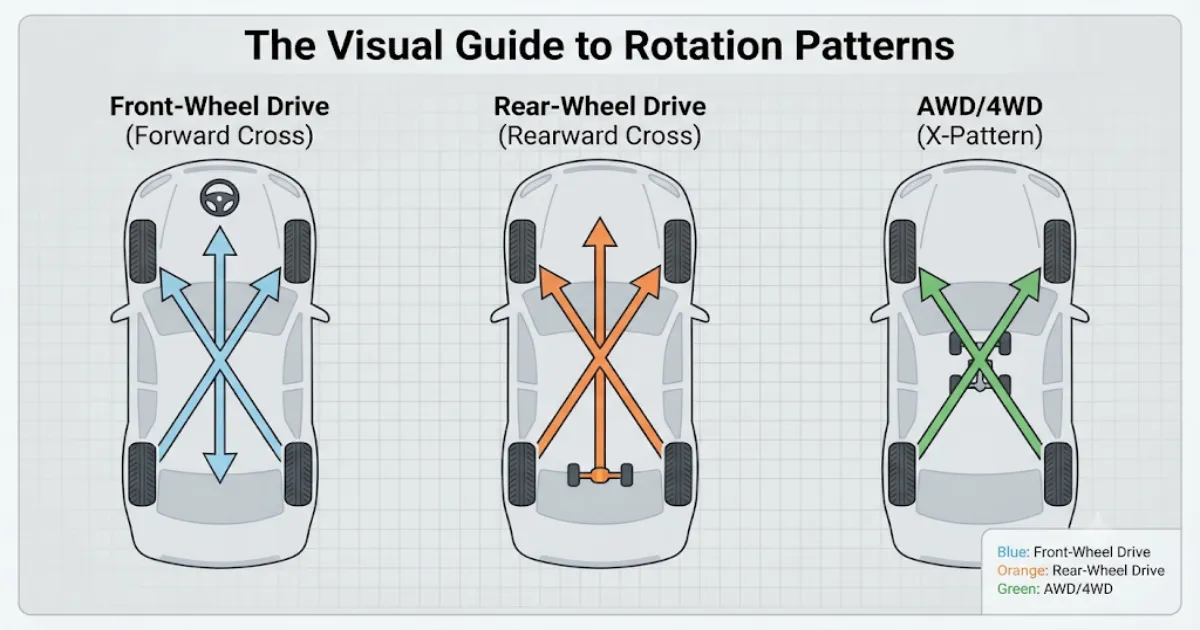
The right pattern depends on how your car is driven and what tires it wears. This is Bridgestone’s guide for four same-size, non-directional tires:
| Setup | Pattern |
|---|---|
| Front-wheel drive | Forward cross: front tires move straight back, rear tires move diagonally to the opposite front side |
| Rear-wheel drive | Rearward cross: rear tires move straight forward on the same side, front tires move to the opposite sides of the rear axle |
| 4WD / AWD | X-pattern: all tires move diagonally |
| Directional tires | Front to back only, keeping each tire on the same side |
| Different front and rear sizes | Side to side, swapping same-size tires within each axle |
Michelin notes the AWD/4WD crisscross applies “unless the manufacturer specifies otherwise,” so check your manual.
Special cases
- Directional tires. Michelin says crossing them left to right would require dismounting and remounting. Look for a direction arrow on the sidewall.
- Staggered fitment. Michelin says these setups “may not allow rotation at all without a size change.” AAA says staggered cars can only be rotated side to side, which is less effective. Tire Rack says if the standard patterns will not even out wear, tires must be dismounted, remounted and rebalanced.
- Full-size matching spare. Bridgestone and Tire Rack both describe five-tire patterns, but Tire Rack says to include the spare only if it matches, is non-directional and is not marked for temporary use. A spare with a sensor needs a TPMS relearn, per Bridgestone.
- Mixed tires. AAA says mismatched brands or tread patterns make rotation less effective.
What Changes the Interval
All-wheel drive and 4WD
J.D. Power says AWD vehicles tend to see more uneven wear and recommends rotating more often, usually every 3,000 to 5,000 miles. Bridgestone suggests 5,000 miles or less for light trucks, AWD and 4WD. These figures are the manufacturer-neutral guides; your own manual may differ.
Performance cars
Bridgestone lists 3,000 to 5,000 miles or every oil change for performance cars. Many have staggered or directional setups, which limits rotation options.
Driving conditions
Bridgestone says to shorten the interval for aggressive city driving, regular towing or heavy loads, off-road use and high-output engines. Michelin adds stop-and-go traffic and rough roads. J.D. Power says off-roading adds extra wear.
Winter tires
Tire Rack says studded winter tires should be rotated at the start of each winter season or every 4,000 miles, whichever comes first. Never change their rolling direction.
Brand-specific recommendations
AAA’s article cites 5,000 miles or six months for Toyota and 7,500 miles for Subaru, but those are secondhand figures. Look up your own manual.
Electric Vehicles Are Different
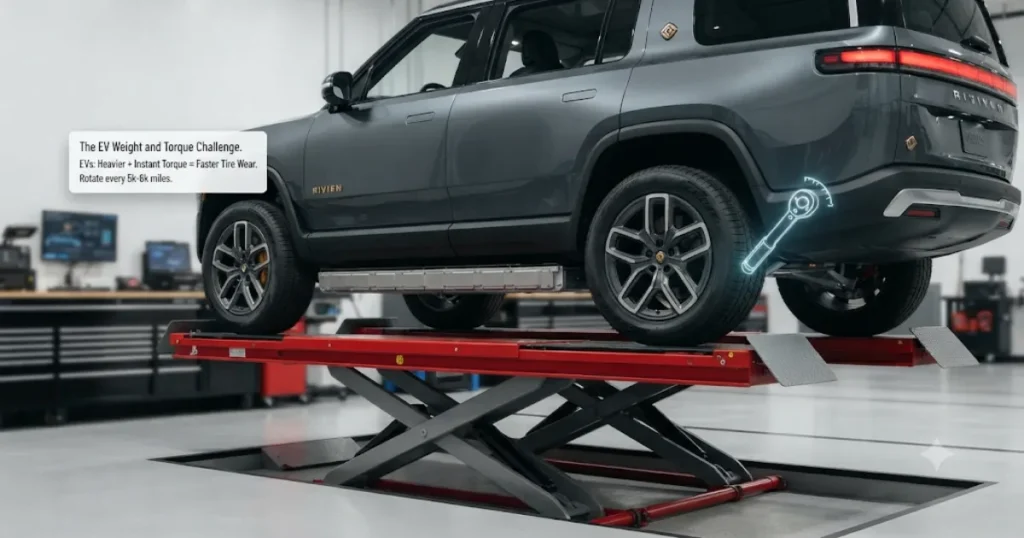
EVs are heavier than comparable gas cars and deliver torque instantly. The Boston.com “Car Doctor” column says that combination, plus low-rolling-resistance tires, tends to wear EV tires faster, and recommends rotating at the recommended intervals even when wear looks even. The column gives no mileage figure.
Bridgestone lists 5,000 to 6,000 miles or 6 months for EVs, which is its own general guidance, not an automaker rule.
For Tesla, a retailer blog (Tesloid) reports that Tesla recommends rotating every 10,000 km, or when the tread depth difference reaches 1.5 mm, whichever comes first. The page does not quote the manual, and it is in kilometers. By my calculation, 10,000 km is about 6,200 miles and 1.5 mm is about 1.9/32 of an inch. Tesloid also sells tire sets, so treat its commentary as commercial. Check the manual for your exact Tesla.
How to Know It’s Time to Rotate Your Tires
Mileage is the main trigger, but your tires can tell you more.
- Check the calendar and odometer. Note the mileage at each rotation. Bridgestone says new tires should be rotated by 5,000 miles because fresh tread wears unevenly more easily.
- Measure the tread. Tire Rack says a 1/32″ to 2/32″ difference between front and rear is small enough that you can still rotate, and faster uneven wear means rotating more often. NHTSA says to replace tires when tread reaches 2/32″. The penny test: if you can see the top of Lincoln’s head, replace them.
- Watch for vibration. Michelin says vibration can call for rebalancing during a rotation visit.
- Look for uneven wear. NHTSA advises rotating sooner if uneven wear appears.
- Check the dashboard. The Car Doctor column mentions a 2023 Nissan Leaf with a dash alert suggesting rotation, so some cars prompt you.
If you buy a used car and do not know its rotation history, J.D. Power says to have a mechanic inspect the tires to decide whether a rotation is due right away.
When rotation will not help
AAA says rotation is preventive: if tires are already worn unevenly or need replacing, rotation typically is not necessary. If you are replacing only two tires, Bridgestone says to mount the new pair on the rear axle regardless of drivetrain, and AAA likewise says to put the least-worn tires on the rear for better control in wet conditions.
Warranty: Why Records Matter
Bridgestone says rotating tires “may also be required to keep your tires covered under warranty.” Michelin’s page is blunter: uneven wear from missed rotations “is a maintenance issue, not a manufacturing defect,” so it is not covered, and some tire warranties set a rotation interval that, if missed, can void mileage coverage. AAA says skipping maintenance may void the manufacturer’s warranty, though road hazard protection may not be affected.
Michelin advises keeping your sales receipt and service records. Read your specific tire warranty for its exact requirement.
A Simple Rotation Schedule You Can Follow
 If your owner’s manual is silent, this routine is my own suggestion, built from the overlapping ranges above rather than from a single source:
- Tie it to an oil change or a calendar date. AAA ties rotation to every oil change on synthetic oil, and Bridgestone says every six months. Whichever comes first is a sensible rule.
- Write the mileage down. A note in your phone or a sticker on the windshield makes it easy to know when the next one is due.
- Rotate new tires early. Bridgestone says by 5,000 miles.
- Shorten the gap if you tow, drive an AWD vehicle, or drive an EV or performance car.
- Measure tread at each visit, and replace tires at 2/32 inch, per NHTSA.
What Does a Tire Rotation Cost?
According to ThePricer (last updated October 10, 2026), a standard rotation runs about $49 to $72 based on RepairPal’s September 2026 estimate, and $60 to $72 according to Kelley Blue Book. A rotation with balancing of all four wheels runs $109 to $160 (RepairPal) or $112 to $132 (Kelley Blue Book). Balancing roughly doubles the price. Prices vary by shop and by what is included, and exclude taxes and local differences.
Some retailers include rotations. ThePricer says Discount Tire offers free rotations and rebalancing for tires bought there, and Costco offers lifetime rotations and balancing on tires bought at its Tire Center, tied to membership. These are secondhand summaries of those programs, so confirm the terms with the retailer.
What it adds up to. At 12,000 miles a year, rotating every 7,500 miles means about 1.6 rotations a year, and every 5,000 miles about 2.4 (my calculation). At $49 to $72 each, that is roughly $80 to $170 a year if you pay for standard rotations, and nothing extra if your tire retailer includes them.
Do It Yourself or Go to a Shop?
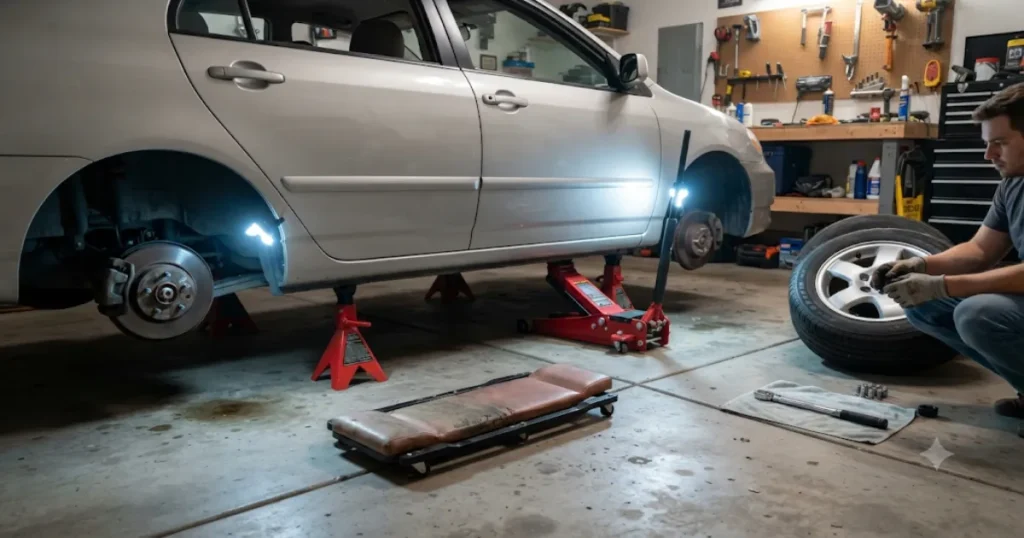 Many drivers rotate their tires at home. Bridgestone’s pattern guide and Tire Rack’s diagrams make the process clear, but a rotation involves lifting the vehicle, so use a proper jack and jack stands on level ground and follow the owner’s manual for lift points. That is general safety practice, not drawn from the sources above. A shop is the easier choice for directional, staggered, run-flat or sensor-equipped setups, and Michelin says a professional should confirm that rotation is appropriate for staggered and run-flat setups.
After rotating, check pressure: J.D. Power notes front and rear recommendations can differ, so you may need to adjust. NHTSA says to check all tires, including the spare, at least once a month when cold, using the pressure on the vehicle’s label or in the owner’s manual, not the number on the tire.
Other Tire Checks That Pair Well With Rotation
NHTSA also advises:
- Alignment and balance. A qualified technician should align the wheels, which extends tire life and keeps the car from pulling. New tires should always be balanced.
- Tire age. Aging is invisible. Some manufacturers recommend replacing tires six to 10 years old regardless of tread. The last four digits of the DOT code give the week and year of manufacture.
- TPMS. Cars and light trucks from model year 2008 on have tire pressure monitoring systems. They warn only when a tire is significantly underinflated, so they do not replace monthly manual checks.
Frequently Asked Questions
How often should I rotate my tires?
Most sources recommend every 5,000 to 8,000 miles or about every six months, with some saying 3,000 to 5,000 miles for AWD or performance cars. Follow your owner’s manual if it gives a number.
Can I skip tire rotation?
You can, but uneven wear builds up and shortens tire life. Michelin says missed rotations are a maintenance issue not covered by warranty, and some warranties require documented rotation.
Do electric cars need tire rotation?
Yes. The Boston.com Car Doctor column says EV owners should rotate at the recommended intervals. Bridgestone lists 5,000 to 6,000 miles or six months for EVs; Tesla’s guidance, as reported by a retailer blog, is about every 10,000 km (roughly 6,200 miles) or at a 1.5 mm tread difference.
What rotation pattern should I use?
For non-directional tires of matching size: forward cross for front-wheel drive, rearward cross for rear-wheel drive and X-pattern for AWD or 4WD. Directional tires go front to back on the same side. Different front and rear sizes go side to side only.
How much does a tire rotation cost?
About $49 to $72 for a standard rotation per RepairPal’s September 2026 estimate, or $60 to $72 per Kelley Blue Book, and about $109 to $160 with balancing. Free rotations come with tire purchases at some retailers.
Do I need to rotate new tires sooner?
Bridgestone says new tires should be rotated by 5,000 miles because fresh tread wears unevenly more easily.
Should I include my spare in the rotation?
Only if it is a full-size matching spare that is non-directional and not marked temporary, per Tire Rack. Otherwise, leave it out.
Does rotating tires fix a pulling or vibrating car?
Not necessarily. Michelin says vibration may call for rebalancing, and NHTSA says alignment keeps the car from pulling. Rotation addresses wear, not those issues.
The Bottom Line
Plan on rotating your tires every 5,000 to 7,500 miles, sooner if you drive an AWD vehicle, a performance car, an EV or a truck that works hard, and always defer to your owner’s manual. Keep service records for the warranty, match the pattern to your drivetrain and tires, and pair each rotation with a quick check of pressure and tread. It is one of the cheapest maintenance jobs on a car and one of the easiest ways to get the full life out of your tires.
12 Rare Classic Motorcycles That Became Valuable Collector’s Treasures
🔹🔹 Follow us on facebook 🔹🔹