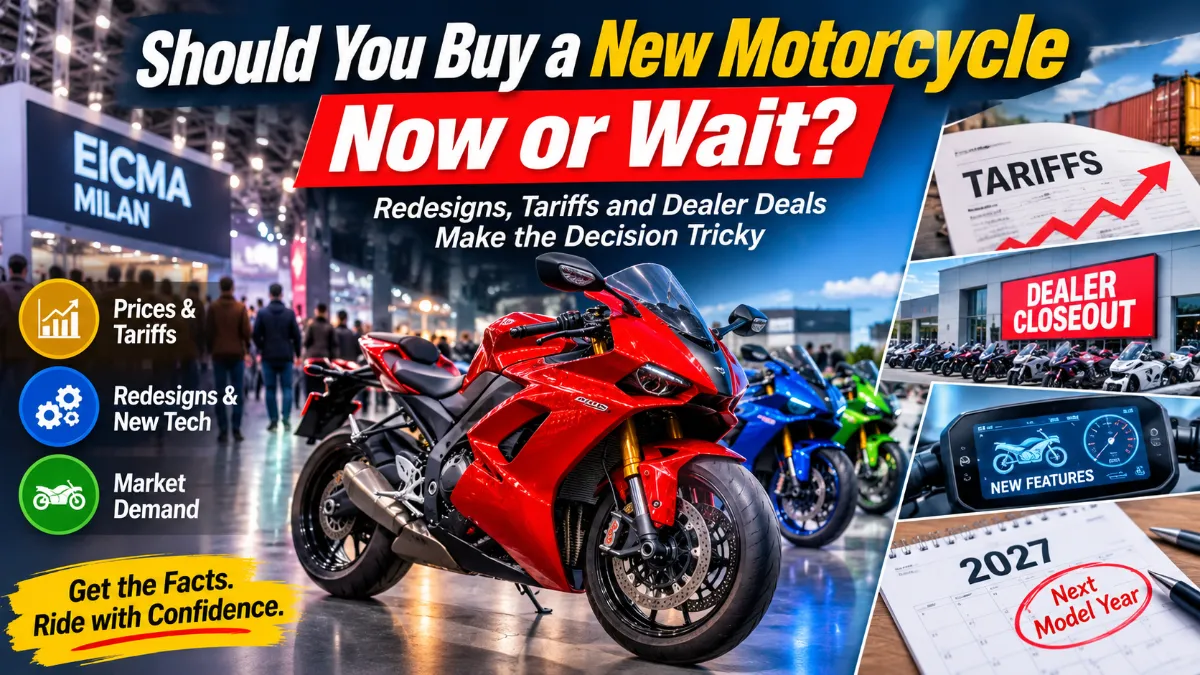
 Redesigns shown at EICMA, tariffs that keep shifting and dealer closeouts all affect whether to buy a new motorcycle or wait, and the answer depends on what changes.
The world’s biggest motorcycle show closes today in Milan, and for anyone with a 2026 bike on their shopping list it has made the timing harder, not easier. Honda used EICMA to premiere a fully redesigned CBR1000RR-R Fireblade, with roughly 75 percent of its components newly designed, and a redesigned Africa Twin that debuts a new rider-assistance system. Months earlier, American Honda had told U.S. buyers that the Fireblade was returning for 2027. If you were about to buy a new motorcycle or wait, those two announcements point in opposite directions.
The honest answer is that waiting is sometimes smart and often just expensive. A redesign can make a current model feel dated, while a tariff change, a closeout discount or a missed riding season can swing the math the other way. This guide lays out how model years actually work, what the evidence says about prices, financing and depreciation, and a short set of questions that settle most decisions. Facts were checked against company releases, government sources and trade reporting as of November 8, 2026, and the article notes where evidence is thin. Should You Buy a New Car Now or Wait for 2027 Models? The Smart Buyer’s Guide
Best Sportbikes for Beginners in 2026: What Should New Riders Consider?
What “the Next Model” Usually Means
Not every new model year is a new motorcycle. Most are one of three things, and the difference is the whole decision.
A carryover model keeps the same bike with new colors or minor equipment. Waiting for one rarely gains you anything except, sometimes, the chance to buy last year’s version at a discount. A mid-cycle update changes meaningful parts, such as brakes, displays or electronics, while leaving the core machine alone. A full redesign replaces the frame, engine or both, and it is the only category where waiting can deliver a materially different bike.
Honda’s 2027 lineup shows all three at once. The European 2027 CBR600RR gets Fireblade-derived brakes and a new display, which makes it a mid-cycle update, and MCNews notes that Honda has not announced a power increase. The CBR1000RR-R Fireblade is a full redesign. The Africa Twin is also fully redesigned, with a larger engine, weight reduction and a lowered center of gravity, according to Honda’s EICMA release.
| Type of change | What you get by waiting | Example | Worth waiting for? |
|---|---|---|---|
| Carryover | Mostly new paint, maybe a lower price on old stock | Many 2027 models | Rarely |
| Mid-cycle update | Better brakes, display or electronics | 2027 CBR600RR (Europe) | Sometimes |
| Full redesign | New engine, frame or rider-assist technology | Fireblade, Africa Twin | Often, if you can wait |
How to Find Out What Is Coming
Information is easier to get than it used to be. EICMA ran from November 3 to 8 at Fiera Milano Rho, with press days November 3 and 4. Motorcycles.News reported in late October that BMW, Ducati, Kawasaki and Honda had shown key 2027 models online before the show, complete with specifications, prices and photos, so much of what visitors saw in Milan was not new to people following the news.
The harder part is the U.S. Honda’s EICMA press release covers the European market, and the CBR500R FOUR it unveiled with Honda’s E-Clutch is described as a European debut, with no U.S. plans stated. American Honda, meanwhile, announced its 2027 street models on June 3, 2026 and its 2027 off-road range on May 28, so U.S. lineups often arrive months before year-end and can lag Europe’s newest bikes.
Regulatory filings can fill the gaps. Motorcycle.com reported that documents Honda submitted to NHTSA and the California Air Resources Board suggest the updated global-spec CBR600RR is headed to the U.S. for 2027, while stressing that official confirmation was still pending. BMW’s F 450 RR, by one report, has a North American starting price of $7,815 for the M Sport trim, with showroom arrivals scheduled for summer 2027, which illustrates how long the gap between reveal and availability can run. Treat filings and previews as signals, not promises, and ask your dealer what has actually been allocated.
Why Price Is Harder to Predict in 2026
The case for buying now once rested on a simple fear: prices only go up. The 2026 record is more mixed.
Tariffs have been the main source of volatility. A Powersports Business report in October 2025 said BMW, KTM, Triumph, Honda, Yamaha and Royal Enfield raised prices on numerous models, and that higher prices slowed new-unit sales while pushing shoppers toward used bikes. Kawasaki added a $350 supply chain surcharge to the 2026 KLX230 Sherpa S ($5,699) and KLX230 DF ($5,799).
The legal footing has since changed twice. On February 20, 2026, the Supreme Court ruled 6 to 3 that the International Emergency Economic Powers Act does not authorize tariffs. A temporary 10 percent surcharge under Section 122 took effect February 24 and expired July 24. That same day, new Section 301 tariffs of 10 to 12.5 percent took effect on imports from 60 economies covering about 99.4 percent of U.S. import value, according to law-firm summaries, with products already subject to Section 232 duties exempt. How those duties reach a given motorcycle’s sticker price depends on the brand, where the bike is built and how much cost the manufacturer absorbs, so the sources reviewed support no across-the-board prediction.
Individual models also move in both directions. Honda says the 2026 CBR500R carries a lower MSRP, and dealer listings show $6,399 for the 2026 bike against $7,399 for the 2025 version. That is a reminder that a model-year change can lower a price as easily as raise it.
The Case for Buying Now
Buying now makes the most sense when the bike you want is a carryover, when dealers are discounting it, or when you are going to ride it soon. Closeout pricing is the clearest advantage. Dealer listings tracked in 2026 showed the Yamaha YZF-R3 dropping from $5,499 to $4,999 on July 29, and the 2025 Honda CBR500R falling from $7,399 to $6,399 in June. Separate dealer listings showed the 2026 Kawasaki Ninja 500 SE ABS at $5,999 against a $6,499 MSRP. These are individual dealer prices, not national averages, but they show that prior-year stock can sell below sticker.
Seasonality can help, too. Retail and trade guides commonly describe late fall and winter as the softest demand period, when dealers clear previous-year inventory before the new season. The discount percentages quoted in those guides vary widely and do not come from a single authoritative U.S. dataset, so treat them as a reason to shop around, not a promise.
Financing is the other variable, and it is not obviously improving. In January 2026, Navy Federal listed new-motorcycle loan rates starting at 7.45 percent for terms up to 36 months and rising to 9.3 percent for 73 to 84 months, with a $15,000, three-year example costing $469 a month. A Meridian Trust listing advertised powersports loans for 2025 and 2026 models from 6.24 percent. These are “as low as” rates for qualified borrowers, so your own quote will differ, but they suggest that waiting for cheaper credit is a gamble.
Depreciation cuts both ways. Published estimates are inconsistent: WebBikeWorld says most motorcycles can lose up to 20 percent of their value in the first year, Harley-Davidson Insurance’s guidance describes a smaller initial drop of about 5 percent in the first six months with larger declines through year two, and a UK-based figure puts the first year near 12.5 percent. No single authoritative U.S. dataset settles it, and brand, segment and mileage matter. The practical point is that you are paying that cost no matter when you buy, and waiting simply moves it.
The Case for Waiting
Waiting is strongest when a redesign is confirmed, when the new features matter to you, and when you can afford to skip a few months of riding.
Technology is the clearest example. Honda’s EICMA release says the redesigned Africa Twin Adventure Sports is the first Honda motorcycle with its new SENSING RIDE advanced rider-assistance system, and Kawasaki’s Versys 900 was revealed in October with radar-based rider aids. If a safety or convenience feature like that is why you are shopping, a current model may not have it. Antilock brakes are the best-documented safety feature available now: a 2022 IIHS study of 65 models found fatal crash rates 22 percent lower on bikes with optional ABS, though the U.S. still does not require ABS on new motorcycles.
Waiting also lets you check a redesign’s early record. First-year models can have teething problems, and NHTSA’s recall database lets you look up a model’s recall history by make, model and year. A redesign that has been on sale for a few months will have more owner reports than one that has just arrived.
The risk is that the next model is a Europe-only bike, or that it arrives months late. Honda’s CBR500R FOUR is the example: the sources reviewed do not say whether it is coming to the U.S. Waiting for a model that never arrives costs you a season.
A Practical Way to Decide
Five questions settle most cases.
First, is the model you want actually being redesigned for the U.S.? Look for an official announcement, not just a European preview. Second, does the update change something you care about, such as safety technology, weight, power or comfort, or does it change paint and a display? Third, what does waiting cost: a riding season, a closeout discount you might miss, or an MSRP increase? Fourth, can you tolerate buying a bike that the manufacturer is about to replace, knowing resale may be affected? Fifth, do you need to ride in the next few months?
If the answers are “no official U.S. plan,” “cosmetic only,” “a riding season” and “yes, I want to ride,” buying a current or closeout model is usually the sensible move. If the answers are “confirmed redesign,” “safety or performance changes” and “I can wait,” then waiting is defensible, with the caution that U.S. arrival dates slip.
The Third Option: Buy the Outgoing Model or a Used Bike
The choice is not only new now or new later. Two middle paths deserve a look. The first is the outgoing model itself: a brand-new prior-year bike bought at a closeout gives you a full factory warranty (confirm when it starts) and a lower price, at the cost of whatever the update adds. The second is a used motorcycle. Powersports Business reported in October 2025 that tariff-driven price increases had slowed new-unit sales and pushed more shoppers toward used bikes, which is a reminder that the used market tends to absorb demand when new prices rise.
Used bikes bring their own checks. Confirm the ABS status, since the same model can be sold with or without it, run the VIN through NHTSA’s recall lookup, and compare the asking price against what a dealer is charging for a new closeout. A lightly used bike only wins if the gap to the new price is large enough to justify an unknown history.
How the Answer Changes by Rider
The right call also depends on who is riding. A new rider choosing a first bike gains little from waiting for a redesign: the most important safety steps, training and a licensed endorsement, do not depend on the model year, and a prior-year small-displacement bike with ABS does the job. A commuter who needs transportation now loses real money for every month spent waiting. A weekend rider who already owns a bike has the most freedom to wait, because nothing is lost if the redesign arrives late. And an enthusiast shopping a flagship, such as a Fireblade, has the strongest reason to wait, since a ground-up redesign changes the bike more than any closeout discount can offset.
How to Check Before You Sign
A few steps protect you either way. Confirm the model year on the bike’s VIN and ask what changes the next year brings. Get the out-the-door price in writing, since destination charges and dealer fees can add well over a thousand dollars to an advertised price. Ask when the warranty starts on a prior-year unit and how long it runs; Honda’s CBR500R and Yamaha’s R3 carry one-year warranties, while Aprilia lists 24 months on the RS 457. Compare financing from a credit union, your bank and the manufacturer before accepting the dealer’s offer. And look up the bike’s recall history on NHTSA’s site.
The Bottom Line
There is no universal rule. If you are shopping for a carryover bike, a closeout or a model that has just been updated, waiting rarely improves the deal and costs you riding time. If you are shopping for a model that has just been redesigned overseas, with a U.S. launch still unconfirmed, waiting can make sense, but only if you are prepared for it to take longer than the headlines suggest.
Several things are worth watching over the next few months: whether American Honda announces U.S. versions of the redesigned Fireblade and Africa Twin, whether the CBR600RR update reaches U.S. showrooms, how manufacturers price 2027 models under the new Section 301 tariffs, and what year-end promotions appear on 2026 stock. For most riders, the right move is to decide what you need the bike to do, find out whether the next model changes that, and put a price on the months you would spend waiting.
🔹🔹 Follow us on Facebook 🔹🔹