
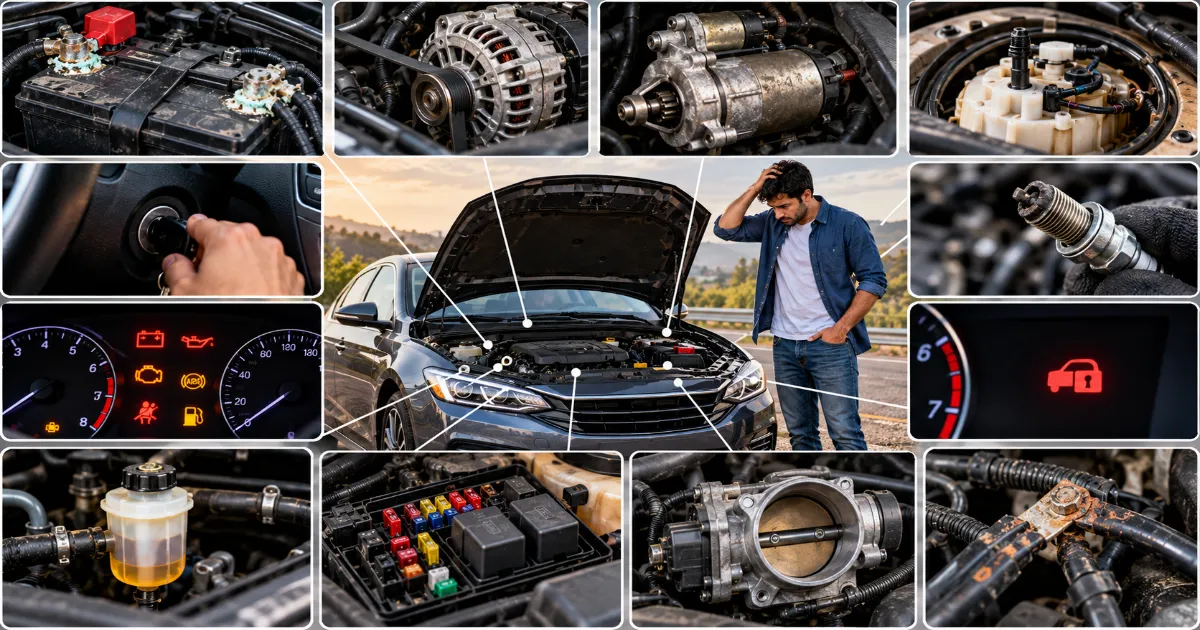
 A symptom guide to answering “why won’t my car start” from clicks and slow cranks to silence
You turn the key or press the button, and nothing happens. Or you hear a click. Or the engine turns over and over but never catches. It is one of the most stressful moments in car ownership, usually at the worst time and in the worst place.
The good news is that a no-start problem often has a short list of likely causes, and the sound your car makes gives you a head start. This guide explains the common reasons behind the question “why won’t my car start,” how to read the symptoms, what you can safely check yourself, how to jump-start a car correctly, and when to stop and call for help. It draws on guidance from Progressive, Edmunds, AAA, a Kia owner’s manual and other sources listed at the end. Procedures differ between vehicles, so your owner’s manual is the final word.
How to Detail Your Car at Home Like a Professional
Start With Safety
Before you open the hood or touch anything:
- Move out of traffic if you can, turn on your hazard lights, and set the parking brake.
- Stay clear of sparks and flames near the battery. AAA warns that “a battery creates hydrogen gas, which is explosive and can be ignited by a spark.” Avoid smoking or wearing metal jewelry near it, and wear eye protection.
- Do not lean over the battery when making connections, advises a Kia owner’s manual, and keep battery acid off your skin and clothing because it is corrosive.
- Do not jump-start a frozen battery, according to both AAA and the Kia manual, because it may rupture or explode.
- If you are unsure, stop. The Kia manual says to have a competent technician or towing service do the job if you are not certain.
Why Won’t My Car Start? Begin With the Key Question
One repair guide boils the diagnosis down to a single question: “Does the engine crank?” Whether the engine turns over, and what you hear when you try to start it, “completely changes the diagnostic direction,” that guide says. Use the table below as a starting point, then read the sections that follow.
| What you notice | Most likely area | What it may mean |
|---|---|---|
| Rapid clicking | Battery or terminals | Weak battery or poor terminal connections |
| Single click, no cranking | Battery or starter | Dead battery or failed starter |
| Slow, labored cranking | Battery | Seriously discharged or failing battery |
| Cranks normally, never starts | Fuel or ignition | Battery is probably fine; check fuel delivery and ignition |
| Starts, then stalls | Air or fuel | Possible air or fuel problem |
| Grinding or high-pitched whine | Starter | Worn starter drive or flywheel teeth |
| Total silence, dash lights dead or dim | Battery or connections | Very low battery or a bad connection |
| Engine cranks, security light flashing | Anti-theft system | Immobilizer may be blocking the start |
The first six rows draw on Rick’s Free Auto Repair Advice and Farm & Fleet’s troubleshooting guide. That repair guide is from 2015 and recommends checking procedures against the manufacturer’s service manual.
Cause 1: A Dead or Weak Battery
Progressive calls a dead battery the most common cause of a car that won’t start, and Farm & Fleet’s guide agrees that the battery is “most often the part that failed.” It is also the cheapest of the three main suspects, battery, alternator and starter, to replace.
How long batteries last. Progressive says standard car batteries usually last “three to five years.” AAA, in a 2019 statement during a cold snap, put the average at four to five years and said many batteries that fail in the cold are already near the end of their life. AAA also notes that age, damage or inadequate charging can make even a good battery too weak to start the car.
Signs of a failing battery:
- No crank, with dim or dead dashboard lights
- Rapid clicking or a low whine when you turn the key
- The car starts after a jump but will not restart after you shut it off
Cold weather makes it worse. Progressive notes that cold weakens batteries and thickens fluids. If your car has been sitting outside in the cold, a battery that worked yesterday may not have enough power today.
What to Check
- Look at the dashboard and headlights. Dim or flickering lights point to a weak battery.
- Inspect the terminals. Farm & Fleet recommends looking for corrosion. Loose or corroded connections can mimic a dead battery.
- Try a simple connection check. The repair guide suggests cleaning the terminals or tapping each one to restore contact, then having the system tested. Treat this as a temporary fix.
- Test the battery. Progressive says auto repair shops and most parts stores can often test it on the spot, frequently for free. With a multimeter, Farm & Fleet says a fully charged battery should read around 12.6 volts, and the repair guide says battery voltage “must be above 12.2 volts” for a car that cranks but will not start.
Cause 2: A Failing Alternator
The alternator recharges the battery and powers the car while it runs. When it fails, the battery slowly drains until the car will not start.
Progressive says that if the battery is known to be good but the car still will not start, the alternator may be failing. Farm & Fleet lists these alternator symptoms:
- A growling noise
- A burning-rubber or hot-wire smell
- Dim, flickering or unusually bright lights
- An “ALT” or “GEN” warning light
- The car dies soon after a jump start
- The battery is dead again even after replacement
Progressive adds that flickering gauges and a burning-rubber smell can mean the alternator has overheated.
AAA offers a useful clue after a jump: if the charging warning light stays on and the engine dies, another jump will not help, but if the light goes out, the battery will likely recharge as you drive.
Test with a multimeter. Farm & Fleet says that with the engine running, battery voltage should be between 13.8 and 14.4 volts. It also says to check that the serpentine belt is intact and properly tensioned.
One warning: Farm & Fleet says not to test an alternator by removing the negative battery cable with the engine running, because it can damage the vehicle’s electrical systems.
Cause 3: A Bad Starter
The starter is the motor that turns the engine over. When it fails, you may hear a click or nothing at all while the lights stay bright.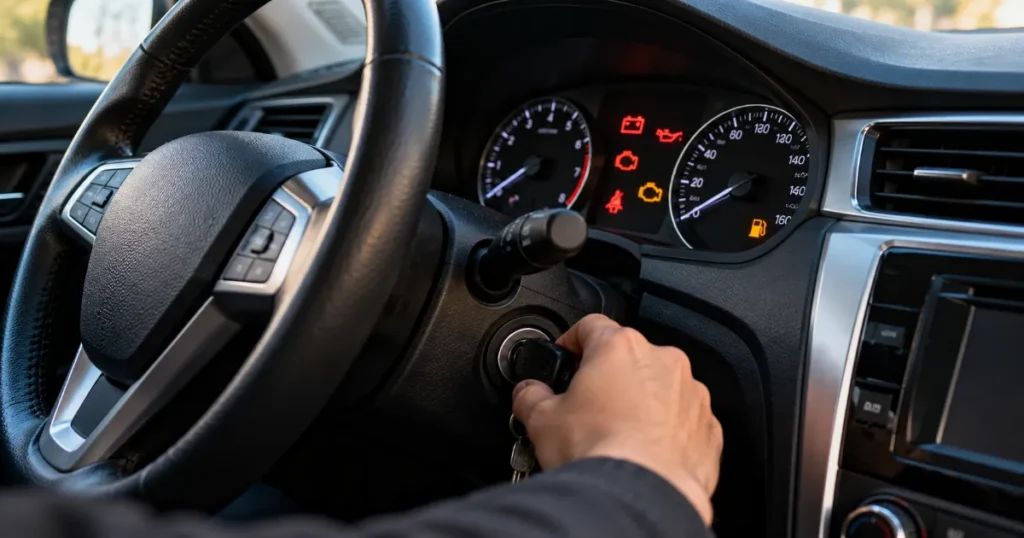
Farm & Fleet lists these starter symptoms:
- A clicking sound when you turn the key, with the dashboard lights on
- A jump start does not turn the engine over at all
- The car starts only sometimes
The repair guide adds that a single click with no cranking could be a dead battery or a dead starter. If a jump start produces the same single click, the starter has likely failed. It also says a high-pitched whine or grinding points to a bad starter drive or worn flywheel and starter teeth, and notes that grinding usually means a costly repair.
Farm & Fleet says that lightly tapping the starter can sometimes free a stuck component, and that you should check that connections are tight and free of corrosion. That is a limited, temporary measure. If you cannot reach the starter safely, leave it to a mechanic.
Cause 4: Fuel and Ignition Problems
If the engine cranks normally but never starts, the battery is probably fine, and the problem is more likely fuel or ignition, according to the repair guide.
Start with the obvious. Edmunds’ jump-start guide reminds drivers that when a car cranks but will not start, they should check for other problems “such as an empty gas tank.” A gauge that reads empty, or one that has been unreliable, is worth ruling out first.
Listen for the fuel pump. The repair guide suggests turning the key to the run position and listening near the tank for the pump’s brief hum. Silence suggests a pump problem.
Other fuel and ignition suspects. Progressive lists the fuel filter, fuel pump, timing belt, spark plugs, ignition switch and cables. The repair guide names worn spark plugs and weak coils, especially after a cold night, and clogged or leaking injectors that can flood the cylinders.
Starts, then stalls. The repair guide points to air or fuel problems, and possibly severely worn spark plugs, and suggests checking the air filter first.
Most of these are not roadside fixes. If the engine cranks but will not start, a mechanic’s diagnostic is usually the next step.
Cause 5: Key Fobs, Immobilizers and Sensors
Not every no-start problem is mechanical.
- Key fob battery. On push-button cars, Progressive says the remote’s battery may have died or fallen out of sync with the car. Replace the fob battery first, and if that fails, reprogram the fob using the owner’s manual.
- Anti-theft system. The repair guide says a flashing SECURITY or key-shaped light suggests the anti-theft system is preventing a start even though the engine cranks.
- Sensors and computers. Progressive says a faulty sensor, such as a temperature sensor, can confuse onboard systems. That calls for shop diagnostics.
- Gear selector. The repair guide includes checking the shifter among its early steps for a car that cranks but will not start, so make sure an automatic is fully in park or neutral.
How to Jump-Start a Car Safely
A jump start can confirm a dead battery, but it needs care. Before you begin, AAA says some carmakers advise against jump-starting to protect the car’s electronics from a power surge, so check your owner’s manual first. The manual also tells you where the jump points are, and Edmunds notes that some vehicles have a remote negative connection even if you can access the battery.
Edmunds’ procedure, which matches AAA’s and the Kia manual’s order, runs like this:
- Prepare both cars. Park the donor car close but not touching. Turn off both ignitions and accessories, set the parking brakes and shift to park or neutral.
- Red clamp to the dead battery’s positive (+) terminal.
- Other red clamp to the donor battery’s positive (+) terminal.
- Black clamp to the donor battery’s negative (−) terminal.
- Last black clamp to bare, unpainted metal on the dead car’s engine, away from the battery. The Kia manual says to use “a solid, stationary, metallic point away from the battery.”
- Start the donor car and let it idle for several minutes.
- Start the dead car.
- Remove the cables in reverse order, starting with the black clamp on the dead car. Edmunds calls that step “the most critical.”
- Drive for at least 20 minutes so the alternator can recharge the battery, Edmunds says.
- Have the battery tested if it is more than three years old, per Edmunds.
The Kia manual warns not to connect the booster’s negative terminal directly to the discharged battery’s negative terminal, because it can overheat and crack the discharged battery. Keep cables away from belts and fans, and keep the clamp ends apart until they are on the right terminals.
When it will not work. Edmunds says that if the car dies again or nothing changes, call roadside assistance or buy a replacement battery, and that recurring failure points to other issues, such as a bad alternator or starter, that need a mechanic. AAA also says “black or clear” means a battery is completely discharged, and you should not try to recharge or jump-start it.
Hybrids and EVs. The sources reviewed for this article do not cover jump-starting hybrids or electric vehicles. Both Edmunds and the Kia manual direct readers to the owner’s manual, so follow it for your vehicle.
A Short Troubleshooting Routine
If you want a simple sequence, work through these steps, stopping when you find the cause.
- Check the basics. Is the car in park or neutral? Is there fuel? Is the fob battery fresh?
- Watch the lights. Do the dashboard and headlights come on bright, dim or not at all?
- Listen as you try to start it. Click, slow crank, normal crank, grinding or silence?
- Look at the battery terminals. Are they tight and clean?
- Try the key cycle. Progressive suggests turning the key from off to start several times in a row, waiting a few minutes, then trying again, which may warm the battery and starter in cold weather. That article says to do it 10 times.
- Test or jump the battery, following the safety steps above.
- Know your limit. If the car cranks but will not start, or you hear grinding, call for help.
When to Call for Help
Progressive’s advice on when to get help is clear:
- If you cannot jump the battery yourself, call roadside assistance if you have it. It may be able to help without a tow.
- If the battery is good but the car still will not start, or you hear clicking, take it to a mechanic.
- Replacing a bad alternator may require a professional, and a tow may be needed.
- Multiple possible faults, or sensor problems, call for shop diagnostics.
Also call for help if you smell fuel, see smoke, or are unsure about any step. Your safety is worth more than a diagnosis.
How to Keep It From Happening Again
- Test the battery before it fails. If it is three or more years old, a free test at a parts store or repair shop is cheap insurance.
- Keep connections clean and tight, and make sure the battery is clamped securely so it cannot shift, as AAA advises.
- Do not ignore early warnings such as slow cranking, dim lights or a warning light.
- Allow extra time in cold weather. AAA notes that a car parked outside may need extra time to start, and that cold lowers tire pressure by about one pound for every 10-degree drop in temperature, so check your tires too.
- Replace the fob battery if your remote starts working inconsistently.
Frequently Asked Questions
Why won’t my car start but the lights come on?
The battery may have enough power for the lights but not enough to turn the starter. It could also be a bad starter, a poor connection or a security-system problem. Listen for a click, and check the terminals and fob.
Why does my car click but not start?
Rapid clicking usually points to a weak battery or poor terminal connections. A single click can mean a dead battery or a failed starter. If a jump start produces the same single click, the starter has likely failed, according to one repair guide.
Why won’t my car start after a jump?
If the car starts on a jump but will not restart after you shut it off, the battery is probably not holding a charge. If the car dies soon after the jump, the alternator may be failing, per Farm & Fleet.
Why does my car crank but not start?
The battery is probably fine, so look at fuel and ignition. Check that there is gas, listen for the fuel pump’s brief hum when you turn the key to run, and consider spark plugs, coils and the fuel system. A mechanic’s diagnosis is usually needed.
How long does a car battery last?
Progressive says standard batteries usually last three to five years, and AAA gives an average of four to five. Climate, age and charging problems all affect it.
Can cold weather stop a car from starting?
Yes. Progressive says cold weakens batteries and thickens fluids, and AAA says many batteries that fail in the cold were already near the end of their life.
Is it safe to jump-start any car?
Not always. AAA says some carmakers advise against it to protect the electronics, and you should never jump a frozen battery. Check your owner’s manual first.
What if my car won’t start and I have a push-button ignition?
Check the key fob’s battery first. Progressive says the remote’s battery may have died or fallen out of sync, and the owner’s manual explains how to reprogram it.
The Bottom Line
When you wonder why your car won’t start, the first clues are free: what you hear, whether the lights are bright or dim, and whether the engine cranks. A dead or weak battery is the most common cause, followed by the alternator that charges it, the starter that turns the engine, and fuel, ignition and key-system faults. Check the simple things, jump-start only with the right order and precautions, and call roadside assistance or a mechanic when the car cranks but will not start, you hear grinding, or you are not sure. A free battery test before winter is the cheapest prevention there is.
🔹🔹 Follow us on Facebook 🔹🔹