
 The Short Answer: A 1955 Lincoln Futura, Plus What Every Other Batmobile Is Really Built On
The most famous Batmobile of all, the one Adam West drove in the 1966 TV series, is based on a 1955 Lincoln Futura. That was a one-off concept car, built in Italy for Ford, that George Barris bought for a single dollar and turned into a TV star.
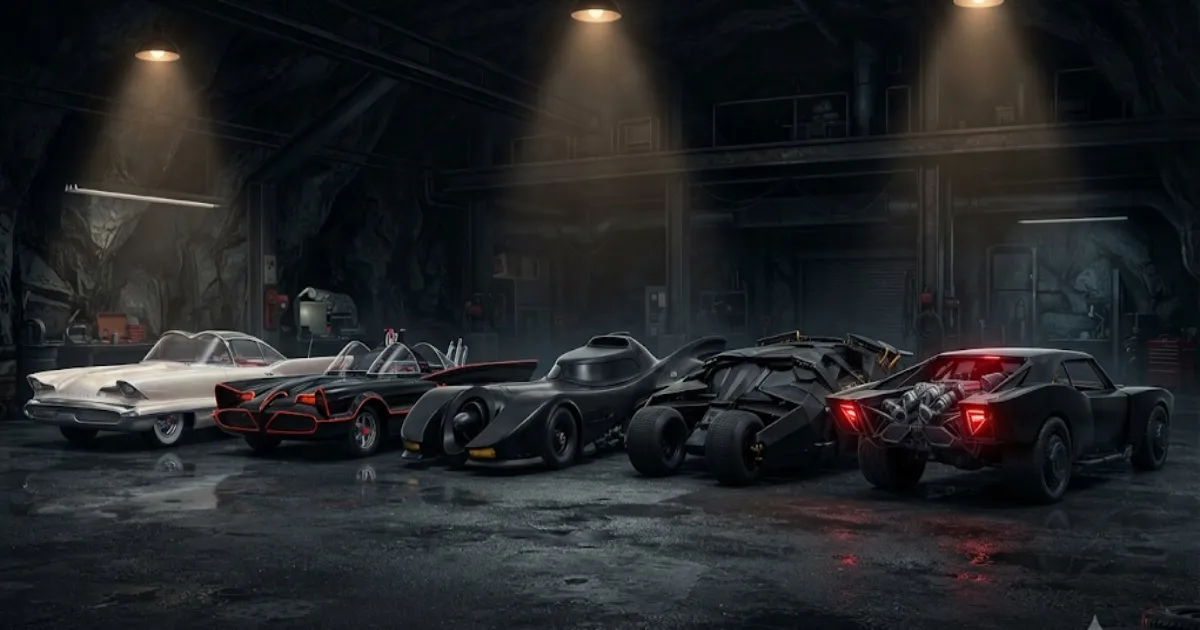
But “the Batmobile” has been many different cars over the years, and the answer changes depending on which one you mean. Tim Burton’s 1989 Batmobile sat on Chevrolet Impala underpinnings. Christopher Nolan’s Tumbler wasn’t based on a real car at all. And Matt Reeves’ 2022 version borrows its look from a late-1960s Dodge Charger without being a Charger in the usual sense.
This guide goes through each one, with the real cars behind them and the places where the sources disagree.
The Batmobiles at a glance
| Batmobile | Year | Real car it’s based on |
|---|---|---|
| Batman TV series | 1966 | 1955 Lincoln Futura concept (later with Ford Galaxie running gear) |
| Burton’s Batman | 1989 | Chevrolet Impala chassis (details vary by source) |
| Schumacher’s Batman Forever | 1995 | None named. Design inspired by H.R. Giger |
| Schumacher’s Batman & Robin | 1997 | NASCAR-style chassis. Design inspired by the Jaguar D-Type and Delahaye 165 |
| Nolan’s Tumbler | 2005 | None. Built from scratch |
| Batman v Superman | 2016 | Chevrolet Camaro chassis |
| The Batman | 2022 | Inspired by a late-1960s Dodge Charger. Custom-built |
The 1966 Batmobile: a Lincoln concept car called the Futura
The Futura is a better story than anything the show could have written.
Ford’s stylists, led by Bill Schmidt and John Najjar, designed it as a showpiece. Ghia in Turin, Italy, hand-built it in 1954, and Wikipedia puts the cost at $250,000. It was a single prototype. The car was shown to the press in Chicago in January 1955 and had jet-fighter styling, fins and a double-dome canopy. Ghia is said to have ground fish scales into the pearlescent white paint to get the effect.
Then it toured. The Futura spent about four years on the road at auto shows, fairs and dealer showrooms. It also had a movie role in the 1959 film It Started with a Kiss, where it was painted red because the white finish didn’t photograph well.
After that, Ford had no use for it. George Barris, the Hollywood customizer, bought it from Ford for $1, and sources differ on exactly when (the Henry Ford museum says 1959, while Barris himself has placed it in the 1960s). The car had never been titled, so it was uninsurable. It sat behind his shop, deteriorating, for several years.
How it became the Batmobile
In the mid-1960s, 20th Century Fox needed a Batmobile for the new Batman series, and fast. According to MeTV, Dean Jeffries had been commissioned first to build one from a 1959 Cadillac, but the deadline was too tight, so the job went to Barris.
Barris gave the Futura a new life. He reworked the sheet metal, added the “bat” equipment and removed the center section of the canopy. And the car wasn’t just a shell. Cracks in the Lincoln frame and transmission problems led him to replace the running gear with a lengthened Ford Galaxie chassis and a Ford 390 cubic inch V8. That’s the 6.4 liter V8 that Top Gear mentions.
The timeline is another place where sources vary. Top Gear says Barris had $15,000 and 15 days. MeTV says the build took about three weeks. Either way, it was astonishingly fast for a car that people still remember six decades later.
What it sold for
Barris kept the car and leased it to the studio. It later sat in his museum in California and spent time at a museum on Grand Cayman. On January 19, 2013, it sold at Barrett-Jackson in Scottsdale, Arizona, to Rick Champagne for $4.62 million, including commission.
The 1989 Batmobile: Impala underneath
Tim Burton’s Batman needed a car that looked nothing like the campy 1960s version. Production designer Anton Furst drew on tanks and military hardware, and the result was a long, low, black machine with a jet-style intake on the hood.
Underneath, it was based on a Chevrolet Impala. According to the Petersen Automotive Museum, it was built from two Impala chassis spliced together, with a 327 cubic inch Chevrolet V8 mounted low in the frame. It’s almost 20 feet long. The hood intake used Rolls-Royce jet engine components, and the turbine blades in the nose came from a British Harrier jet.
The sources aren’t unanimous on the details. The Internet Movie Cars Database collects several accounts: one commenter describes a single Impala chassis stretched to a 141 inch wheelbase, and another says a second car used an Oldsmobile Delta 88 Royale. Top Gear says the car was built in 14 weeks with a fiberglass body and a custom chassis.
The number built varies too. Petersen says five were made in total: two for filming Batman (1989) and Batman Returns (1992), and three for publicity. The IMCDB account says two were built for the original film.
The Schumacher Batmobiles: wild designs, race-car hearts
Joel Schumacher’s two Batman films went for a much more flamboyant look.
The 1995 car, built for Batman Forever, was inspired by the artist H.R. Giger. Top Gear says it was built from three layered molds over a 6.2 liter Chevy V8 race engine with a roll cage, and that more than 8,000 man-hours went into building two cars.
The 1997 car, from Batman & Robin, was inspired by the Jaguar D-Type and the Delahaye 165. It sat on a NASCAR chassis with a Chevy V8 racing engine, was around 30 feet long, and had a road-tested top speed of 140 mph. Top Gear notes the tires even had bat symbols in the tread.
The Tumbler: not a car at all
Christopher Nolan’s Batmobile is the exception to the rule. The Tumbler isn’t based on a real car.
John Holmes, a senior special effects technician who worked on it, told TechRadar that it’s a bespoke vehicle designed by Nathan Crowley’s team and built from scratch. He rejected claims that it was based on a Hummer or a Mercedes. A 20-person team in Britain designed, built and mostly drove it.
It was built like a race car. A tubular space-frame chassis carried a 5.7 liter Chevrolet V8 making about 400 horsepower. The brief called for 60 mph, but the team raised the target to 100 mph. The car had to jump off a six-foot ramp, travel 60 feet and land and drive away without a cut. Top Gear says the design drew on military vehicles and Lamborghinis, and that five 2.5-tonne vehicles took five months to build.
Batman v Superman: a Camaro underneath
The Batmobile in Batman v Superman: Dawn of Justice (2016) is a more cartoonish take. According to Top Gear, the chassis is a Chevrolet Camaro with a 6.2 liter LS3 V8, rear-wheel drive and a three-speed automatic, and three were made for the film.
The Batman (2022): a Dodge Charger in spirit
Matt Reeves’ Batmobile is the most interesting recent case, because the story is part of the design. In the film, Bruce Wayne built it himself in his garage from parts of other cars. It’s meant to look like something a very rich, very obsessive gearhead might create.
The look is clear. KBB says it’s based on a late-1960s Dodge Charger, the car this version of Bruce raced as a teenager. Hagerty adds that production designer James Chinlund drew on the possessed ’58 Plymouth Fury from Stephen King’s Christine for its menace, and that vehicle designer Ash Thorp cited the Porsche 917.
Whether any actual Charger sits under it is where things get messy.
- KBB says the designers built a custom chassis from scratch instead of starting from a donor car.
- Motor Biscuit reports that the stunt cars were built on a second-generation 1968–1970 Dodge Charger. But that comes from a collector’s walkaround video at the premiere, quoting an unnamed crew member, so it isn’t officially confirmed.
- Power figures vary. Hagerty says a 627 horsepower Chevy V8. KBB says about 700 horsepower from an off-the-shelf V8 with a pair of added turbochargers, and notes the engine wasn’t named. Motor Biscuit claims a Ford Triton V10.
Four cars were built for filming, each for a different job. One used an electric drivetrain borrowed from a Tesla, so the crew could record dialogue without engine noise and run it quietly on stage.
Where the sources disagree
This is a topic where trivia gets repeated until it sounds like fact. Here are the main points that don’t line up.
| Question | What the sources say |
|---|---|
| How long did the 1966 build take? | 15 days (Top Gear, CarAdvice) versus about three weeks (MeTV) |
| When did Barris buy the Futura? | 1959 (The Henry Ford) versus the 1960s (Barris, via Consumer Guide) |
| How many 1989 Batmobiles were built? | Two (IMCDB) versus five (Petersen) |
| Is the 1989 car one Impala chassis or two? | Two spliced together (Petersen) versus one stretched (IMCDB commenter) |
| Is the 2022 car built on a Charger? | Custom chassis (KBB) versus a 1968–1970 Charger for stunts (Motor Biscuit, unconfirmed) |
| What engine is in the 2022 car? | Chevy V8 (Hagerty), unnamed V8 (KBB), Ford Triton V10 (Motor Biscuit) |
What the changing bases tell you
The base cars show how the idea of the Batmobile has changed.
In 1966, the Batmobile was a dream car, a show car that was never meant for the road and was a perfect fit for a bright, pop-art series. In 1989, it became a gothic weapon. In the 2000s it turned into a military vehicle, with the Tumbler. And in 2022, it came full circle to a real car culture, a muscle car built in a garage.
There’s a pattern, too. Almost every film Batmobile since 1989 has an American V8 under the skin, usually a Chevrolet. The look changes, but the heart stays the same.
If you want one of your own
Replicas of the Batmobile exist, built on donor cars or from scratch. If you’re thinking of building or buying one, check the street-legal rules and insurance requirements where you live, since a car like that can be tricky to register. And remember the lesson of the Futura: a vehicle that was never titled can be uninsurable.
Frequently asked questions
What real car is the 1966 Batmobile based on?
A 1955 Lincoln Futura, a one-off concept car that Ford had Ghia build in Italy. George Barris bought it for $1 and converted it into the Batmobile for the 1966 Batman TV series.
Who built the 1966 Batmobile?
George Barris, the Hollywood customizer. Dean Jeffries was first commissioned to build one from a 1959 Cadillac, but the schedule was too tight.
How much did the original Batmobile sell for?
$4.62 million, including commission, at Barrett-Jackson in Scottsdale on January 19, 2013. The buyer was Rick Champagne.
Is the Tumbler based on a real car?
No. It was built from scratch by a British team using a tubular space-frame chassis and a 5.7 liter Chevrolet V8.
What car is the Batmobile in The Batman (2022)?
It’s a custom build, designed to look like a late-1960s Dodge Charger. Sources disagree on whether a real Charger sits underneath.
The bottom line
If you only remember one answer, make it this: the classic Batmobile is a 1955 Lincoln Futura. It was a $250,000 show car that its owner picked up for $1 and that sold for $4.62 million six decades later.
After that, the answer depends on which Batmobile you mean. Some are Chevrolets in costume, one was built from scratch, and the newest one is a love letter to a muscle car. And as the table above shows, even the experts don’t always agree on the details.
🔹🔹 Follow us on facebook 🔹🔹