
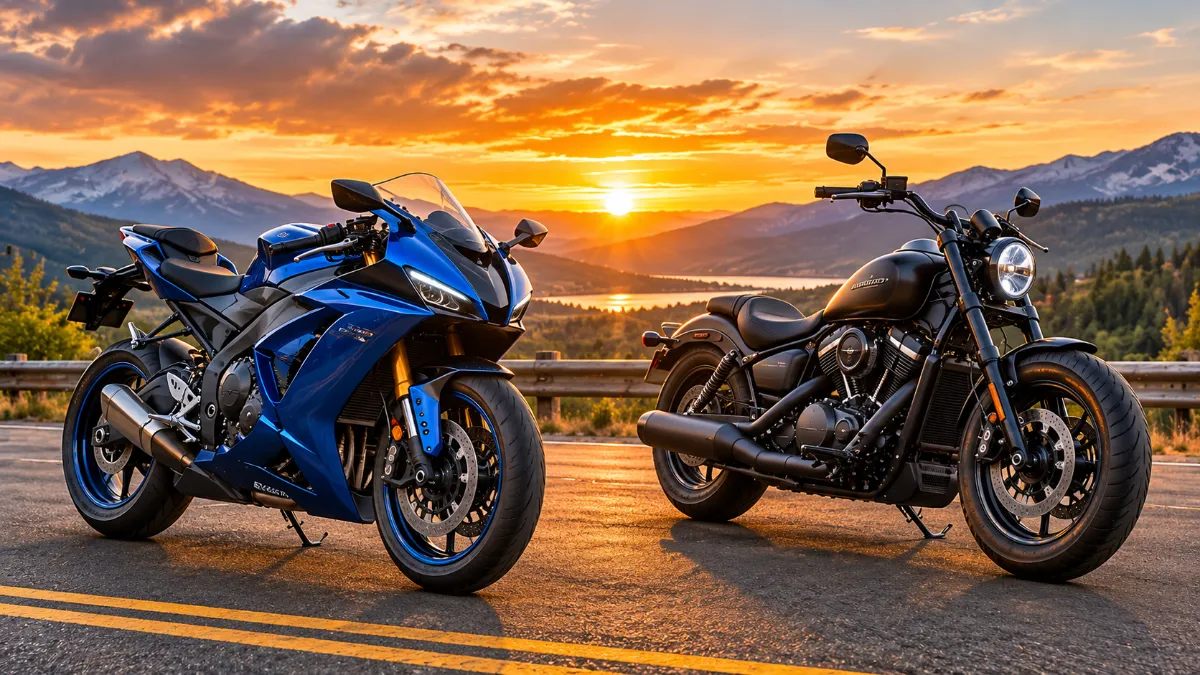
 Prices overlap, but fit and risk differ. See how sportbike vs cruiser compares on 2026 seat heights, weights, mpg range and crash data.
Seat height, weight, fuel range and crash data point in different directions in the sportbike vs cruiser debate, depending on how and where you ride.
Honda sells two motorcycles with the same 471 cc parallel-twin engine size and almost the same weight. The CBR500R sportbike weighs 421 pounds, has a 31.1-inch seat and lists at $6,399. The Rebel 500 cruiser weighs 414 pounds, has a 27.2-inch seat and lists at $6,799. On paper they are siblings. On the road they are opposites, which is the clearest way to understand the sportbike vs cruiser decision: the engine matters less than where it puts you.
This guide compares the two styles using 2026 manufacturer specifications and U.S. crash data. It covers fit, comfort, fuel range, price, safety patterns and a decision guide for common riding styles. Figures were checked against manufacturer pages, NHTSA, IIHS and trade reporting as of November 17, 2026, and the text separates measured facts from editorial judgment.
The Core Difference: Where You Sit and What the Bike Is For
A sportbike puts the rider in a forward lean, with weight on the wrists, feet on rear-set pegs and a seat high enough to give ground clearance in corners. A cruiser puts the rider upright or slightly reclined with feet forward, a low seat and a relaxed reach to the bars. Those layouts follow from different goals. A sportbike is built for cornering precision and high-rpm power. A cruiser is built for low-speed ease, torque and a laid-back posture.
The table below uses 2026 models from the manufacturers’ own listings. Weights are not measured the same way across brands, since some list curb weight with a full tank and others list wet weight, and prices are base MSRPs before destination and dealer fees.
| Model (2026) | Style | Engine | Seat height | Weight | Base MSRP |
|---|---|---|---|---|---|
| Yamaha YZF-R3 | Sportbike | 321 cc twin | 30.7 in | 373 lb wet | $5,499 |
| Kawasaki Ninja 500 SE ABS | Sportbike | 451 cc twin | 30.9 in | About 380 lb curb | $6,499 |
| Honda CBR500R | Sportbike | 471 cc twin | 31.1 in | 421 lb curb | $6,399 |
| Aprilia RS 457 | Sportbike | 457 cc twin | 31.5 in | 385 lb wet | About $6,800 (dealer-listed) |
| Honda Rebel 300 E-Clutch | Cruiser | 286 cc single | 27.2 in | 379 lb curb | $5,349 |
| Honda Rebel 500 | Cruiser | 471 cc twin | 27.2 in | 414 lb curb | $6,799 |
| Honda Rebel 1100 | Cruiser | 1,083 cc twin | 27.2 to 27.9 in (varies by trim) | About 487 lb curb | $9,699 |
| Harley-Davidson Nightster | Cruiser | 975 cc V-twin | 27.1 in (laden) | 481 lb running order | About $9,999 |
The pattern is consistent. In these examples the cruisers sit roughly 3 to 4 inches lower than the sportbikes. The small cruisers weigh about the same as the sportbikes, and the 1,000 cc-class cruisers add roughly 60 to 110 pounds.
How Each One Rides
Sportbike
The sportbike’s strengths are steering precision, braking feel and a power band that rewards revs. The CBR500R’s 471 cc twin makes about 46 horsepower in published listings, and the RS 457 makes 47.6 horsepower with ride-by-wire throttle, engine maps and dual-channel ABS. Those figures are modest by sportbike standards, which is exactly why this class suits beginners.
The costs are posture and range. The forward lean loads the wrists and neck on long rides, and tanks are small: the Ninja 500 holds 3.7 gallons, the R3 is listed at the same size, and the CBR500R holds 4.5. Yamaha claims 56 mpg for the R3, which would give a theoretical range of about 207 miles, by simple arithmetic.
Cruiser
The cruiser’s strengths are low-speed confidence and relaxed comfort. The low seat lets most riders plant both feet at stops, and Honda emphasizes the Rebel’s 27.2-inch seat for exactly that reason. Cruisers also tend to deliver torque at low rpm, which makes city traffic easier.
The trade-offs are cornering clearance, wind exposure and, in some cases, range. Harley-Davidson’s Nightster, one of the more sporting cruisers, lists 32 degrees of lean in each direction and 4.3 inches of ground clearance, which is adequate for backroads but sets a lower limit than a sportbike. It also holds 3.1 gallons and is listed at 52 mpg, which works out to a theoretical range of about 160 miles. The Rebel 500 holds 3.0 gallons, compared with 4.5 for the CBR500R. Smaller tanks and small windscreens mean cruiser riders make more fuel stops than the cubic-inch numbers suggest, unless they buy a touring model such as the Rebel 1100T.
Matching the Bike to Your Riding Style
Riding style should drive the choice, and the evidence supports a few rules of thumb.
Daily commuting and city riding. Both work, with different strengths. A cruiser’s low seat and relaxed posture make stop-and-go riding less tiring, while a sportbike’s lighter feel and mirrors-to-brakes responsiveness suit filtering and quick moves. The Rebel 300 E-Clutch, new for 2026, adds an automated clutch aimed at new riders. In dense traffic, an upright posture also lets the rider see over cars more easily, though that is an editorial observation, not a measured result.
Weekend canyon riding. Sportbikes are better matched. Their ground clearance, steeper rake and higher pegs are designed for lean angles that a cruiser’s footboards or pegs will touch sooner.
Long highway rides. Cruisers generally win on comfort, and touring-oriented versions add fairings and saddlebags, such as the Rebel 1100T at $10,899. Sportbike riders can tour, but the wrist load and small tank make it work harder.
Riding with a passenger. Passenger comfort varies by model, so check each bike’s pillion seat and pegs. The Nightster Special, for instance, lists a standard pillion pad and footpegs.
Shorter riders. The roughly 3- to 4-inch seat-height advantage of the cruisers in the table is the biggest fit difference, so shorter riders often start there. Sportbikes with narrow seats can still work, so sit on each one.
New riders. The best first bike is the one that is light, low-powered and has ABS, whatever its style. The Rebel 500 has ABS standard on every 2026 trim, and the sportbikes in the table all offer it.
Safety: What the Data Says About Each Style
U.S. motorcycle deaths are a serious number: NHTSA counted 6,228 in 2024, and the fatality rate per mile traveled was 28.00 per 100 million vehicle miles, nearly 27 times the rate for passenger car occupants. Motorcycles were 3 percent of registered vehicles and 0.7 percent of miles traveled. Within that total, the type of motorcycle and the type of rider differ.
IIHS research found that driver death rates for supersport motorcycles were four times those of cruisers and standards. A 2007 IIHS analysis republished by the U.S. Department of Transportation reported 22.5 deaths per 10,000 registered supersport motorcycles in 2005, against 10.7 for sport and unclad sport bikes and 5.7 for cruisers and standards. That data is old, it reflects rider age and behavior as well as the bikes, and the entry-level sportbikes in this guide are far less powerful than the supersports in the study. Treat it as a direction, not a verdict.
Rider profiles differ in ways that matter more than the label. In 2021, 81 percent of fatally injured supersport riders were wearing helmets, against 51 percent of fatally injured cruiser and touring riders, according to IIHS data cited by NHTSA. Sixty-four percent of fatally injured cruiser riders and 81 percent of touring riders were 40 or older. IIHS reports that 31 percent of fatally injured motorcyclists in 2024 were 50 or older, and that the typical owner was 50 in 2018.
Two factors cut across both styles. In 2024, 25 percent of motorcycle riders in fatal crashes were alcohol-impaired, and 40 percent of those killed in single-vehicle crashes were. In states without universal helmet laws, 48 percent of the motorcyclists killed in 2024 were not wearing helmets. Helmets are about 37 percent effective at preventing deaths, according to IIHS, and a 2022 IIHS study found ABS associated with 22 percent lower fatal crash rates, though ABS is still not required on new U.S. motorcycles.
The safe reading is that each style has a characteristic failure mode. Sportbikes are associated with younger riders and loss of control at speed. Cruisers are associated with older riders, less helmet use and alcohol in single-vehicle crashes. The bike does not decide your risk on its own, and training, gear and sober riding do more than the style you choose.
Engine Size Matters More Than Style
One finding cuts across the sportbike vs cruiser divide. The same 2010 IIHS study that found higher death rates for supersports also found that larger engine displacement was associated with higher driver death rates within every motorcycle type, cruisers included. In other words, a 1,000 cc cruiser is not automatically gentler than a 500 cc sportbike, and a first-time rider is better served by a modest engine in either style. The Honda lineup shows the choice clearly: the Rebel 500 and CBR500R share a 471 cc engine size, while the Rebel 1100 has more than twice that displacement and weighs about 70 pounds more than the Rebel 500.
The study has limits. Rider age, experience and miles ridden affect the results, and the data predates today’s traction control and ABS. But the advice instructors give new riders matches it: start with a bike you can control, in whichever style you will actually enjoy riding, and move up after you have built skills.
Cost: Purchase Price and What Comes With It
Entry-level prices overlap. The cheapest sportbike in the table is $5,499 and the cheapest cruiser $5,349, and both classes reach about $6,800 for 450 to 500 cc models. The gap opens at the top: the Rebel 1100 starts at $9,699 and the Nightster is listed around $9,999, both well above the sportbikes shown.
Destination charges add to every figure. Honda lists $600 for the Rebel 300 and 500 and $775 for the Rebel 1100. Dealer fees, taxes, insurance and gear come on top. Insurers price by motorcycle class, rider age and record, so get quotes on specific models before you buy. Budget for a helmet, jacket, gloves, pants and boots at the same time as the bike.
The Middle Ground: Standards and Sport-Cruisers
If neither style fits, two options sit between them. Standard motorcycles, which IIHS describes as having basic designs, upright riding positions and low power-to-weight ratios that make them user-friendly, offer neutral ergonomics. Many sportbikes have naked siblings, such as the Aprilia Tuono 457, which Motorcycle.com describes as the unfaired version of the RS 457. And some cruisers lean sporty: the Nightster uses Harley-Davidson’s Revolution Max engine, lists 91 horsepower and carries the Sportster name’s styling.
How to Test Before You Buy
Sit on both styles at a dealer and check that you can touch the ground comfortably, reach the bars without strain and hold the bike upright from the side stand. If the dealer offers demo rides, take one. Better still, take the Motorcycle Safety Foundation’s Basic RiderCourse before buying: training motorcycles are provided, so you can try a style without owning it, and in many states completing the course waives some or all of the DMV skills test.
The Bottom Line
The sportbike vs cruiser choice comes down to posture, purpose and the kind of rider you are. Sportbikes reward precision and suit riders who want to corner hard, and they ask more of the wrists and the tank range. Cruisers reward low-speed ease and relaxed miles, and they trade away some cornering clearance. In 2026, small versions of both start near $5,400 to $5,500 and come with ABS, so price is no longer the deciding factor for beginners.
A few developments are worth watching: more automated clutches such as Honda’s E-Clutch on the Rebel 300, which lower the barrier for new riders, 2027 model-year pricing and any federal action on antilock brakes, which the IIHS has petitioned NHTSA to require. For most riders, the right move is to decide how you will actually ride, sit on both styles, take a training course and choose the bike you are comfortable controlling.
🔹🔹 Follow us on facebook 🔹🔹