
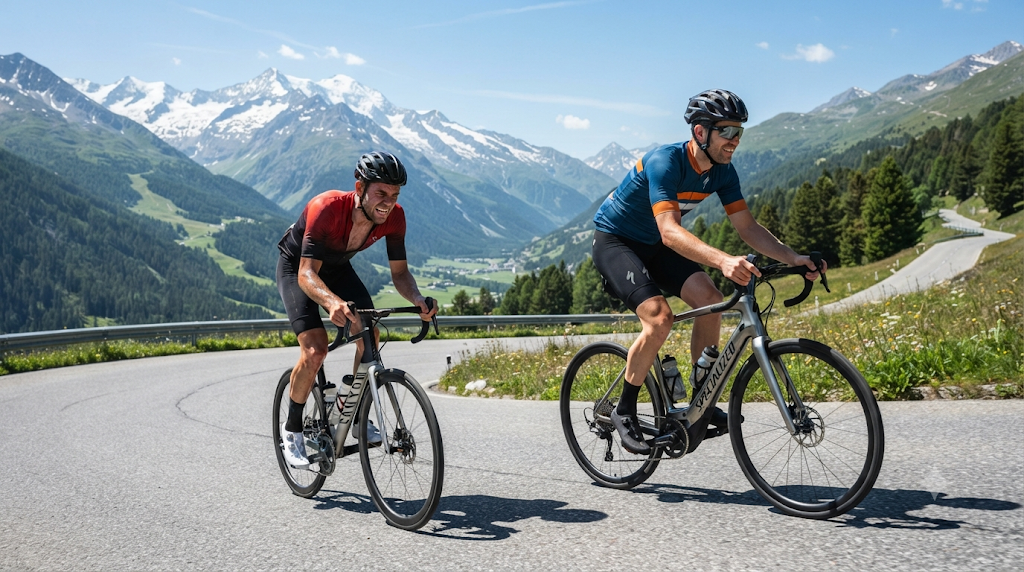
Understanding the Key Differences: Electric Bike vs Regular Bike
Choose an e-bike if you want to replace car trips, ride hills or distance without arriving exhausted, carry loads, or get back into cycling. Choose a regular bike if you want the lowest cost, the lightest weight, the simplest upkeep, or you ride mainly for high-intensity training. Both give real health benefits. The right pick depends on how you will actually ride, not on which is “better.”
Quick verdict
| If you… | Pick |
|---|---|
| Commute 5 to 20 miles and want to arrive without sweating | E-bike |
| Live somewhere hilly or windy | E-bike |
| Want to replace a second car or most short car trips | E-bike |
| Carry kids, groceries or cargo | E-bike (especially a cargo model) |
| Are returning to exercise, older, or recovering | E-bike |
| Have a tight budget | Regular bike |
| Live in a walk-up or have no safe place to store a heavy bike | Regular bike |
| Train for races or structured intervals | Regular bike |
| Ride mainly for leisure on flat paths | Either |
How they differ
A regular bike is powered only by you. An e-bike adds a motor, a battery, a controller and sensors that add power as you pedal (or, on some models, on demand with a throttle). The frame, wheels, gears and brakes work the same way.
What the motor changes
- Effort: a hill that would make you stand up and strain becomes a steady climb.
- Distance: trips you would have ruled out become realistic.
- Speed: you hold a higher average speed with less effort, which matters in traffic.
- Weight: the motor and battery add a lot of mass.
- Cost: you pay more up front and have more parts that can wear.
Where the motor sits
| Motor type | Feel | Good for |
|---|---|---|
| Mid-drive (at the cranks) | Natural, strong on hills, uses the bike’s gears | Hills, heavy loads, longer rides |
| Hub motor (in a wheel) | Simple, often cheaper, a bit less natural | Flat commutes, budget bikes |
Pedal-assist vs. throttle: pedal-assist adds power only while you pedal and tends to feel more like cycling. A throttle works like a scooter and needs no pedaling, which suits riders with limited mobility but is regulated differently in many places.
Cost: the real five-year picture
Price is the biggest difference, but the running cost is also worth checking.
| Cost item | Regular bike | E-bike |
|---|---|---|
| Typical purchase (commuter-grade) | about $500 to $1,000 | Entry: about $1,200 to $2,000. Premium: about $3,500 to $6,000+ |
| Battery replacement | n/a | about $400 to $900, every 3 to 6 years |
| Electricity | $0 | pennies per charge, typically under $50 a year for a daily commuter |
| Servicing per year | lower | about $120 to $250 per year, often specialist work |
| Tires and drivetrain | normal wear | faster wear, around 20 to 30% quicker on tires |
One cycling-guide estimate (BikeTips, updated September 2026) put a daily-commuting e-bike’s five-year cost at roughly £2,000 to £4,000 more than a comparable regular bike. That is a lot, but the same source compares it with £3,000 to £5,000 a year to run a car, so the e-bike can still be cheap if it replaces driving.
Ways to pay less
- Look for local and state e-bike rebates or vouchers, which many cities, utilities and states have offered. Programs change, so check yours.
- Consider a good used e-bike from a reputable dealer, but get the battery’s age and condition checked.
- Avoid very cheap, unbranded bikes with uncertified batteries (see the safety section).
- Buy from a local shop where possible. Service and warranty support are part of the price.
Rule of thumb: an e-bike pays off when it replaces car trips, not when it replaces a bike you already ride happily.
Fitness and Health Benefits of Electric Bike vs Regular Bike
The common worry is that an e-bike is “cheating.” The evidence says otherwise.
- A study by the University of Basel, published in the Clinical Journal of Sport Medicine, found that riding an e-bike promoted fitness and health, with effects comparable to a conventional bike, and benefits showing up after about four weeks. The researchers noted that overweight and untrained people may benefit most.
- A 2019 study (Transportation Research Interdisciplinary Perspectives) found e-bike commuters got significantly more moderate-intensity activity each week than non-cyclists, close to what regular-bike commuters achieved.
- A 2021 University of Colorado study found that people who switched from driving to e-bike commuting for a month improved cardiovascular fitness, blood sugar control and mental-health markers.
Why it works: people ride an e-bike more often and farther. A bike you use five days a week beats a bike you use twice a month.
Where a regular bike wins: for structured, high-intensity training, a regular bike gives you a precise, repeatable workload. With variable assist, it is harder to control your effort on an e-bike.
Practical tip: if you want more of a workout on an e-bike, use a lower assist level and save the high setting for hills and headwinds.
Range, battery and charging
Range per charge: typically about 30 to 90 miles (roughly 50 to 150 km), depending on:
- Battery capacity (watt-hours, or Wh)
- Assist level (higher assist drains the battery faster)
- Hills and wind
- Rider and cargo weight
- Tire pressure
- Temperature: cold weather can cut range by 20 to 40%
Battery life: a typical pack lasts 500 to 1,000 charge cycles, or about 3 to 6 years at three charges a week.
Charging: a full charge takes a few hours from a household outlet and costs a few cents to roughly a dime or two. You do not need a special charger.
Battery habits that extend life
- Avoid leaving the battery fully drained for long periods.
- Store it at a partial charge (not full or empty) if unused for weeks.
- Keep it out of extreme heat and deep freeze.
- Use the charger that came with the bike.
- Do not charge it while you sleep or when you are away, and charge on a hard, non-flammable surface.
Range anxiety is smaller than on a car. If the battery dies, you still have a bike. A heavy one, but a bike.
Weight, storage and theft
Weight is the e-bike’s main practical drawback.
| Regular bike | E-bike | |
|---|---|---|
| Typical weight | about 18 to 26 lb (8 to 12 kg) | about 40 to 55 lb (18 to 25 kg), more for cargo bikes |
What it means in daily life
- Stairs. Carrying 45 lb or more up a flight of stairs every day gets old fast.
- Car racks. Many racks have weight limits. Check before buying, or look at hitch racks designed for e-bikes.
- Public transport. Some systems limit or ban e-bikes, or require you to lift them.
- Flat tires. A flat on a heavy bike with a hub motor is harder to fix on the road.
- Folding e-bikes exist for small spaces, but are costlier and have smaller wheels.
Theft
E-bikes cost more, so thieves target them.
- Use two good locks (a U-lock plus a chain or second lock), and lock the frame and a wheel to something fixed.
- Remove the battery when parking in public if it detaches.
- Register the serial number, and consider insurance (some home or renter’s policies cover bikes, many have caps).
Maintenance
| Regular bike | E-bike | |
|---|---|---|
| Parts that wear | Chain, tires, brake pads, cables | All of those, faster, plus battery, motor and sensors |
| DIY-friendly? | Largely | Mechanical parts yes, electronics usually need a shop |
| Typical annual servicing | lower | higher, often $120 to $250 |
| Brakes | Standard | Often stronger brakes because of the extra weight and speed |
Tips
- Check tire pressure often. Heavy bikes punish low pressure.
- Keep the chain clean and lubricated. The motor puts more load on it.
- Do not pressure-wash the motor, display or battery contacts.
- Know your shop. A bike with no local support is a risk if the motor or battery fails.
A regular bike is far easier to keep running with basic tools and a few videos.
Rules, classes and safety in 2026
E-bike classes (US)
Many US states use a three-class system:
| Class | Assist | Typical max assist speed |
|---|---|---|
| Class 1 | Pedal-assist only | 20 mph |
| Class 2 | Pedal-assist plus throttle | 20 mph |
| Class 3 | Pedal-assist only | 28 mph |
Rules about where each class may ride (bike lanes, multi-use paths, trails), helmet requirements for Class 3, and minimum ages vary by state, city and park. In Europe, assist generally cuts out at 15.5 mph (25 km/h).
Before you buy: check your local rules for the class you want and where you plan to ride.
Battery safety is the big 2026 story
Lithium-ion battery fires from poorly made or damaged packs have drawn regulators’ attention. In June 2026, the US Consumer Product Safety Commission (CPSC) approved a proposed rule that would make safety standards for e-bike and micromobility batteries federally enforceable:
- UL 2849 (e-bike electrical systems)
- UL 2271 (user-replaceable battery packs)
- UL 2272 (other micromobility devices)
The proposal also covers measures such as tamper-resistant battery enclosures, battery-management tests and expanded warning labels, and would apply to e-bikes, replacement packs, chargers and conversion kits. According to the source I checked, it is a proposal, not a final rule, and any final rule would likely come with a phase-in period. Check the CPSC or Federal Register for the current status.
What you can do today
- Buy a bike or battery certified to UL 2849 / UL 2271, or a recognized equivalent standard, from a reputable seller.
- Use only the manufacturer’s charger and battery.
- Do not charge unattended or overnight, and do not charge near exits or flammable items.
- Stop using a swollen, hot, damaged or smelly battery and contact the maker.
- Avoid cheap uncertified replacement batteries and DIY conversion kits.
Riding safety
- Wear a helmet, always. E-bikes are faster than they feel.
- Use lights and reflectors, especially at dusk.
- Brake early. The extra weight lengthens stopping distance.
- Be careful on shared paths. Slow down around pedestrians.
- Practice in a quiet area first. Assist can surprise new riders at a start or when turning.
Who should buy what
Choose an e-bike if you are…
- A commuter with a 5 to 20 mile trip who needs to arrive presentable.
- A car-lite household that wants to replace a second car or most short trips.
- A parent or cargo hauler who carries kids or groceries (a cargo or long-tail e-bike is a game changer).
- Returning to fitness, older, overweight or managing a health condition that makes a normal bike discouraging.
- A hilly-city resident where a regular bike would sit unused.
- Riding with a stronger partner. An e-bike evens out fitness gaps.
Choose a regular bike if you are…
- On a tight budget or want a cheap, simple first bike.
- A fitness or racing rider who wants exact control over workload.
- Living in a small space or up stairs with nowhere to store a heavy bike.
- A bike tourer or gravel rider who wants low weight and no need to find chargers.
- A hobbyist mechanic who enjoys fixing things.
- A casual weekend rider on flat roads and paths.
Why not both?
Many cyclists end up with a regular bike for training and fun and an e-bike for errands and commuting.
Test ride checklist
Take at least 20 to 30 minutes, ideally with a hill in the route.
- Fit. Can you stand over it, reach the bars comfortably and see the display?
- Motor feel. Is the assist smooth or jerky? Does it cut off sharply at the speed limit?
- Hills. Does it climb without straining?
- Brakes. Do they stop the bike confidently (disc brakes are common)?
- Weight. Can you lift it onto a rack or up steps if you need to?
- Battery. Ask the capacity (Wh), the real-world range and the replacement price. Is it removable?
- Certification. Ask for UL 2849 / UL 2271 documentation.
- Warranty and service. Who repairs the motor and battery, and how long does it take?
- Accessories. Racks, fenders, lights and a kickstand are important for commuting.
- Class and local rules. Does the bike’s class suit where you ride?
FAQ
Is an e-bike worth it compared with a regular bike? It is if you will ride more often, farther or in tougher terrain, or if it replaces car trips. If you only ride occasionally on flat paths, a regular bike is cheaper and simpler.
Do e-bikes give you a workout? Yes. Studies, including one from the University of Basel, found fitness benefits comparable to a regular bike, mainly because people ride more. A regular bike is better for structured high-intensity training.
How much does an e-bike cost in 2026? Entry-level e-bikes run roughly $1,200 to $2,000 and premium models $3,500 to $6,000 or more. A good commuter-grade regular bike is typically $500 to $1,000.
How long does an e-bike battery last? About 500 to 1,000 charge cycles, or roughly 3 to 6 years of regular use. A replacement typically costs $400 to $900.
How far can an e-bike go on one charge? Typically around 30 to 90 miles, depending on battery size, assist level, hills, weight and temperature. Cold weather can cut range by 20 to 40%.
Are e-bike batteries dangerous? Certified batteries used with the right charger are generally safe, but poorly made or damaged packs can overheat. Buy UL-certified equipment and follow charging rules.
What is a Class 3 e-bike? A pedal-assist e-bike with assistance up to 28 mph. Many places limit where it can ride and may require helmets or minimum ages.
Can I ride an e-bike in the rain? Most are built to handle rain, but check the manufacturer’s rating. Avoid pressure washing, deep puddles and submerging the battery.
Final Verdict: Electric Bike vs Regular Bike – Which Is Better?
An e-bike is the better choice if your goal is to ride more: more trips, more distance, more hills, more people. A regular bike is better if your goal is to spend less and keep things simple or train hard. Neither is “real” or “fake” cycling. Decide on your route, your budget, your storage and your habits, test ride both, and buy from a shop that will support you. In 2026, add one more filter: choose certified battery equipment and follow the charging rules.
Prices, rules and rebates change. Verify local laws, current pricing and the status of the CPSC proposal before you buy or publish.
🔹🔹 Follow us on facebook 🔹🔹