
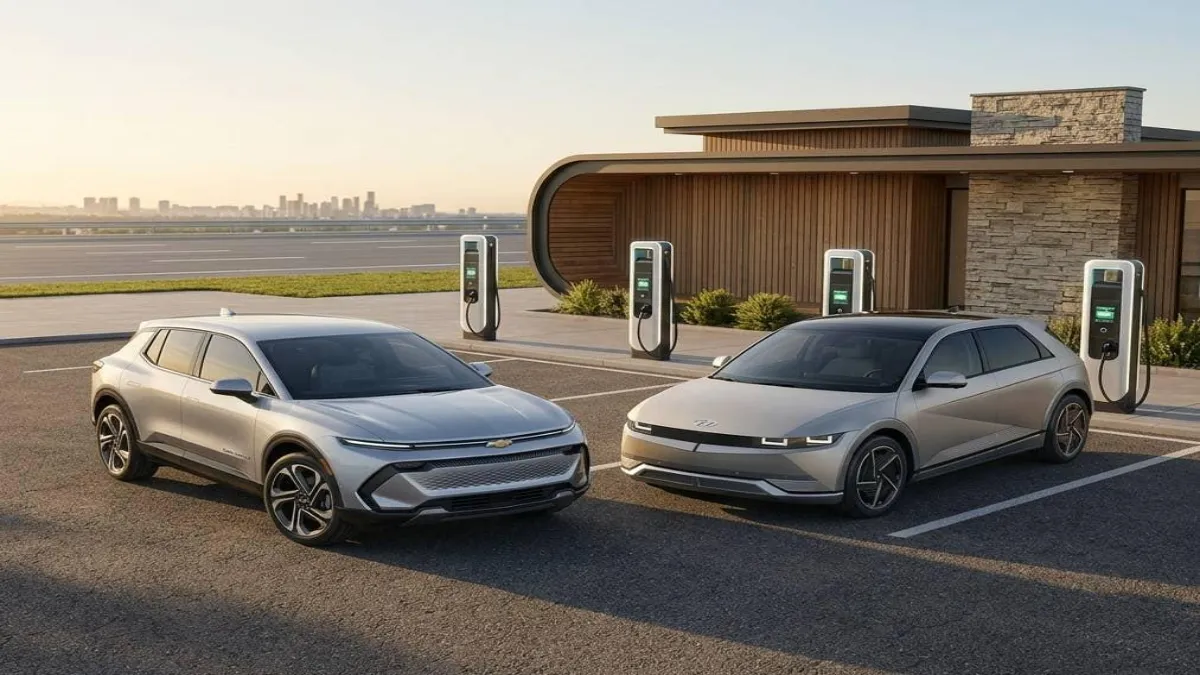
 Edmunds tests, EPA ratings and real prices side by side, so you can pick the best electric cars for the money
Shopping for an EV on a budget has changed. The federal tax credit of up to $7,500 for new electric vehicles ended for purchases after September 30, 2025, so the price on the window sticker is now close to what you pay, apart from state and local incentives. At the same time, cheaper models have arrived, and several of them offer more than 300 miles of range.
That makes the question harder than “which EV is cheapest.” The best electric cars for the money balance sticker price with real range, how comfortable they are on a long drive, and how quickly they charge. This guide compares the main contenders for US buyers in October 2026 using Edmunds’ ratings and tests, Kelley Blue Book rankings, Cars.com’s price list and several reviews. Where sources disagree, I say so, because on this topic they often do.
Best EVs for Road Trips in 2026: Electric Car Long Range Picks
Tesla Flying Car Roadster Revealed: 2028 Target & Ferrari Patent
The Best Electric Cars for the Money: The Short Answer
- Best all-around value: Hyundai Ioniq 6. It is KBB’s top-ranked EV, scores 7.8 out of 10 at Edmunds, and charges faster than almost anything near its price.
- Best range for the price: Chevrolet Equinox EV. Its 319-mile EPA rating and 356-mile Edmunds test result come at a low starting price.
- Best to drive and to live with: Tesla Model 3. It has Edmunds’ highest rating of the mainstream group, at 8.4 out of 10, plus Supercharger access.
- Lowest price: Chevrolet Bolt (2027), from about $29,000, though GM is reportedly ending it.
- Best new arrival: Nissan Leaf (2026), which starts around $30,000 and offers up to 303 miles, but reviewers disagree about its ride.
The right pick depends on how you rank price, range, comfort and charging speed. The details follow.
How These Cars Were Compared
Three kinds of numbers appear in this article, and they are not interchangeable.
- EPA range is the government-rated figure on the sticker.
- Edmunds tested range comes from Edmunds’ own EV Range Test, which sometimes beats and sometimes misses EPA ratings.
- Starting prices vary by source. Edmunds lists base MSRP, while Cars.com includes the destination charge but excludes state and local subsidies. KBB lists its own starting prices. Expect differences of a few hundred to a couple of thousand dollars between lists.
Model years also vary. KBB’s and Edmunds’ pages list the Hyundai Ioniq 6 as a 2025 model, the Bolt as a 2027 model, and the Leaf, Model 3 and Equinox EV as 2026 models. Confirm the model year and trim at the dealership before you compare prices.
The Cheapest New EVs
Cars.com’s August 5, 2026 list of the 11 cheapest EVs gives a snapshot of prices and EPA ranges (prices include destination charges but not incentives):
| Model | Model year | Starting price | Range |
|---|---|---|---|
| Chevrolet Bolt | 2027 | $28,995 | 255 mi (manufacturer estimate at the time) |
| Nissan Leaf | 2026 | $31,535 | 259–303 mi (EPA) |
| Subaru Uncharted | 2026 | $36,445 | 273–308 mi (EPA) |
| Toyota bZ | 2026 | $36,555 | 236–314 mi (EPA) |
| Hyundai Ioniq 5 | 2026 | $36,600 | 221–318 mi (EPA) |
| Chevrolet Equinox EV | 2026 | $36,795 | 288–319 mi (EPA) |
| Fiat 500e | Not stated | $37,695 | 141–149 mi (EPA) |
| Tesla Model 3 | 2026 | $38,380 | 309–363 mi (EPA) |
| Toyota C-HR | 2026 | $38,595 | 273–287 mi (manufacturer estimate) |
| Kia EV6 | 2026 | $39,445 | 237–319 mi |
| Ford Mustang Mach-E | 2026 | $39,840 | 240–320 mi (EPA) |
The Bolt’s range in that list was a manufacturer estimate, and KBB, Edmunds and BGR all give 262 EPA miles for the 2027 model, so use that figure. The list shows two things: a very cheap tier under $32,000, and a crowded group around $36,000 to $40,000 where range runs 300 miles or more.
Hyundai Ioniq 6: The Best All-Around Value
Kelley Blue Book ranks the Ioniq 6 first among EVs, with a 4.6 out of 5 expert rating, a $39,095 starting price and an estimated range of 342 miles. It describes the sedan as “brimming with charisma as well as capability.”
Edmunds rates it 7.8 out of 10 (“Excellent”) and breaks that down:
- Range, efficiency and charging: 8.5
- In-cabin tech: 8.4
- Value: 8.3
- Driving experience: 8.2
- Comfort: 7.7
Edmunds calls the ride “fantastic,” saying the suspension absorbs imperfections without feeling floaty. The cons are tight rear headroom and poor rearward visibility.
Range: Edmunds’ dual-motor Limited test car covered 303 miles, beating its 270-mile EPA estimate. KBB’s 342-mile figure applies to a different trim, so check the version you plan to buy.
Charging: This is the Ioniq 6’s standout feature. It accepts up to 350 kW DC charging, and Hyundai claims 10% to 80% in 18 minutes under ideal conditions, which Edmunds says it verified. Edmunds starts the model at $37,850, and KBB at $39,095.
The catch: Both lists show a 2025 model year, so check what is available new today. The sedan shape also gives up the cargo flexibility of an SUV, and Edmunds rates its storage and cargo at 6 out of 10.
Chevrolet Equinox EV: The Range-Per-Dollar Pick
The Equinox EV is the strongest case for buyers who want a conventional small SUV with long range at a modest price. Edmunds lists a 319-mile EPA estimate and measured 356 miles in its own EV Range Test, with efficiency of 28.9 kWh per 100 miles. A starting MSRP of $34,995 for the LT 1 trim comes from Edmunds’ spec page, while Cars.com lists $36,795 with destination.
Edmunds scores it 7.0 out of 10, with the following breakdown:
- Value: 8.2
- Range, efficiency and charging: 7.2
- Driving experience: 7.1
- Comfort: 6.9
- Storage and cargo: 6.9
- In-cabin tech: 5.6
What reviewers like: Long range, an inexpensive price, a roomy back seat, and a smooth ride and quiet cabin on the highway.
What they do not: The front seats are called “too flat and firm,” and there is no Apple CarPlay. Acceleration and handling are described as lackluster, with a 7.8-second 0–60 mph time for the front-wheel-drive test car. Edmunds says fast charging adds about 100 miles in roughly 19 minutes.
Cargo space is 26.4 cubic feet behind the seats and 57.2 cubic feet at maximum, according to Edmunds’ spec page.
Tesla Model 3: The Most Rounded Package
The Model 3 earns the highest overall rating in Edmunds’ mainstream EV group: 8.4 out of 10 (“Excellent”), compared with 7.8 for the Ioniq 6 and 6.9 for the Bolt.
Its sub-ratings:
- Driving experience: 9.3
- Range, efficiency and charging: 8.7
- Storage and cargo: 9.0
- Value: 8.4
- Comfort: 8.1
- In-cabin tech: 7.6
Edmunds says the Model 3 “rides smoothly over most road surfaces.” It praises comfortable seating, ample space and access to Tesla’s Supercharger network. The main complaints are that the touchscreen controls nearly everything and is distracting to use, and that the car has no Apple CarPlay or Android Auto.
Range: Edmunds’ range test produced 393 miles for the rear-wheel-drive model against a 363-mile EPA estimate, and 338 miles for the all-wheel-drive model against 346. Edmunds’ own page also shows a 321-mile EPA figure in a spec table, which conflicts with those numbers, so confirm the range for the specific trim. Edmunds measured 100 miles of range added in 12 minutes of fast charging for the rear-wheel-drive car.
Price: Edmunds’ ranking shows the Model 3 from $36,990, but its spec page lists that price for the Standard trim, which it marks as discontinued, with the Premium from $42,490. Cars.com lists the Model 3 from $38,380 with destination. What you can buy new may differ, so confirm the current trims.
Chevrolet Bolt: The Lowest Price
The 2027 Bolt is the cheapest new EV in most 2026 lists, with a $28,995 starting price in KBB and Cars.com. Edmunds shows two figures on one page, $27,600 and $28,995 for the LT, and the same inconsistency for the RS.
Edmunds scores it 6.9 out of 10, with a value rating of 8.2 and a comfort rating of 6.2. Its pros include a low price, a well-equipped interior, easy driving and parking, and optional Super Cruise hands-free driving. Its cons are no Apple CarPlay or Android Auto, front seats that reviewers found uncomfortable and no all-wheel-drive option.
The numbers:
- EPA range: 262 miles. Edmunds’ RS test car covered 290 miles.
- Fast charging: Peak charging of 150 kW, up from the previous model’s 55 kW, with 100 miles added in 12 minutes 39 seconds in Edmunds’ test.
- Home charging: About 6.8 hours at 240V.
There is one significant caution. BGR reported in February 2026 that General Motors has decided to discontinue the Bolt, with the current production cycle lasting about 18 months, though no exact end date was given. For a buyer, that raises questions about long-term parts and service that this article cannot answer from the sources reviewed. Ask your dealer about it.
Nissan Leaf: Cheap, Long-Range and Divisive
The redesigned 2026 Leaf is now a compact crossover rather than a hatchback. InsideEVs reports the S+ starting at $29,990 before destination, with an estimated 303 miles from a 75-kWh battery. KBB’s list price is $31,535, and KBB gives it a 4.5 out of 5 rating. It has the North American Charging Standard plug and a CCS port, and InsideEVs says that should allow adapter-free use at many Tesla Superchargers, though that was described as expected, not confirmed.
Reviewers disagree on comfort, and it is worth knowing why.
- Edmunds rates it 6.9 out of 10, with comfort at 6.1. Its cons include an “uncomfortable ride quality,” a loud interior on the highway and a snug rear seat. The ride “can feel floaty and bouncy over bumps, but harsh over broken pavement.”
- The Drive scored it 9 out of 10 after a first drive, finding the ride smooth, the “zero gravity” seats comfortable for a full day and the cabin quiet on the highway.
Both reviews agree on one point: DC fast charging is capped at 150 kW. Edmunds calls its charging showing “below average,” and The Drive notes Nissan’s claim of 10% to 80% in 35 minutes.
Range results also vary. Edmunds’ Platinum+ test car went 310 miles, above the EPA’s 259-mile estimate for that trim. On one day of driving, The Drive’s reviewer saw indicated range fall from 236 to 93 miles while the battery dropped from 97% to 35%, which works out to roughly 230 miles on a full charge, below the 259- to 303-mile estimates. That figure is my arithmetic, not the review’s. Higher trims trade range for features, so the S+ is the range pick.
How Comfort Compares
Comfort is the hardest thing to judge from specs, so use Edmunds’ sub-ratings as a rough guide, and then test drive:
| Model | Edmunds comfort rating (out of 10) |
|---|---|
| Tesla Model 3 | 8.1 |
| Hyundai Ioniq 6 | 7.7 |
| Chevrolet Equinox EV | 6.9 |
| Chevrolet Bolt | 6.2 |
| Nissan Leaf | 6.1 |
The pattern is clear. The two best-rated cars for comfort cost more than the cheapest two. Seat comfort comes up repeatedly in the lower scores: Edmunds calls the Equinox EV’s seats “too flat and firm” and the Bolt’s front seats uncomfortable.
How Charging Speed Compares
A cheap EV that charges slowly can cost you time on long trips. Using Edmunds’ measurements and manufacturer claims:
| Model | Charging data |
|---|---|
| Hyundai Ioniq 6 | Up to 350 kW; 10–80% in 18 minutes (Hyundai claim, verified by Edmunds) |
| Tesla Model 3 | 100 miles added in 12 minutes (Edmunds test, RWD); Supercharger access |
| Chevrolet Bolt | 150 kW peak; 100 miles in 12 minutes 39 seconds (Edmunds test) |
| Chevrolet Equinox EV | About 100 miles in 19 minutes (Edmunds) |
| Nissan Leaf | 150 kW peak; Edmunds calls it below average; Nissan claims 10–80% in 35 minutes |
The Ioniq 6 and Model 3 lead. If you take frequent long trips, charging speed may matter more than a few miles of range.
Other Contenders Worth a Look
- Hyundai Ioniq 5. Edmunds ranks the 2027 Ioniq 5 Limited AWD first among small electric SUVs, with an 8.3 rating, a 282-mile tested range and a starting price listed at $35,250. Cars.com lists the 2026 Ioniq 5 from $36,600 with EPA range of 221 to 318 miles.
- Tesla Model Y. Edmunds ranks the 2026 Model Y Long Range tied for second among small electric SUVs, at 8.2, with a 327-mile tested range and a price from $39,990.
- Kia EV6, Subaru Uncharted, Toyota bZ and Ford Mustang Mach-E. All appear on Cars.com’s cheapest list at prices of about $36,000 to $40,000, with top EPA ranges between 308 and 320 miles.
How to Choose
- Set a total budget. Include destination charges, taxes and home charger installation if you need one. Check state and local incentives, since the federal credit is gone.
- Rank what matters. Price, comfort, charging speed and cargo rarely line up in one car.
- Match the car to your driving. Mostly commuting and charging at home? A lower-cost Bolt or Leaf may be enough. Frequent road trips? Favor charging speed and network access.
- Check the exact trim. Range, price and charging can differ by trim, as the Leaf and Ioniq 6 examples show.
- Test drive on your own roads. Reviews disagree on the Leaf’s ride, so your seat time is the deciding vote.
- Ask about availability. Some models listed are earlier model years, and the Bolt’s future is uncertain.
Frequently Asked Questions
What are the best electric cars for the money in 2026?
Among the models reviewed, the Hyundai Ioniq 6 is the best all-around value, the Chevrolet Equinox EV offers the most range for the price, the Tesla Model 3 is the best-rated overall in Edmunds’ mainstream group, and the Chevrolet Bolt is the cheapest.
What is the cheapest new electric car in 2026?
The 2027 Chevrolet Bolt, at $28,995 in KBB and Cars.com listings. The 2026 Nissan Leaf follows, from $29,990 before destination (InsideEVs) or $31,535 including it (KBB and Cars.com).
Is the federal EV tax credit still available?
No. Federal credits for new EVs ended for purchases after September 30, 2025, according to EVLife. Many states and utilities still offer incentives.
Which cheap EV has the longest range?
On EPA numbers, the Chevrolet Equinox EV (up to 319 miles) and the Nissan Leaf S+ (303 miles) lead the budget group. In Edmunds’ tests, the Equinox EV covered 356 miles and the Leaf Platinum+ covered 310.
Is the Nissan Leaf comfortable?
Reviewers disagree. Edmunds rates its comfort 6.1 out of 10 and criticizes the ride and highway noise. The Drive’s first-drive review found it smooth, quiet and comfortable. Test drive it on roads you use.
Is the Chevrolet Bolt being discontinued?
BGR reported in February 2026 that GM decided to discontinue the Bolt, with the current production cycle lasting about 18 months. It did not give a specific end date.
Which affordable EV charges the fastest?
The Hyundai Ioniq 6 accepts up to 350 kW and claims 10% to 80% in 18 minutes, which Edmunds says it verified. The Tesla Model 3 added 100 miles in 12 minutes in Edmunds’ test.
Are EPA ranges accurate?
Often not exactly. Edmunds’ tests beat EPA estimates for the Equinox EV, Ioniq 6, Bolt and Leaf Platinum+, but another reviewer got about 230 miles from a Leaf on a mixed day. Treat EPA range as a comparison tool and plan for some variation.
The Bottom Line
The best electric cars for the money in 2026 are not one car but a short list. The Hyundai Ioniq 6 combines high ratings, strong range and the fastest charging of the group. The Chevrolet Equinox EV offers the most range per dollar in an SUV body, with a firm seat and slower charging as trade-offs. The Tesla Model 3 is the most polished and best rated by Edmunds, and the Bolt and Leaf are the lowest-priced choices, with caveats about comfort and, for the Bolt, its future. Compare current prices, check the exact trim and model year, and test drive before you decide.
🔹🔹 Follow us on Facebook 🔹🔹